10-K: Annual report [Section 13 and 15(d), not S-K Item 405]
Published on June 26, 2026

UNITED STATES
SECURITIES AND EXCHANGE COMMISSION
Washington, D.C. 20549
Form 10-K
(Mark One)
| ANNUAL REPORT PURSUANT TO SECTION 13 OR 15(d) OF THE SECURITIES EXCHANGE ACT OF 1934 | |||||
For the fiscal year ended April 30 , 2026
OR
| TRANSITION REPORT PURSUANT TO SECTION 13 OR 15(d) OF THE SECURITIES EXCHANGE ACT OF 1934 | |||||
For the transition period from ____to _____
Commission File Number 001-14505
(Exact Name of Registrant as Specified in its Charter)
| (State or Other Jurisdiction of Incorporation or Organization) | (I.R.S. Employer Identification No.) | ||||
| (Address of Principal Executive Offices) | (Zip Code) | ||||
(310 ) 552-1834
(Registrant’s Telephone Number, Including Area Code)
Securities Registered Pursuant to Section 12(b) of the Act:
| Title of Each Class | Trading Symbol(s) | Name of Each Exchange on Which Registered | ||||||
Securities Registered Pursuant to Section 12(g) of the Act: None
Indicate by check mark if the registrant is a well-known seasoned issuer, as defined in Rule 405 of the Securities Act. Yes þ No o
Indicate by check mark if the registrant is not required to file reports pursuant to Section 13 or Section 15(d) of the Act. Yes o No þ
Indicate by check mark whether the registrant (1) has filed all reports required to be filed by Section 13 or 15(d) of the Securities Exchange Act of 1934 during the preceding 12 months (or for such shorter period that the registrant was required to file such reports), and (2) has been subject to such filing requirements for the past 90 days. Yes þ No o
Indicate by check mark whether the registrant has submitted electronically every Interactive Data File required to be submitted pursuant to Rule 405 of Regulation S-T (§232.405 of this chapter) during the preceding 12 months (or for such shorter period that the registrant was required to submit such files). Yes þ No o
Indicate by check mark whether the registrant is a large accelerated filer, an accelerated filer, a non-accelerated filer, a smaller reporting company, or an emerging growth company. See the definitions of “large accelerated filer,” “accelerated filer,” “smaller reporting company,” and “emerging growth company” in Rule 12b-2 of the Exchange Act.
| þ | Accelerated filer | o | ||||||||||||
| Non-accelerated filer | o | Smaller reporting company | ||||||||||||
| Emerging growth company | ||||||||||||||
If an emerging growth company, indicate by check mark if the registrant has elected not to use the extended transition period for complying with any new or revised financial accounting standards provided pursuant to Section 13(a) of the Exchange Act. o
Indicate by check mark whether the registrant has filed a report on and attestation to its management’s assessment of the effectiveness of its internal control over financial reporting under Section 404(b) of the Sarbanes-Oxley Act (15 U.S.C. 7262(b)) by the registered public accounting firm that prepared or issued its audit report. þ
If securities are registered pursuant to Section 12(b) of the Act, indicate by check mark whether the financial statements of the registrant included in the filing reflect the correction of an error to previously issued financial statements. o
Indicate by check mark whether any of those error corrections are restatements that required a recovery analysis of incentive-based compensation received by any of the registrant's executive officers during the relevant recovery period pursuant to §240.10D-1(b). o
Indicate by check mark whether the registrant is a shell company (as defined in Rule 12b-2 of the Act). Yes o No þ
The aggregate market value of the registrant’s voting and non-voting common stock held by non-affiliates of the registrant on October 31, 2025, the last business day of the registrant’s most recently completed second fiscal quarter (assuming that the registrant’s only affiliates are its officers, directors and 10% or greater stockholders) was approximately $2,929,744 thousand based upon the closing market price of $64.70 on that date of a share of common stock as reported on the New York Stock Exchange.
The number of shares outstanding of our common stock as of June 18, 2026 was 50,857 thousand shares.
Documents incorporated by reference
Portions of the registrant’s definitive proxy statement for its 2026 Annual Meeting of Stockholders are incorporated by reference into Part III of this Form 10-K.
KORN FERRY
Index to Annual Report on Form 10-K for the Fiscal Year Ended April 30, 2026
| Item # | Description | Page | ||||||
Item 1C | ||||||||
Item 15 | ||||||||
F-1 | ||||||||
PART I.

1
2
3
Item 1. Business
Company Overview
Korn Ferry (referred to herein as the “Company” or in the first-person notations “we,” “our” and “us”) is a global consulting firm that powers individual and business performance. The impact we create spans entire organizations, but it always starts with people.
In every market and every technology shift, strategy sets direction, but people make it happen. They lead, adapt, innovate and execute the work that moves organizations forward.
For more than 50 years, Korn Ferry has studied how people and organizations perform. With decades of workforce intelligence and real-world experience, we've built a deep understanding of what drives organizational success, what gets in the way and what needs to change. We put that insight into practice every day.
Korn Ferry works across the full organization—from strategy and leadership to hiring, development, rewards, and the roles, skills and workforce models needed for the future. While many firms address individual parts of that system, we look across and connect them. By aligning leaders, teams and organizations around a common definition of success, we help organizations make better decisions, execute with confidence and achieve stronger outcomes.
Clients increasingly engage us through integrated, multi-year relationships that span a broad range of offerings and scalable delivery models. Our reach reflects the trust clients place in us. Across fiscal years 2025 and 2026, Korn Ferry worked with 94% of the S&P 100, 82% of the S&P 500, 86% of the S&P Europe 350, and 96% of Fortune’s Top 50 World’s Most Admired. These relationships span regions, industries and business models, reinforcing Korn Ferry’s role as a partner to many of the world’s leading and complex organizations.
In fiscal 2026, Korn Ferry was named a Founding Partner of the LA28 Olympic and Paralympic Games and the Official Talent and Organizational Consulting Partner. Entrusted to build and align the 5,000+ people who will power the Games, Korn Ferry is helping shape the workforce, leadership structure and organizational capabilities required to deliver one of the world's most visible and operationally complex global events, work that reflects our broader role in helping organizations to succeed in high-stakes environments at pace and scale.
The Korn Ferry Advantage
What We Know
Korn Ferry brings together talent and organizational consulting expertise with more than 50 years of proprietary insight. Our consultants work with boards, CEOs, senior leaders and workforces around the world, giving us a practical view of how organizations are structured, led, staffed, rewarded and run.
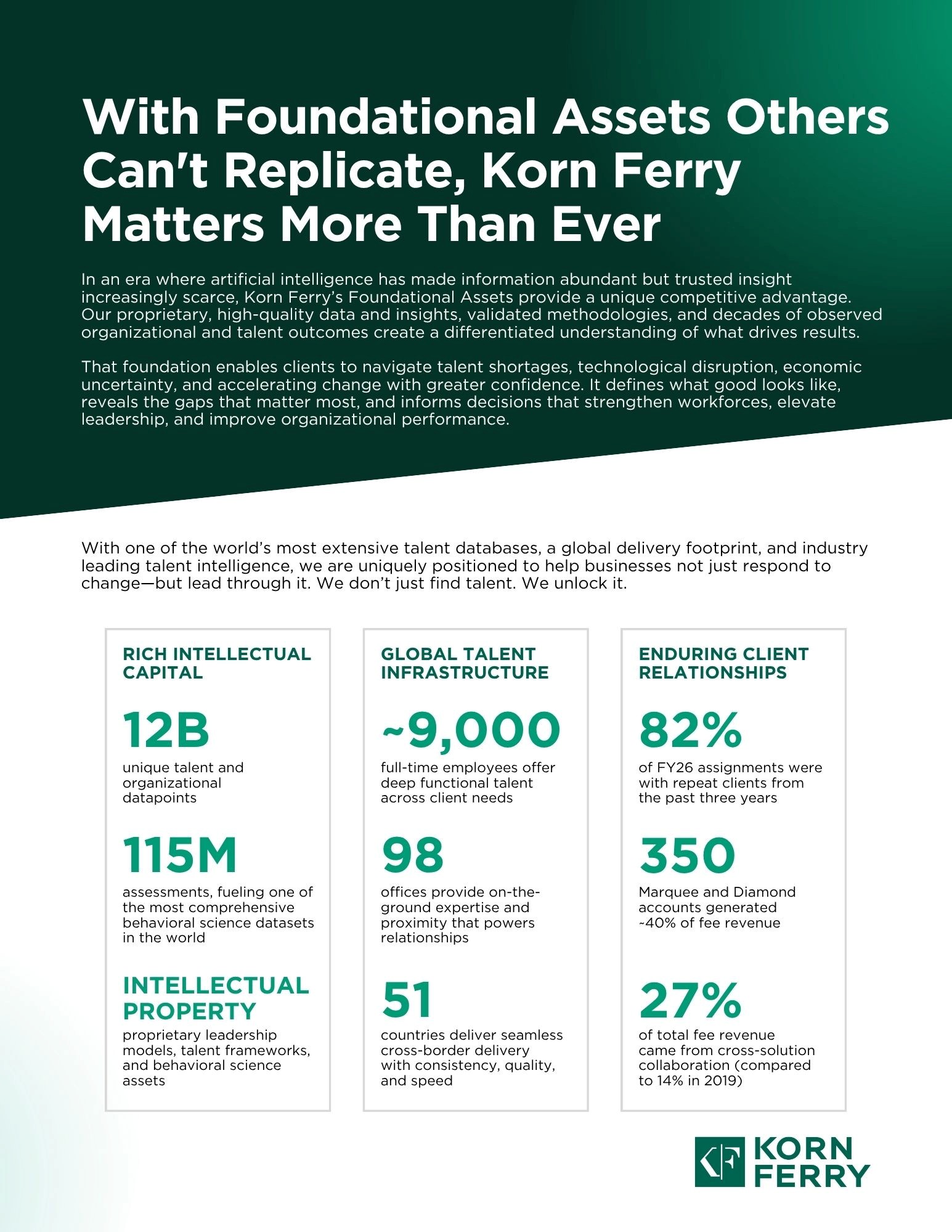
We have one of the world's deepest and broadest bodies of insight into how people and organizations perform, grounded in real performance in real organizations across industries, regions and markets. Built on more than 12 billion proprietary data points and decades of real-world application, we combine our expertise with our Foundational Assets—data, intellectual property ("IP") and behavioral science—to help organizations identify opportunity and drive results.
How We Apply It
Our talent intelligence helps reveal patterns that are difficult to see in isolation, connecting leadership, workforce capability, rewards, structure and culture to provide a clearer view of organizational effectiveness. It helps identify where friction exists, where capability gaps are limiting execution and where change will have the greatest impact.
To make these insights accessible and actionable, Korn Ferry Talent Suite® brings them together in a consistent and scalable way. Increasingly, artificial intelligence ("AI") capabilities help surface patterns, generate recommendations, and support decision-making by drawing on those insights. Together, these capabilities enable consultants and clients to access and apply Korn Ferry's insight in a consistent and scalable way through embedded solutions and subscription-based offerings.
How We Help Clients Act on It
Many organizations address business challenges through separate initiatives. Korn Ferry helps clients understand how leadership, workforce and organizational decisions work together to drive results.
By connecting these factors to our clients' business strategies, we help clients improve execution, deploy talent more effectively, focus investment on the areas that matter most and make better decisions about how their organizations grow, adapt and perform.
Intelligence in Action
Our business is organized around three connected elements: Foundational Assets, Capabilities and Integrated Solutions. Together, they allow us to connect insight, expertise and execution to help clients address complex business challenges.
4
Our Foundational Assets are the proprietary data, science and IP that inform our work and help clients make better people and organizational decisions.
•More than 115 million assessments conducted across industries, functions and geographies.
•More than 11,000 validated success profiles covering more than 30,000 job titles.
•Compensation and rewards data from more than 29 million professionals across 31,000 organizations.
•Employee engagement benchmarks based on approximately 44 million responses.
•Culture survey data from approximately 7.1 million individuals across 500 organizations.
•Pay policy and practice data covering nearly 160 countries.
Our Capabilities are the areas of expertise we bring to clients.
•Organization Strategy: Aligning people, processes, structure and operating models to support business goals.
•Assessment & Succession: Evaluating potential, readiness, and fit to guide hiring, promotion, mobility and succession decisions.
•Talent Acquisition: Sourcing and hiring talent across all levels through executive search, professional recruiting, interim talent and Recruitment Process Outsourcing ("RPO").
•Leadership & Professional Development: Developing leaders and building critical skills through coaching, experiential learning and scalable digital programs.
•Total Rewards: Designing compensation, benefits, recognition and pay transparency strategies that support performance and reflect evolving regulatory and business priorities.
•Board & CEO Services: Advising boards and CEOs on leadership transitions, governance, succession and long-term planning.
Our Integrated Solutions combine multiple Capabilities to address high-priority business challenges.
•Sales Effectiveness & Revenue Growth: Improving salesforce structure, roles, skills and pay to strengthen go-to-market performance.
•Productivity & Cost Optimization: Redesigning work, roles, structures, and rewards to improve efficiency, simplify organizations and ensure talent is deployed effectively.
•Workforce Readiness & AI Enablement: Helping organizations prepare for changing business models and AI-enabled ways of working by aligning talent, skills, workforce capabilities and organizational structures.
•Leadership & Succession: Strengthening leadership pipelines, succession planning and executive readiness for critical roles.
•Reward, Engagement & Pay Transparency: Designing compensation, rewards and pay transparency strategies that support performance, retention and evolving regulatory requirements.
•Strategy Execution & Change Management: Turning strategy into action by aligning leadership, building commitment and driving cultural change.
Go-To-Market Approach
Central to our approach is We Are Korn Ferry, an enterprise-wide go-to-market model designed to bring the full breadth of Korn Ferry’s capabilities, insights and expertise to clients. Rather than organizing around individual solution areas, we organize around client needs, bringing together expertise from across the firm to address increasingly interconnected business challenges. This approach helps our teams work more collaboratively across industries, functions, geographies and solutions, enabling clients to access the full breadth of Korn Ferry’s capabilities and insights while positioning us to deepen relationships as client needs evolve over time.
Because our consultants work collaboratively across industries, functions and areas of expertise, we are able to apply a wider range of experiences and perspectives to client challenges. This helps clients benefit from what Korn Ferry is learning across markets and organizations, while creating additional opportunities for us to expand our relationships and deliver value across multiple areas of the business.
In fiscal 2026, approximately 27% of our consolidated fee revenue came from cross-solution referrals, up from 14% in 2018 when we began tracking this metric. This increase reflects the growing traction of We Are Korn Ferry, expanding client demand for connected solutions, and demonstrates the value of bringing together the full breadth of Korn Ferry's expertise to help clients achieve better business outcomes.
5
We serve clients through strategic account partnerships and flexible engagement models that are tailored to client needs. Core to this is our Marquee and Diamond Accounts Program (the “Program”)—a structured approach to managing long-term relationships with many of the world’s most complex organizations.
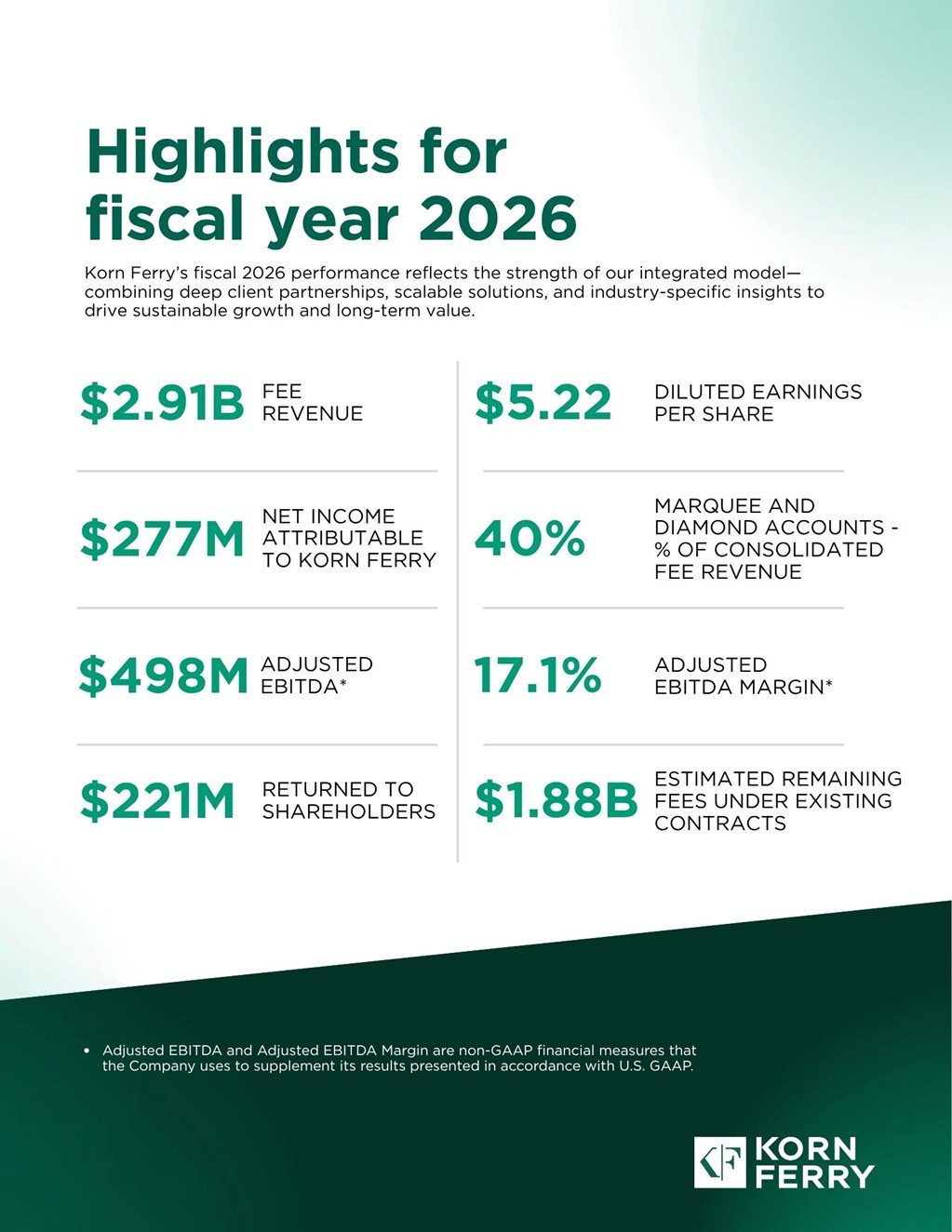
Clients within the Program are supported by dedicated account leaders who coordinate engagement across Korn Ferry’s portfolio. This model supports consistent delivery, a deeper understanding of client priorities and broader access to the firm’s capabilities. As of fiscal year-end 2026, our 350 Marquee and Diamond accounts represented approximately 40% of consolidated fee revenue—more than double their contribution at the Program’s inception.
Outside the Program, we serve thousands of additional clients worldwide through both project-based and recurring engagements. These organizations range from emerging businesses to global enterprises that engage with us in ways that match their scale, priorities and pace of growth.
To deliver value at scale across this broad client base, we operate through three primary engagement models:
1.Advisory engagements – tailored consulting and talent acquisition services grounded in proprietary data, behavioral science and expert advisory.
2.Embedded solutions – technology-enabled capabilities integrated into client workflows and decision-making processes to support ongoing talent, leadership and organizational decisions.
3.Subscription-based offerings – licensed offerings that provide clients direct access to Korn Ferry's talent intelligence.
This diversified model balances project-based work with recurring revenue streams while maintaining flexibility to meet varying client needs. In fiscal 2026, approximately 82% of our assignments were with clients we had served in the prior three years—reflecting strong loyalty and long-term engagement.
Corporate Functions, Technology, and Global Footprint
Our global operating model supports the firm’s alignment, consistency and ability to scale. Centralized teams spanning finance, legal, human resource ("HR"), technology, marketing and the Korn Ferry Institute ("KFI") support our work worldwide and enables effective, cohesive delivery.
Our technology capabilities support the firm's digital platforms, data assets and enterprise operations. We are integrating AI capabilities across the firm to enable consultants and clients to access and apply Korn Ferry's insights more effectively. By strengthening our platforms, protecting proprietary data and helping unlock the value of our Foundational Assets, AI supports how we deliver solutions, improve decision-making and expand the value of our offerings. In fiscal 2026, we accelerated firm-wide AI transformation initiatives designed to embed AI into key workflows and digital platforms across our solutions and enterprise functions, improving consultant effectiveness, efficiency, quality, and client outcomes while maintaining strong standards for security, transparency and responsible use.
As a firm, we operate across four regions—North America, EMEA, APAC, and Latin America—balancing global reach with local expertise. As of April 30, 2026, we had 98 offices in 51 countries.
Korn Ferry Institute
KFI is the firm’s research and innovation hub. KFI develops the insights, analytics, and behavioral science that inform our IP, offerings and delivery models. Drawing on decades of proprietary research and real-world organizational data, KFI helps ensure our methodologies remain rigorous, relevant and responsive to changing workforce and business needs.
Culture & People
Our people are central to our success. Our culture—rooted in our values of inclusion, performance, honesty and knowledge—empowers employees to grow, collaborate and drive impact. We invest in internal mobility, leadership development and recognition programs that support long-term careers. Globally competitive benefits and flexible work models promote well-being, while our enterprise-wide promotion process highlights exceptional contributions. This commitment to our people is reflected in our global workforce, which is strategically distributed by function and region to support delivery at scale. As of April 30, 2026, Korn Ferry employed 8,965 full-time professionals.
6
Consultants and execution staff1 | Support staff2 | Total employees | |||||||||||||||
Consulting | 1,522 | 318 | 1,840 | ||||||||||||||
Digital | 233 | 1,005 | 1,238 | ||||||||||||||
Executive Search | 566 | 1,169 | 1,735 | ||||||||||||||
Professional Search & Interim | 467 | 333 | 800 | ||||||||||||||
RPO | 156 | 2,936 | 3,092 | ||||||||||||||
Corporate | — | 260 | 260 | ||||||||||||||
Total | 2,944 | 6,021 | 8,965 | ||||||||||||||
1.Consultants and execution staff, primarily responsible for originating client services
2.Support staff includes associates, researchers, administrative and support staff
Operating Model and Financial Reporting Alignment
To bring our strategy to life, we deliver services through five solution areas. These solutions reflect the breadth of our expertise and allow us to develop deep specialization, build proprietary insight and innovate within our areas of focus. They are further strengthened by industry, functional and regional expertise that gives Korn Ferry a practical understanding of the market dynamics, leadership challenges, workforce trends and competitive forces shaping organizations around the world. Centralized corporate functions help connect expertise, intelligence and delivery across the firm, driving alignment, connectivity and scale.
Beginning in the first quarter of fiscal 2027, our external reporting structure will transition from a solution-based presentation to a regional reporting model consisting of the Americas, EMEA and APAC. We will continue to provide new business, fee revenue and estimated remaining fees under existing contacts information through three groupings: Search (Executive Search and Professional Search), Talent & Organizational Solutions (Consulting and Digital), and Workforce Solutions (RPO and Interim). We believe this structure better reflects how work is delivered across the firm, aligns more closely with how clients buy our services and supports our We Are Korn Ferry operating model.
Fiscal 2026 Financial Performance
Our financial performance in fiscal 2026 is a direct result of our initiatives to integrate technology, deepen client relationships and drive growth. It also reflects the introduction of our We Are Korn Ferry initiative and the ongoing success of the Program. Together, these efforts are helping clients access the full breadth of our capabilities and insights, strengthening our position as a strategic enterprise partner and creating additional opportunities to serve clients across the firm. Long-term, strategic partnerships underscore the success of our client-first approach and our ability to deliver integrated, enterprise-wide solutions across diverse industries. As we continue to evolve and execute our strategy, we are confident that our investments in innovation and client-tailored solutions align with and support our growth plan, while delivering value to shareholders.
In fiscal 2026, we advanced our strategic priorities, delivering meaningful business results:
•$2,907.5 million in fee revenue.
•Net Income Attributable to Korn Ferry was $277.4 million with a margin of 9.5%, a 50bps increase compared to fiscal 2025.
•Adjusted EBITDA* was $497.8 million with a margin of 17.1%, a 10bps increase compared to fiscal 2025.
•Diluted Earnings Per Share was $5.22.
•We continued with our balanced approach to capital allocation and for the full year, the Company invested $84.7 million in capital expenditures (excluding leasehold improvements and furniture & fixtures), $18.5 million on debt service costs, and returned $116.1 million and $104.6 million to shareholders in the form of share repurchases and dividends, respectively.
*Consolidated Adjusted EBITDA and Consolidated Adjusted EBITDA margin are non-GAAP financial measures and have limitations as analytical tools. See Item 7. Management’s Discussion and Analysis of Financial Condition and Results of Operations for a discussion of why management believes the presentation of non-GAAP financial measures provide meaningful supplemental information regarding Korn Ferry’s performance.
7
1.Consulting helps clients design and implement the talent strategies, organizational structures, and workforce capabilities and rewards to drive growth. Our consulting teams collaborate across Korn Ferry to deliver integrated solutions that support end-to-end transformation—from strategy through execution.
Fiscal 2026 highlights:
•Fee revenue was $691.7 million.
•Adjusted EBITDA was $118.4 million, and Adjusted EBITDA margin was 17.1%.
•The number of consulting and execution staff at year-end was 1,522 with an average bill rate (fee revenue divided by the number of hours worked by consultants and execution staff) of $458 per hour.
Client Base: In fiscal 2026, Consulting supported over 4,300 clients globally with 32% of Consulting’s fiscal 2026 fee revenue being referred from Korn Ferry’s other solutions. Our clients span Fortune 500 companies, public institutions and high-growth innovators across industries and geographies.
Competition: The market for organizational consulting is competitive, with a mix of large advisory firms and specialized boutiques providing services in leadership assessment and development, transformation and workforce strategy and rewards. Korn Ferry’s differentiation lies in its ability to leverage its Foundational Assets into its technology-enabled service offerings, creating unique and differentiated insights and end-to-end solutions that connect strategy and talent to drive business outcomes.
2.Digital develops and manages the technology, data, platform, and AI capabilities that power Talent Suite and help us unlock the value of our Foundational Assets. Working closely with our Solution teams, Digital enables consultants and clients to access and apply our insights through embedded and subscription-based offerings.
Fiscal 2026 highlights:
•Fee revenue was $363.5 million.
•Subscription/license revenue was $148.6 million, an increase of 7.9% compared to fiscal 2025.
•Adjusted EBITDA was $113.1 million, and Adjusted EBITDA margin was 31.1%.
Client Base: In fiscal 2026, Digital engaged with more than 7,600 clients globally with 34% of Digital's fiscal 2026 fee revenue being referred from Korn Ferry's other solutions. Our clients come from the private, public and not-for-profit sectors, across every major industry and represent diverse business challenges. Subscription and license growth was driven by both direct access to the Talent Suite platform, as well as integrated delivery in partnership with our other solutions, driving increased client utilization and stickiness.
Competition: A broad range of HR technology companies compete in this space, including independent software vendors and enterprise HR platform providers. While many competitors focus on specific talent challenges, Korn Ferry differentiates itself through its ability to connect insights across the talent lifecycle by combining its Foundational Assets, technology, AI capabilities and advisory expertise. Talent Suite enables those insights to be embedded within client workflows, accessed directly through subscription-based offerings, or leveraged by Korn Ferry consultants to help clients improve performance and make more effective people and organizational decisions.
3.Executive Search delivers industry-leading executive recruitment across global markets, powered by decades of expertise and deep industry/sector specialization and Korn Ferry’s own top-tier executive search professionals. We help organizations recruit board-level, C-suite and senior executive talent, using proprietary assessments, leadership benchmarks and deep functional insight to identify leaders who align with strategy, culture and long-term priorities. This solution is managed and reported on a geographic basis and represents four of the Company’s reportable segments (Executive Search North America, Executive Search Europe, Middle East and Africa (“EMEA”), Executive Search Asia Pacific (“APAC”) and Executive Search Latin America).
Fiscal 2026 highlights:
•Fee revenue was $924.1 million.
•Adjusted EBITDA was $237.4 million, and Adjusted EBITDA margin was 25.7%*.
•In fiscal 2026, we opened more than 6,500 new engagements with an average of 563 consultants.
*Executive Search Adjusted EBITDA and Executive Search Adjusted EBITDA margin are non-GAAP financial measures and have limitations as analytical tools. See Item 7. Management's Discussion and Analysis of Financial Condition and Results of Operations for a discussion of why management believes the presentation of these non-GAAP financial measures provide meaningful supplemental information regarding Korn Ferry's performance.
8
Consultants are organized in six broad industry groups and bring an in-depth understanding of the market conditions and strategic management issues clients face within their sectors and geographies. In addition, we regularly look to expand our specialized expertise through internal development and strategic hiring in targeted growth areas. We also have consultants organized by centers of functional expertise. This helps our teams comprehensively grasp the specific requirements and nuances involved in the role itself. These partners bring a deep understanding of the functional dynamics–from strategy through to execution–enabling them to identify and place candidates who possess the necessary skills, knowledge and experience to excel in the role.
Client Base: In fiscal 2026, we partnered with more than 3,700 Executive Search engagement clients including many of the world’s most recognized public and private enterprises.
Competition: Competitors include global executive search firms and specialized regional boutiques. Korn Ferry differentiates itself through a combination of deep industry expertise, global scale, proprietary assessment tools, and integration with leadership development and succession planning services. This integrated approach positions Korn Ferry to deliver high-impact talent solutions across diverse client needs.
4.Professional Search & Interim focuses on scalable, high impact recruiting and interim talent solutions at the professional level that offer flexibility and speed in dynamic business environments. Korn Ferry helps clients rapidly place permanent professionals and senior/professional interim leaders across business-critical functions such as Finance and Accounting, IT, HR and Operations.
Fiscal 2026 highlights:
•Fee revenue was $561.1 million.
•Adjusted EBITDA was $121.2 million, and Adjusted EBITDA margin was 21.6%.
•Average bill rates were $145 per hour in fiscal 2026.
•Professional Search annual fee revenue reached $741K per consultant in fiscal 2026.
Client Base: In FY26, Professional Search & Interim partnered with over 3,100 clients globally delivering strategic hiring solutions at the intersection of speed, quality, and scalability, and 26% of Professional Search & Interim’s fiscal 2026 fee revenue was referred from Korn Ferry’s other solutions.
Competition: Professional Search competitors include regional search firms, global staffing companies and specialist recruiters. Korn Ferry differentiates itself by combining specialist recruitment with proprietary assessment tools, and integration with broader talent strategies. The firm’s ability to work across professional-level and executive level search on both full-time and an interim basis enables clients to address immediate talent needs while building long-term professional/leadership pipelines—offering flexibility and insight as organizations navigate evolving workforce demands.
5.RPO provides high-volume, outsourced hiring solutions that deliver end-to-end talent acquisition services for enterprise clients. These programs are delivered through global Talent Delivery Centers, using a technology-enabled platform and are designed and managed to align with each client’s business objectives, leveraging Korn Ferry’s IP, data, science and deep talent expertise. Advanced technology and AI-driven tools are used to enhance the platform to drive scale, efficiency and quality, while offering an engaging experience for candidates throughout the hiring process.
Fiscal 2026 highlights:
•Fee revenue was $367.1 million.
•Adjusted EBITDA was $57.7 million, and Adjusted EBITDA margin was 15.7%.
•New business was $543.9 million in fiscal 2026 with 43% from New Logo clients (new RPO engagements).
Client Base: RPO supported more than 250 enterprise clients in fiscal 2026 with strategic hiring programs and large-scale workforce buildouts across regions and sectors, and 66% of RPO’s fiscal 2026 fee revenue was referred from Korn Ferry’s other solutions.
Competition: The RPO market includes a broad range of global and regional firms offering high-volume recruitment solutions. Korn Ferry stands apart through its ability to combine proprietary data, IP, technology-enabled service delivery and advisory expertise into fully integrated talent acquisition programs. The firm’s use of AI and automation enhances decision-making, accelerates time-to-fill and improves hiring precision at scale. This approach supports consistent hiring outcomes and positions Korn Ferry as a long-term strategic partner for clients.
Available Information
Korn Ferry files annual, quarterly, and current reports, proxy statements, and other documents with the Securities and Exchange Commission (the "SEC"), according to the Securities Exchange Act of 1934, as amended (the "Exchange Act").
9
Our reports, proxy statements, and other documents filed electronically with the SEC are available at the website maintained by the SEC at https://www.sec.gov.
We also make available, free of charge on the Investor Relations portion of our website at http://ir.kornferry.com, those annual, quarterly, and current reports, and, if applicable, amendments to those reports, filed or furnished under Section 13(a) or 15(d) of the Exchange Act as soon as reasonably practicable after we electronically file such reports with, or furnish them to, the SEC at www.sec.gov.
Our Corporate Governance Guidelines, Code of Business Conduct and Ethics, and the charters of the Audit Committee, Compensation and Personnel Committee, and Nominating and Corporate Governance Committee of our Board of Directors are also posted on the Investor Relations portion of our website at http://ir.kornferry.com. Stockholders may request copies of these documents by writing to our Corporate Secretary at 1900 Avenue of the Stars, Suite 1225, Los Angeles, California 90067.
In addition, we make available on the Investor Relations portion of our website at http://ir.kornferry.com press releases and related earnings presentations and other essential information, which we encourage you to review.
Item 1A. Risk Factors
The discussion below describes the material factors, events, and uncertainties that make an investment in our securities risky, and these risk factors should be considered carefully together with all other information in this Annual Report, including the financial statements and notes thereto. Statements in this section are based on the Company's beliefs and opinions regarding matters that could materially adversely affect the Company in the future. References to past events are provided by way of example only and are not intended to be a complete listing or representation as to whether or not such factors have occurred in the past. Moreover, the factors, events and contingencies discussed below are not the only ones we face and should not be considered a complete statement of all potential factors, events or contingencies that the Company faces or may face in the future. Our business, financial condition or results of operations could be materially adversely affected by the occurrence of any of these risks. Additional risks not presently known to us or that we currently deem immaterial may also arise and impair our business operations.
Risks Related to Our Business
We face significant competition. Competition in our industries could result in lost market share, reduced demand for our services, and/or require us to charge lower prices for our services, which could adversely affect our operating results and future growth.
We continue to face significant competition within each of our services and product offerings. The human resource consulting market has been traditionally fragmented and a number of large consulting firms, such as AON, Deloitte, McKinsey, Mercer and Willis Towers Watson have built businesses in human resource consulting to serve these needs. Our consulting business line has faced, and continues to face competition from human resource consulting businesses. Many of these competitors are significantly larger than Korn Ferry and have considerable resources at their disposal, allowing for potentially significant investment to grow their human resource consulting business. Digital products in the human resource market have been traditionally fragmented and a number of firms such as AON, Eightfold, Hogan, Mercer, SHL, Richardson/Challenger, Willis Towers Watson and other boutique HR technology firms offer competitive products. Competitors in the digital marketplace are a combination of large, well-capitalized firms and niche players who have received multiple rounds of private financing. Increased competition, whether as a result of professional and social networking website providers, traditional executive search firms, sole proprietors and in-house human resource professionals (as noted above) or larger consulting firms building human resources consulting businesses, may lead to pricing pressures that could negatively impact our business. For example, increased competition could require us to charge lower prices, and/or cause us to lose market share, each of which could reduce our fee revenue.
Our executive search services face competition from both traditional and non-traditional competitors that provide job placement services, including other large global executive search firms, smaller specialty firms and web-based firms. We also face increased competition from sole proprietors and in-house human resource professionals whose ability to provide job placement services has been enhanced by professional profiles made available on the internet and enhanced social media-based or AI-based search tools. The continued growth of the shared economy and related freelancing platform sites may also negatively impact demand for our services by allowing employers seeking services to connect with employees in real time and without any significant cost. Traditional executive search competitors include Egon Zehnder, Heidrick & Struggles International, Inc., Russell Reynolds Associates and Spencer Stuart. In each of our markets, one or more of our competitors may possess greater resources, greater name recognition, lower overhead or other costs and longer operating histories than we do, which may give them an advantage in obtaining future clients, capitalizing on new technology and attracting qualified professionals in these markets. Additionally, specialty firms can focus on regional or functional markets or on particular industries and executive search firms that have a smaller client base are subject to fewer off-limits arrangements. There are no extensive barriers to entry into the executive search industry and new recruiting firms continue to enter the market.
10
We believe the continuing development and increased availability of information technology will continue to attract new competitors, especially AI-enabled companies, web-enabled professional and social networking website providers, and these providers may be facilitating a company’s ability to insource their recruiting capabilities. Competitors in these fields include Eightfold AI, Google for Jobs, HireVue, iCIMS, Indeed, Jobvite, LinkedIn, Paradox, Phenom, Symphony Talent and Yello. As these providers continue to evolve, they may develop offerings similar to or more expansive than ours, thereby increasing competition for our services or more broadly causing disruption in the executive search industry. Further, as technology continues to develop and the shared economy continues to grow, we expect that the use of freelancing platform sites will become more prevalent. As a result, companies may turn to such sites for their talent needs, which could negatively impact demand for the services we offer.
Our RPO services primarily compete for business with other RPO providers such as Alexander Mann Solutions, Allegis, Cielo, Randstad, WilsonHCG, Hudson and LHH. Professional Search competes for mid-level professional search assignments with regional contingency recruitment firms and large national retained recruitment firms such as Michael Page, Robert Half and Hays, while our Interim services compete with firms such as Axiom, Heidrick & Struggles, KForce, MLA, RGP and Robert Half. In addition, some organizations have developed or may develop internal solutions to address talent acquisition that may be competitive with our solutions. This is a highly competitive and developing industry with numerous specialists. To compete successfully and achieve our growth targets for our talent acquisition business, we must continue to support and develop assessment and analytics solutions, maintain and grow our proprietary database, deliver demonstrable return on investment to clients, support our products and services globally, and continue to provide consulting and training to support our assessment products. Our failure to compete effectively could adversely affect our operating results and future growth.
We are limited in our ability to recruit candidates from certain of our clients due to off-limit agreements with those clients and for client relation and marketing purposes. Such limitations could harm our business.
Either by agreement with clients, or for client relations or marketing purposes, we are required to or elect to refrain from, for a specified period of time, recruiting candidates from a client when conducting searches on behalf of other clients. These off-limit agreements can cause us to lose search opportunities to our competition. The duration and scope of the off-limit agreement, including whether it covers all operations of the client and its affiliates or only certain divisions of a client, generally are subject to negotiation or internal policies and may depend on factors such as the scope, size and complexity of the client’s business, the length of the client relationship and the frequency with which we have been engaged to perform executive and professional searches for the client. We cannot ensure that off-limit agreements will not impede our growth or our ability to attract and serve new clients, or otherwise harm our business.
Failure to recruit and retain qualified and experienced consultants could result in a loss of clients which in turn could cause a decline in our revenue and harm to our business.
We compete with other executive, professional search and interim and consulting firms for qualified and experienced consultants. These other firms may be able to offer greater bonuses, incentives or compensation and benefits or more attractive lifestyle choices, career paths, office cultures, or geographic locations than we do. Competition for these consultants typically increases during periods of wage inflation, labor constraints, and/or low unemployment and can result in material increases to our costs and stock usage under authorized employee stock plans, among other impacts.
Recruiting and retaining consultants in our industry is particularly important because, generally, a small number of consultants have primary responsibility for a client relationship. Because client responsibility is so concentrated, the loss of key consultants may lead to the loss of client relationships. In fiscal 2026, our top six consultants combined generated business equal to approximately 3% of our total fee revenues. Furthermore, our top ten consultants combined generated business equal to approximately 4% of our total fee revenues. This risk is heightened due to the general portability of a consultant’s business: consultants have in the past, and will in the future, terminate their employment with our Company. Any decrease in the quality of our reputation, reduction in our compensation levels relative to our peers or modifications of our compensation program, whether as a result of insufficient revenue, a decline in the market price of our common stock or for any other reason, could impair our ability to retain existing consultants or attract additional qualified consultants with the requisite experience, skills and established client relationships. Our failure to retain our most productive consultants, whether in Executive Search, Consulting, Digital, Professional Search & Interim or RPO, or maintain the quality of service to which our clients are accustomed, as well as the ability of a departing consultant to move business to his or her new employer, could result in a loss of clients, which could in turn cause our fee revenue to decline and our business to be harmed. We may also lose clients if the departing consultant has widespread name recognition or a reputation as a specialist in his or her line of business in a specific industry or management function. We could also lose additional consultants if they choose to join the departing consultant at another executive search or consulting firm. Failing to limit departing consultants from moving business or recruiting our consultants to a competitor could adversely affect our business, financial condition and results of operations.
11
We are working to advance culture change through the continued implementation of inclusion and talent development initiatives throughout our organization. If we do not or are perceived not to successfully implement these initiatives, our ability to recruit, attract and retain talent may be adversely impacted and shifts in perspective and expectations about social issues and priorities surrounding such initiatives may occur at a faster pace than we are capable of managing effectively. If we are unable to identify, recruit and retain sufficient talent in key positions, it may prevent us from achieving our strategic vision, disrupt our business, impact revenues, increase costs, damage employee morale, impact our ability to keep pace with the continuing changes in technology, such as with AI, and client demand within the professional services market and affect the quality and continuity of client service.
Failing to maintain our professional reputation and the goodwill associated with our brand name could seriously harm our business.
We depend on our overall reputation and brand name recognition to secure new engagements and to hire qualified professionals. Our success also depends on the individual reputations of our professionals. We obtain a majority of our new engagements from existing clients or from referrals by those clients. Any client who is dissatisfied with our services can adversely affect our ability to secure new engagements. If any factor, including poor performance or negative publicity, whether or not true, hurts our reputation, we may experience difficulties in competing successfully for both new engagements and qualified consultants, which could seriously harm our business.
As we develop new services, obtain clients, enter new practices and lines of business, and focus more of our business on providing a full range of client solutions, the demands on our business and our operating and legal risks may increase.
As part of our corporate strategy, we are attempting to market a more unified firm bringing together the full range of our capabilities and solutions to address our clients' talent and organizational challenges, including to accelerate cross-Solution integration and deepen our client-centric focus, across the life cycle of a policy, program, project or initiative. We are also regularly searching for ways to provide new services to clients, such as our entry into the Interim business in fiscal 2022 and strategic acquisitions in fiscal 2022 through fiscal 2025. This strategy may not be effective or timely executed, due to disruptions or operational challenges that may arise from efforts to consolidate or coordinate new teams, areas of the business, marketing, technical expertise or business operations. Even if this strategy is effectively executed, it may prove insufficient in light of changes in market or economic conditions, workforce trends, technology, competitive pressures or other external factors. In addition, we plan to extend our services to new clients and into new lines of business and geographic locations. As we focus on developing new services, clients, practice areas and lines of business; acquire or dispose of businesses; and engage in business in new geographic locations, our operations are exposed to additional as well as enhanced risks.
In particular, our growth efforts place substantial additional demands on our management and staff, as well as on our information, financial, administrative and operational systems. We may not be able to manage these demands successfully. Growth may require increased recruiting efforts, opening new offices, increased business development, selling, marketing and other actions that are expensive and entail increased risk. We may need to invest more in our people and systems, controls, compliance efforts, policies and procedures than we anticipate. Therefore, even if we do grow, the demands on our people and systems, controls, compliance efforts, policies and procedures may exceed the benefits of such growth, and our operating results may suffer, at least in the short-term, and perhaps in the long-term.
Efforts involving a different focus and/or new services, clients, practice areas, solutions, offices and geographic locations entail inherent risks associated with our inexperience and competition from mature participants in those areas. Our inexperience may result in costly decisions that could harm our profit and operating results. In particular, new or improved services often relate to the development, implementation and improvement of critical infrastructure or operating systems that our clients may view as “mission critical,” and if we fail to satisfy the needs of our clients in providing these services, our clients could incur significant costs and losses for which they could seek compensation from us. As our business continues to evolve and we provide a wider range of services, we will become increasingly dependent upon our employees, particularly those operating in business environments less familiar to us. Failure to identify, hire, train and retain talented employees who share our values could have a negative effect on our reputation and our business.
We are subject to potential legal liability from clients, employees, candidates for employment, stockholders and others. Insurance coverage may not be available to cover all of our potential liability and available coverage may not be sufficient to cover all claims that we may incur.
We are exposed to potential claims with respect to the executive search process and our consulting services, among numerous other matters. For example, a client could assert a claim for matters such as breach of an off-limit agreement or recommending a candidate who subsequently proves to be unsuitable for the position filled. Further, the current employer of a candidate whom we placed could file a claim against us alleging interference with an employment contract; a candidate could assert an action against us for failure to maintain the confidentiality of the candidate’s employment search; and a candidate or employee could assert an action against us for alleged discrimination, violations of labor and employment law or other matters. Also, in various countries, we are subject to data protection, employment and other laws impacting the processing of candidate information and other regulatory requirements that could give rise to liabilities/claims. Client dissatisfaction with the consulting services provided by our consultants may also lead to claims against us.
12
Additionally, as part of our consulting services, we often send a team of leadership consultants to our clients’ workplaces. Such consultants generally have access to client information systems and confidential information. An inherent risk of such activity includes possible claims of misuse or misappropriation of client IP, confidential information, funds or other property, as well as harassment, criminal activity, torts, or other claims. Such claims may result in negative publicity, injunctive relief, criminal investigations and/or charges, payment by us of monetary damages or fines, or other material adverse effects on our business.
From time to time, we may also be subject to legal actions or claims brought by our stockholders, including securities, derivative and class actions, for a variety of matters related to our operations, such as significant business transactions, cybersecurity incidents, volatility in our stock, and our responses to stockholder activism, among others. Such actions or claims and their resolution may result in defense costs, as well as settlements, fines or judgments against us, some of which are not, or cannot be, covered by insurance. The payment of any such costs, settlements, fines or judgments that are not insured could have a material adverse effect on our business. In addition, such matters may affect the availability or cost of some of our insurance coverage, which could adversely impact our results of operations and expose us to increased risks that would be uninsured.
We cannot ensure that our insurance will cover all claims or that insurance coverage will be available at economically acceptable rates. Our ability to obtain insurance, its coverage levels, deductibles and premiums, are all dependent on market factors, our loss history and insurers’ perception of our overall risk profile. Our insurance may also require us to meet a deductible. Significant uninsured liabilities could have a material adverse effect on our business, financial condition and results of operations.
We are subject to numerous and varied government regulations across the jurisdictions in which we operate.
Our business is subject to various federal, state, local, and foreign laws and regulations that are complex, change frequently and may become more stringent over time. Future legislation, regulatory changes or policy shifts under the current U.S. administration or other governments could in the future impact our business. Our failure to comply with applicable laws and regulations could restrict our ability to provide certain services including to federal, state, local and foreign governments or result in the imposition of fines and penalties, substantial regulatory and compliance costs, litigation expense, adverse publicity, and loss of revenue. We incur, and expect to continue to incur, significant expenses in our attempt to comply with these laws, and our businesses are also subject to an increasing degree of compliance oversight by regulators and by our clients. In addition, our Digital services and increasing use of technology in our business expose us to data privacy and cybersecurity laws and regulations that vary and are evolving across jurisdictions. These and other laws and regulations, as well as laws and regulations in the various states or in other countries, could limit our ability to pursue business opportunities we might otherwise consider engaging in, impose additional costs or restrictions on us, result in significant loss of revenue, impact the value of assets we hold, or otherwise significantly adversely affect our business. Any failure by us to comply with applicable laws or regulations could also result in significant liability to us from private legal actions, or may result in the cessation of our operations or portions of our operations or impositions of fines and restrictions on our ability to carry on or expand our operations. Our operations could also be negatively affected by changes to laws and regulations or their application or interpretation and enhanced regulatory oversight of our clients and us. These changes may compel us to change our prices, may restrict our ability to implement price increases, and may limit the manner in which or where we conduct our business or otherwise may have a negative impact on our ability to generate revenues, earnings, and cash flows. If we are unable to adapt our products and services to conform to the new laws and regulations, or if these laws and regulations have a negative impact on our clients, we may experience client losses or increased operating costs, and our business and results of operations could be negatively affected.
As we incorporate AI and machine learning into our business there are uncertainties in the legal regulatory regime relating to AI that may require significant resources to modify and maintain business practices to comply with U.S. and non-U.S. laws, the nature of which cannot be determined at this time. Several jurisdictions around the globe, including Europe and certain U.S. states, have already proposed or enacted laws governing AI. For example, European regulators have proposed stringent AI regulations and laws, and the Company expects other jurisdictions will adopt similar legislation. Other jurisdictions may decide to adopt similar or more restrictive legislation that may render the use of such technologies challenging, impossible or financially prohibitive. Violations of these laws and regulations may lead to reputational damage, financial penalties and increased regulatory scrutiny.
Our business and operations are impacted by developing laws and regulations, as well as evolving investor and customer expectations with regard to, corporate responsibility matters and reporting, which expose us to numerous risks.
We are subject to evolving laws, regulations and expectations regarding corporate responsibility matters, including sustainability, the environment, climate change, human capital management, data privacy and cybersecurity, business risks and opportunities, including shifts in market preferences for reporting, more sustainable or socially responsible products and services, and other actions. These requirements, expectations, and/or frameworks, which can include assessments and ratings published by third-party firms, are not synchronized and vary by stakeholder, industry and geography. As a result, they may: increase the time and cost of our efforts to monitor and comply with those obligations; impact our business opportunities, supplier and customer relationships and reputation; limit our ability to satisfy all stakeholders, some of whom may disagree with our focus on such initiatives; and expose us to heightened scrutiny, liability, and risks that could negatively affect us. We report on our aspirations, targets and initiatives related to corporate responsibility matters. Our
13
ability to achieve our corporate responsibility aspirations, which may change, or to meet evolving expectations is not guaranteed and is subject to numerous risks, including the existence, cost and availability of certain methodologies and processes, the acquisition and integration of new entities and trends in demand. Failing to accurately report, progress on, or meet any such aspirations or expectations (including a perceived failure to do so) on a timely basis or at all could negatively affect our business, growth, results of operations and reputation.
Our inability to successfully recover should we experience a disaster or other business continuity problem could cause material financial loss, loss of human capital, regulatory actions, reputational harm or legal liability.
Should we experience a disaster or other business continuity problem, such as a natural disaster, unusual weather conditions, terrorist attack, security breach, power loss, telecommunications failure or other man-made disaster, our continued success will depend, in part, on the availability of our personnel, our office facilities, and the proper functioning of our computer, telecommunication and other related systems and operations. In such an event, we could experience near-term operational challenges with regard to particular areas of our operations. In particular, our ability to recover from any disaster or other business continuity problem will depend on our ability to protect our technology infrastructure against damage from business continuity events that could have a significant disruptive effect on our operations. For example, a large number of our corporate staff are based in California, which has a high level of risk and past damages from wildfires and earthquakes. The impacts of climate change may present risks, including damage to assets and technology caused by extreme weather events and may otherwise heighten or exacerbate the occurrence of such weather events. We could potentially lose client data or experience material adverse interruptions to our operations or delivery of services to our clients in a disaster. A disaster on a significant scale or affecting certain of our key operating areas within or across regions, or our inability to successfully recover should we experience a disaster, pandemic or other business continuity problem, could materially interrupt our business operations and cause material financial loss, loss of human capital, regulatory actions, reputational harm, damaged client relationships or legal liability.
Risks Related to Our Profitability
We may not be able to align our cost structure with our revenue level, which in turn may require additional financing in the future that may not be available at all or may be available only on unfavorable terms.
Our efforts to align our cost structure with the current realities of our markets may not be successful. When actual or projected fee revenues are negatively impacted by weakening customer demand, we have and may again find it necessary to take cost cutting measures so that we can minimize the impact on our profitability, such as the restructuring initiated in the first half of fiscal 2024. Failing to maintain a balance between our cost structure and our revenue could adversely affect our business, financial condition, and results of operations and lead to negative cash flows, which in turn might require us to obtain additional financing to meet our capital needs. If we are unable to secure such additional financing on favorable terms, or at all, our ability to fund our operations could be impaired, which could have a material adverse effect on our results of operations.
Our financial results could suffer if we are unable to achieve or maintain adequate utilization and suitable billing rates for our consultants.
Our profitability depends, to a large extent, on the utilization and billing rates of our professionals. Utilization of our professionals is affected by a number of factors, including: the number and size of client engagements; the timing of the commencement, completion and termination of engagements (for example, the commencement or termination of multiple RPO engagements could have a significant impact on our business, including significant fluctuations in our fee revenue, since these types of engagements are generally larger, in terms of both staffing and fee revenue generated, than our other engagements); our ability to transition our consultants efficiently from completed engagements to new engagements; the hiring of additional consultants because there is generally a transition period for new consultants that results in a temporary drop in our utilization rate; unanticipated changes in the scope of client engagements; our ability to forecast demand for our services and thereby maintain an appropriate level of consultants; and conditions affecting the industries in which we practice, as well as general economic conditions.
The billing rates of our consultants that we are able to charge are also affected by a number of factors, including: our clients’ perception of our ability to add value through our services; the market demand for the services we provide, which may vary globally or within particular industries that we serve; an increase in the number of clients in the government sector in the industries we serve; the introduction of new services by us or our competitors; our competition and the pricing policies of our competitors; the introduction of new technologies, such as generative and agentic AI, which may compete with or affect the pricing of our services; and current economic conditions.
If we are unable to achieve and maintain adequate overall utilization, as well as maintain or increase the billing rates for our consultants, our financial results could materially suffer. In addition, our consultants oftentimes perform services at the physical locations of our clients. Natural disasters, pandemics, disruptions to travel and transportation or problems with communications systems negatively impact our ability to perform services for, and interact with, our clients at their physical locations, which could have an adverse effect on our business and results of operations.
14
The profitability of our fixed-fee engagements with clients may not meet our expectations if we underestimate the cost of these engagements when pricing them.
When making proposals for fixed-fee engagements, we estimate the costs and timing for completing the engagements and these estimates may not be accurate. Any increased or unexpected costs or unanticipated delays in connection with the performance of fixed-fee engagements, including delays caused by factors outside our control, could make these contracts less profitable or unprofitable, which would have an adverse effect on our profit margin. Clients may also delay or cancel engagements, which could cause expected revenues to be realized at a later time or not at all. For the years ended 2026, 2025 and 2024, fixed-fee engagements represented 23%, 23%, and 24% of our revenues, respectively.
Inflationary pressure has adversely impacted and may continue to adversely impact our profitability.
Demand for our services is affected by global economic conditions and the general level of economic activity in the geographic regions in which we operate. During periods of slowed economic activity, many companies hire fewer permanent employees, and our business, financial condition and results of operations have been and may in the future be adversely affected. If unfavorable changes in regional or global economic conditions occur, our business, financial condition and results of operations could suffer. Accelerated and pronounced economic pressures, such as the ongoing inflationary cost pressures and recent increases in interest rates, as well as geopolitical uncertainty, have negatively impacted, and may continue to negatively impact our expense base, by increasing our operating costs, including labor, borrowing, and other costs of doing business. Continued inflationary pressures may result in increases in operating costs that we may not be able to fully offset by raising prices for our services because if we do our clients may choose to reduce their business with us, which may reduce our operating margin.
Risks Related to Accounting and Taxation
Foreign currency exchange rate risks affect our results of operations.
A material portion of our revenue and expenses are generated by our operations in foreign countries, and we expect that our foreign operations will account for a material portion of our revenue and expenses in the future. Most of our international expenses and revenue are denominated in foreign currencies. As a result, our financial results are affected by changes in foreign currency exchange rates or weak economic conditions in foreign markets in which we have operations, among other factors. Global events, including political instability, international conflicts, trade disputes, economic sanctions, inflation, increasing interest rates and emerging market volatility, and the resulting uncertainties, may cause foreign currency exchange rates to fluctuate in relation to the U.S. dollar. Fluctuations in the value of those currencies in relation to the U.S. dollar have caused and will continue to cause dollar-translated amounts to vary from one period to another. Such variations expose us to both adverse as well as beneficial movements in currency exchange rates. Given the volatility of exchange rates, we are not always able to manage effectively our currency translation or transaction risks, which has and may continue to adversely affect our financial condition and results of operations.
We have deferred tax assets that we may not be able to use under certain circumstances.
If we are unable to generate sufficient future taxable income in certain jurisdictions, or if there is a significant change in the time period within which the underlying temporary differences become taxable or deductible, we could be required to increase our valuation allowances against our deferred tax assets. This would result in an increase in our effective tax rate, and an adverse effect on our future operating results. In addition, changes in statutory tax rates may also change our deferred tax assets or liability balances, with either a favorable or unfavorable impact on our effective tax rate. Our deferred tax assets may also be impacted by new legislation or regulation.
Risks Related to Our Financing/Indebtedness
Our level of indebtedness could adversely affect our financial condition, our ability to operate our business, react to changes in the economy or our industry, prevent us from fulfilling our obligations under our indebtedness and could divert our cash flow from operations for debt payments.
As of April 30, 2026, we had approximately $400.0 million in total indebtedness outstanding, and $845.7 million of availability under our $850.0 million five-year senior secured revolving credit facility (the “Facility”) provided for under our Credit Agreement, on July 1, 2025 (the “Credit Agreement”) that we entered into with a syndicate of banks and Wells Fargo Bank, National Association as administrative agent. Subject to the limits contained in the Credit Agreement that govern our Facility and the indenture governing our $400.0 million principal amount of the 4.625% Senior Unsecured Notes due 2027 (the “Notes”), we may be able to incur substantial additional debt from time to time to finance working capital, capital expenditures, investments or acquisition, or for other purposes. If we do so, the risks related to our debt could increase.
Specifically, our level of debt could have important consequences to us, including the following: it may be difficult for us to satisfy our obligations, including debt service requirements under our outstanding debt; our ability to obtain additional financing for working capital, capital expenditures, debt service requirements, acquisitions or other general corporate purposes may be impaired; requiring a substantial portion of cash flow from operations to be dedicated to the payment of principal and interest on our indebtedness, including the Notes, therefore reducing our ability to use our cash flow to fund our operations, capital expenditures, future business opportunities and other purposes; we are more vulnerable to economic downturns and adverse industry conditions and our flexibility to plan for, or react to, changes in our business or industry is more limited; our ability to capitalize on business opportunities and to react to competitive pressures, as compared to our competitors, may be compromised due to our high level of debt and the restrictive covenants in the Credit Agreement and
15
the indenture governing our Notes; our ability to borrow additional funds or to refinance debt may be limited; and it may cause potential or existing customers to not contract with us due to concerns over our ability to meet our financial obligations, such as insuring against our professional liability risks, under such contracts. Furthermore, our debt under our Facility bears interest at variable rates.
Despite our indebtedness levels, we and our subsidiaries may still incur substantially more debt, which could further exacerbate the risks associated with our substantial leverage.
We and our subsidiaries may incur substantial additional indebtedness in the future. Although the Credit Agreement and the indenture governing our Notes contain restrictions on the incurrence of additional indebtedness, these restrictions are subject to several qualifications and exceptions, and the indebtedness that may be incurred in compliance with these restrictions could be substantial. If we incur additional debt, the risks associated with our leverage, including those described above, would increase. Further, the restrictions in the indenture governing the Notes and the Credit Agreement will not prevent us from incurring obligations, such as trade payables, that do not constitute indebtedness as defined in such debt instruments. As of April 30, 2026, we had $845.7 million available to incur additional secured indebtedness under our Facility.
Our variable rate indebtedness subjects us to interest rate risk, which could cause our indebtedness service obligations to increase significantly.
Interest rates fluctuate. As a result, interest rates on the Facility or other variable rate debt offerings could be higher or lower than current levels. When interest rates increase, as they have recently, our debt service obligations on our variable rate indebtedness, if any, increase even though the amount borrowed remained the same, and our net income and cash flows, including cash available for servicing our indebtedness, correspondingly decrease.
We may be unable to service our indebtedness.
Our ability to make scheduled payments on and to refinance our indebtedness depends on and is subject to our financial and operating performance, which in turn is affected by general and regional economic, financial, competitive, business and other factors, all of which are beyond our control, including the availability of financing in the international banking and capital markets. Lower total revenue generally will reduce our cash flow. We cannot assure you that our business will generate sufficient cash flow from operations or that future borrowings will be available to us in an amount sufficient to enable us to service our debt, to refinance our debt or to fund our other liquidity needs.
If we are unable to meet our debt service obligations or to fund our other liquidity needs, we will need to restructure or refinance all or a portion of our debt, which could cause us to default on our debt obligations and impair our liquidity. Our ability to restructure or refinance our debt will depend on the condition of the capital markets and our financial condition at such time. Any refinancing of our indebtedness could be at higher interest rates and may require us to comply with more onerous covenants that could further restrict our business operations.
Moreover, in the event of a default, the holders of our indebtedness, including the Notes, could elect to declare all the funds borrowed to be due and payable, together with accrued and unpaid interest, if any. The lenders under the Facility could also elect to terminate their commitments thereunder, cease making further loans, and institute foreclosure proceedings against their collateral, and we could be forced into bankruptcy or liquidation. If we breach our covenants under the Facility, we would be in default thereunder. The lenders could exercise their rights, as described above, and we could be forced into bankruptcy or liquidation.
The agreements governing our debt impose significant operating and financial restrictions on us and our subsidiaries, which may prevent us from capitalizing on business opportunities.
The Credit Agreement and the indenture governing the Notes impose significant operating and financial restrictions on us. These restrictions limit our ability and the ability of our subsidiaries to, among other things: incur or guarantee additional debt or issue capital stock; pay dividends and make other distributions on, or redeem or repurchase, capital stock; make certain investments; incur certain liens; enter into transactions with affiliates; merge or consolidate; enter into agreements that restrict the ability of subsidiaries to make dividends, distributions or other payments to us or the guarantors; in the case of the indenture governing our Notes, designate restricted subsidiaries as unrestricted subsidiaries; and transfer or sell assets.
We and our subsidiaries are subject to covenants, representations and warranties in respect of the Facility, including financial covenants as defined in the Credit Agreement. See “Note 11 – Long-Term Debt” of our notes to our consolidated financial statements included in this Annual Report on Form 10-K.
As a result of these restrictions, we are limited as to how we conduct our business, and we may be unable to raise additional debt or equity financing to compete effectively or to take advantage of new business opportunities. The terms of any future indebtedness we may incur could include more restrictive covenants. We cannot assure you that we will be able to maintain compliance with these covenants in the future and, if we fail to do so, that we will be able to obtain waivers from the lenders and/or amend the covenants.
16
Our failure to comply with the restrictive covenants described above and/or the terms of any future indebtedness from time to time could result in an event of default, which, if not cured or waived, could result in our being required to repay these borrowings before their due date. If we are forced to refinance these borrowings on less favorable terms or cannot refinance these borrowings, our results of operations and financial condition could be adversely affected.
A decline in our operating results or available cash could cause us to experience difficulties in complying with covenants contained in more than one agreement, which could result in our bankruptcy or liquidation.
If we sustain a decline in our operating results or available cash, we could experience difficulties in complying with the financial covenants contained in the Credit Agreement. The failure to comply with such covenants could result in an event of default under the Facility and by reason of cross-acceleration or cross-default provisions, other indebtedness may then become immediately due and payable. In addition, should an event of default occur, the lenders under our Facility could elect to terminate their commitments thereunder, cease making loans and institute foreclosure proceedings against our assets, and we could be forced into bankruptcy or liquidation. If our operating performance declines, we may in the future need to obtain waivers from the lenders under our Facility to avoid being in default. If we breach our covenants under our Facility and seek a waiver, we may not be able to obtain a waiver from the lenders thereunder. If this occurs, we would be in default under our Facility, the lenders could exercise their rights, as described above, and we could be forced into bankruptcy or liquidation.
Risks Related to Technology, Cybersecurity and Intellectual Property
Technological advances may significantly disrupt the labor market and weaken demand for human capital at a rapid rate.
Our success is directly dependent on our customers’ demands for talent. As technology continues to evolve, more tasks currently performed by people have been and may continue to be replaced by automation, robotics, machine learning, AI and other technological advances outside of our control. The human resource industry has been and continues to be impacted by significant technological changes, enabling companies to offer services competitive with ours. Many of those technological changes may (i) reduce demand for our services, (ii) enable the development of competitive products or services, or (iii) enable our current customers to reduce or bypass the use of our services, particularly in lower-skill job categories. Additionally, rapid changes in AI, such as with generative and agentic AI, which involves the use of advanced algorithms and machine learning techniques to create content, generate ideas, or simulate human-like behaviors, and block chain-based technology are increasing the competitive landscape. We may not be successful in anticipating or responding to these changes and demand for our services could be further reduced by advanced technologies being deployed by our competitors or new competitors leveraging AI and other technologies to offer competitive services at lower costs and quicker turnaround, disrupting our business model. Technological developments such as these may materially affect the cost and use of technology by our clients and demand for our services, and if we do not sufficiently invest in new technology and industry developments, or if we do not make the right strategic investments to respond to these developments and successfully drive innovation, our services and solutions, our ability to generate demand for our services, attract and retain clients, and our ability to develop and achieve a competitive advantage and continue to grow could be negatively affected. If we are unable to keep pace with industry changes this could result in an impairment of goodwill or other intangible assets and would have a negative impact on our profitability and operating results.
Our development and use of AI, as well as the adoption of AI by our clients, candidates, and competitors, present competitive, operational, financial, cybersecurity, legal, regulatory, and reputational risks that could adversely affect our business, financial condition, and results of operations.
We use, and intend to further develop and utilize, AI, including generative AI, across our businesses, digital products and operations. Key risks relating to our use of AI and the expansion of AI’s capabilities in our industry include, but are not limited to:
•Data - Our use of AI depends on the integrity, quality and availability of large data sets and systems; corrupted, incomplete, biased or unreliable data, model drift, or outages could produce flawed or biased output or disrupt our services.
•Cyber threat - AI may expand our attack surface, and threat actors increasingly use AI to mount more sophisticated attacks against us, our vendors and our clients.
•Legal compliance - Our use of AI may also present risks of claims of noncompliance with evolving AI and employment laws, breaches of data privacy and loss or infringement of intellectual property. Our employees, contractors, or other agents may not adhere to our AI governance policies and processes and those policies and processes may not keep pace with legal and/or technological changes.
•Cost and pricing models - The cost of the AI tools and infrastructure on which we rely is uncertain and may increase materially as providers rapidly change their pricing models, often with limited notice. We may be unable to control these costs or pass them through to clients, compressing our margins, and because a limited number of providers hold significant pricing power, switching or developing alternatives could require significant investment or be unavailable on commercially reasonable terms — any of which could adversely affect our results of operations.
17
•Reliance on third party providers - We depend on a limited number of third party providers to access, use and develop AI in our business. We do not control these providers, and we are subject to risk if they fail to comply with applicable law, suffer a cybersecurity breach or service outage, degrade, deprecate, or discontinue models or services on which we rely, or change their pricing, terms, or availability (as described above).
•Disintermediation - AI may reduce demand for our services as clients, candidates and competitors use AI tools and platforms to perform functions we currently provide, compressing the scope, value, or pricing of our engagements.
•Talent-model transformation - AI is reshaping the nature of work and the talent markets central to our business, and may require us to redesign our offerings and reskill or restructure our own workforce.
Failure to manage any of the foregoing risks, or other unforeseen AI-related risks, could adversely affect our business, financial condition, and results of operations.
Reliance on third party technology to provide technology and other support for both our internal operations and delivering services to our clients could adversely affect our ability to execute our strategic initiative if these third parties fail to perform their obligations.
We depend on key vendors and partners to provide technology and other support for both our internal operations and delivering services to our clients. If these third parties fail to perform their obligations or cease to work with us, including as a result of damage or disruption from fire, power loss, system malfunctions, telecommunications failure, computer viruses, cybersecurity attacks, natural disasters, acts of war or terrorism, employee errors or malfeasance, or other events beyond our control, our ability to execute on our strategic initiatives could be adversely affected.
We have invested in specialized technology and other IP for which we may fail to fully recover our investment, or which may become obsolete.
We have invested in developing specialized technology and IP, including proprietary systems, processes and methodologies, that we believe provide us a competitive advantage in serving our current clients and winning new engagements. Many of our service and product offerings rely on specialized technology or IP that is subject to rapid change, and to the extent that this technology and IP is rendered obsolete and of no further use to us or our clients, our ability to continue offering these services, and grow our revenues, has been and may continue to be adversely affected. There is no assurance that we will be able to develop new, innovative or improved technology or IP or that our technology and IP will effectively compete with the IP developed by our competitors. If we are unable to develop new technology and IP or if our competitors develop better technology or IP, our revenues and results of operations could be adversely affected.
We rely heavily on our information systems, and if we lose that technology, or fail to further develop our technology, our business could be harmed.
Our success depends in large part upon our ability to store, retrieve, process, manage and protect substantial amounts of information. Our information systems are subject to the risk of failure, obsolescence and inadequacy. To achieve our strategic objectives and to remain competitive, we must continue to develop and enhance our information systems. This may require the acquisition of equipment and software and the development of new proprietary software, either internally or through independent consultants. If we are unable to design, develop, implement and utilize, in a cost-effective manner, information systems that provide the capabilities necessary for us to compete effectively, or for any reason any interruption or loss of our information processing capabilities occurs, this could harm our business, results of operations and financial condition. We cannot be sure that our current insurance against the effects of a disaster regarding our information technology or our disaster recovery procedures will continue to be available at reasonable prices, cover all our losses or compensate us for the possible loss of clients occurring during any period that we are unable to provide business services.
We are subject to risk as it relates to software that we license from third parties.
We license software from third parties, much of which is integral to our systems and our business. The licenses are generally terminable if we breach our obligations under the license agreements. If any of these relationships were terminated or if any of these parties were to cease doing business or cease to support the applications we currently utilize, we may be forced to spend significant time and money to replace the licensed software. However, we cannot assure you that the necessary replacements will be available on reasonable terms, if at all.
We are dependent on third parties for the execution of certain critical functions.
We do not maintain all of our technology infrastructure, and we have outsourced certain other critical applications or business processes to external providers, including cloud-based services. The failure or inability to perform on the part of one or more of these critical suppliers or partners have caused, and could in the future cause significant disruptions and increased costs. We are also dependent on security measures that some of our third-party vendors and customers are taking to protect their own systems and infrastructures. If our third-party vendors do not maintain adequate security measures, do not require their sub-contractors to maintain adequate security measures, do not perform as anticipated and in accordance with contractual requirements, or become targets of cyber-attacks, we may experience operational difficulties and increased costs, which could materially and adversely affect our business.
18
Cybersecurity vulnerabilities and incidents have and may again lead to the improper disclosure of information obtained from our clients, candidates and employees, which could result in liability and harm to our reputation.
We use information technology and other computer resources to carry out operational and marketing activities and to maintain our business records. We rely on information technology systems to process, transmit, and store electronic information and to communicate among our locations around the world and with our clients, partners, and employees. The breadth and complexity of this infrastructure increases the risk of security incidents resulting in the unauthorized disclosure of sensitive or confidential information and other adverse consequences that could have a material adverse impact on our business and results of operations. Our reliance on trained professionals to configure and operate this infrastructure creates the potential for human error, leading to potential exposure of sensitive or confidential information.
Our systems and networks and the vendors who provide us services are vulnerable to incidents, including physical and electronic break-ins, attacks by hackers, computer viruses, malware, worms, router disruption, sabotage or espionage, ransomware attacks, supply chain attacks, disruptions from unauthorized access and tampering (including through social engineering such as phishing attacks), employee error and misconduct, impersonation of authorized users and coordinated denial-of-service attacks. We have experienced and may again in the future experience cybersecurity incidents resulting from unauthorized access to our systems, which over the past decade have not had a material impact on our business or results of operations; however, there is no assurance that such impacts will not be material in the future. Cyberattacks using AI are increasing, enabling automated phishing exploits and dynamic malware. These advancements pose challenges for traditional defense controls, emphasizing the need for new strategies and tools to protect against these threats. We expect cybersecurity incidents to continue to occur in the future.
The continued occurrence of high-profile data breaches against various entities and organizations provides evidence of an external environment that is increasingly hostile to information security. This environment demands that we regularly improve our design and coordination of security controls across our business groups and geographies in order to protect information that we develop or that is obtained from our clients, candidates and employees. Despite these efforts, given the ongoing and increasingly sophisticated attempts to access the information of entities, our security controls over this information, our training of employees, and other practices we follow have not and may not prevent the improper disclosure of such information. Our efforts and the costs incurred to bolster our security against attacks cannot provide absolute assurance that future data breaches will not occur. We depend on our overall reputation and brand name recognition to secure new engagements. Perceptions that we do not adequately protect the privacy of information could inhibit attaining new engagements and/or qualified consultants and could potentially damage currently existing client relationships.
Further, unauthorized use or misuse of AI by the Company's employees, vendors or others may result in disclosure of confidential company and customer data, reputational harm, privacy law violations and legal liability. The Company's use of AI may also lead to novel and urgent cybersecurity risks, including access to or the misuse of personal data, all of which may adversely affect its operations and reputation.
Data security, data privacy and data protection laws, such as the European Union General Data Protection Regulation (“GDPR”), and other evolving regulations and cross-border data transfer restrictions, may limit the use of our services, increase our costs and adversely affect our business.
We are subject to numerous laws and regulations, both within the U.S. and internationally, designed to protect client, colleague, supplier and company data, such as the GDPR, which requires companies to meet stringent requirements regarding the handling of personal data, including its use, protection and transfer and the ability of persons whose data is stored to correct or delete such data about themselves. Complying with the enhanced obligations imposed by laws, like the GDPR, has resulted and may continue to result in additional costs to our business and has required and may further require us to amend certain of our business practices. Failure to meet the various legal and regulatory requirements could result in significant penalties, including fines up to 5% of annual worldwide revenue. These laws may also confer a private right of action on certain individuals and associations.
Laws and regulations in this area are evolving and generally becoming more stringent. State legislatures and regulators across the globe and here in the U.S. have significantly amplified their focus on data privacy and cybersecurity regulations, reflecting the growing public concern over data security. For instance, a number of state privacy laws have been enacted, and we expect that other states will continue to adopt legislation in this area. The U.S. Department of Justice ("DOJ") is a relatively new regulator of sensitive data following the release of its rule regarding transfers of bulk U.S. sensitive personal data to certain "countries of concern." In addition, enforcement of privacy and data protection laws has increased in recent years. Other countries have amended their privacy laws to bring them in line with international regulations, such as the GDPR. As these laws continue to evolve, we may be required to make changes to our services, solutions and/or products so as to enable the Company and/or our clients to meet the new legal requirements, including by taking on more onerous obligations in our contracts, limiting our storage, transfer and processing of data and, in some cases, limiting our service and/or solution offerings in certain locations. Changes in these laws, or the interpretation and application thereof, may also increase our potential exposure through significantly higher potential penalties for non-compliance. The costs of compliance with, and other burdens imposed by, such laws and regulations and client demand in this area may limit the use of, or demand for, our services, solutions and/or products, make it more difficult and costly to meet client expectations, or lead to significant fines, penalties or liabilities for noncompliance, any of which could adversely affect our business, financial condition, and results of operations.
19
In addition, due to the uncertainty and potentially conflicting interpretations of these laws, it is possible that such laws and regulations may be interpreted and applied in a manner that is inconsistent from one jurisdiction to another and may conflict with other rules or our practices. Any failure or perceived failure by us to comply with applicable laws or satisfactorily protect personal information could result in governmental enforcement actions, litigation, or negative publicity, any of which could inhibit sales of our services, solutions and/or products.
Further, enforcement actions and investigations by regulatory authorities related to data security incidents and privacy violations continue to increase. It is possible that future enactment of more restrictive laws, rules or regulations and/or future enforcement actions or investigations could have an adverse impact on us through increased costs or restrictions on our businesses and noncompliance could result in regulatory penalties and significant legal liability.
Social media platforms present risks and challenges that can cause damage to our brand and reputation.
The inappropriate and/or unauthorized use of social media platforms, including blogs, social media websites and other forms of Internet-based communications, which allow individuals access to a broad audience of consumers and other interested persons by our clients or employees could increase our costs, cause damage to our brand, lead to litigation or result in information leakage, including the improper collection and/or dissemination of personally identifiable information of candidates and clients. In addition, negative or inaccurate posts or comments about us on any social networking platforms could damage our reputation, brand image and goodwill.
Risks Related to Acquisitions
Acquisitions, or our inability to effect acquisitions, may have an adverse effect on our business.
We have completed several strategic acquisitions of businesses in the last several years, including our acquisition of Infinity Consulting Solutions and Salo LLC in fiscal 2023 and Trilogy International ("Trilogy") in fiscal 2025. Targeted acquisitions have been and continue to be part of our growth strategy, and we may in the future selectively acquire businesses that are complementary to our existing service offerings. However, we cannot be certain that we will be able to continue to identify appropriate acquisition candidates or acquire them on satisfactory terms. Our ability to consummate such acquisitions on satisfactory terms will depend on the extent to which acquisition opportunities become available; our success in bidding for the opportunities that do become available; negotiating terms that we believe are reasonable; and regulatory approval, if required.
Our ability to make strategic acquisitions may also be conditioned on our ability to fund such acquisitions through the incurrence of debt or the issuance of equity. Our Credit Agreement limits us from consummating acquisitions unless we are in pro forma compliance with our financial covenants, and certain other conditions are met. If we are required to incur substantial indebtedness in connection with an acquisition, and the results of the acquisition are not favorable, the increased indebtedness could decrease the value of our equity. In addition, if we need to issue additional equity to consummate an acquisition, doing so would cause dilution to existing stockholders.
If we are unable to make strategic acquisitions, or the acquisitions we do make are not on terms favorable to us or not effected in a timely manner, it may impede the growth of our business, which could adversely impact our profitability and our stock price.
We may not be able to successfully integrate or realize the expected benefits from our acquisitions.
Our future success depends in part on our ability to complete the integration of acquisition targets successfully into our operations. The process of integrating an acquired business subjects us to a number of risks, including:
▪diversion of management attention;
▪amortization of intangible assets, adversely affecting our reported results of operations;
▪inability to retain and/or integrate the management, key personnel and other employees of the acquired business;
▪inability to properly integrate businesses resulting in operating inefficiencies;
▪inability to establish uniform standards, disclosure controls and procedures, internal control over financial reporting and other systems, procedures and policies in a timely manner;
▪inability to retain the acquired company’s clients;
▪exposure to legal claims for activities of the acquired business prior to acquisition; and
▪incurrence of additional expenses in connection with the integration process.
If our acquisitions are not successfully integrated, our business, financial condition and results of operations, as well as our professional reputation, could be materially adversely affected.
Further, we cannot assure you that acquisitions will result in the financial, operational or other benefits that we anticipate. Some acquisitions may not be immediately accretive to earnings and some expansion may result in significant expenditures.
20
Businesses we acquire may have liabilities or adverse operating issues that could harm our operating results.
Businesses we acquire may have liabilities or adverse operating issues, or both, that we either fail to discover through due diligence or underestimate prior to the consummation of the acquisition. These liabilities and/or issues may include the acquired business’ failure to comply with, or other violations of, applicable laws, rules or regulations or contractual or other obligations or liabilities. As the successor owner, we may be financially responsible for, and may suffer harm to our reputation or otherwise be adversely affected by, such liabilities and/or issues. An acquired business also may have problems with internal controls over financial reporting, which could in turn cause us to have significant deficiencies or material weaknesses in our own internal controls over financial reporting. These and any other costs, liabilities, issues, and/or disruptions associated with any past or future acquisitions, and the related integration, could harm our operating results.
As a result of our acquisitions, we have substantial amounts of goodwill and intangible assets, and changes in business conditions could cause these assets to become impaired, requiring write-downs that would adversely affect our operating results.
Our acquisitions involved purchase prices well in excess of tangible net asset values, resulting in the creation of a significant amount of goodwill and other intangible assets. As of April 30, 2026, goodwill and purchased intangibles accounted for approximately 23% and 1%, respectively, of our total assets. We review goodwill and intangible assets annually (or more frequently, if impairment indicators arise) for impairment. In assessing the carrying value of goodwill, we make qualitative and quantitative assumptions and estimates about revenues, operating margins, growth rates and discount rates based on our business plans, economic projections, anticipated future cash flows and marketplace data. There are inherent uncertainties related to these factors and management’s judgment in applying these factors. Goodwill valuations have been calculated using an income approach based on the present value of future cash flows of each reporting unit and a market approach. We could be required to evaluate the carrying value of goodwill prior to the annual assessment if we experience unexpected, significant declines in operating results or sustained market capitalization declines. These types of events and the resulting analyses could result in goodwill impairment charges in the future and therefore impact the value of assets we hold, or otherwise significantly adversely affect our profitability and operating results, which could limit our financial flexibility and liquidity.
Risks Related to Global Operations
We are a company whose performance is tied to local and global economic conditions that can be cyclical.
Demand for our services is affected by global economic conditions, including recessions, inflation, interest rates, tax rates and economic uncertainty, and the general level of economic activity in the geographic regions and industries in which we operate. When conditions in the global economy, including the credit markets, deteriorate, or economic activity slows, many companies hire fewer permanent employees and some companies, as a cost-saving measure, choose to rely on their own human resources departments or in-house technologies rather than third-party search firms to find talent, and under these conditions, companies have cut back on human resource initiatives, all of which negatively affects our financial condition and results of operations. We also experience more competitive pricing pressure during periods of economic uncertainty or decline, such as when geopolitical uncertainties result in a reduction in business confidence, the national or global economy or credit market conditions in general deteriorate, the unemployment rate increases or any changes occur in U.S. trade policy (including any increases in tariffs that result in a trade war). This can result in lower cash flows and have a negative effect on our business, financial condition and results of operations. In addition, some of our clients experience reduced access to credit and lower revenues, resulting in their inability to meet their payment obligations to us.
We face risks associated with social and political instability, legal requirements and economic conditions in our international operations.
We operate in 51 countries and, during the year ended April 30, 2026, generated 48% of our fee revenue from operations outside of the U.S. We are exposed to the risk of changes in social, political, legal and economic conditions inherent in international operations. Examples of risks inherent in transacting business worldwide that we are exposed to include:
▪changes in and compliance with applicable laws and regulatory requirements, including U.S. laws affecting the activities of U.S. companies abroad, including the Foreign Corrupt Practices Act of 1977 and sanctions programs administered by the U.S. Department of the Treasury Office of Foreign Assets Control, and similar foreign laws such as the U.K. Bribery Act, as well as the fact that many countries have legal systems, local laws and trade practices that are unsettled and evolving, and/or commercial laws that are vague and/or inconsistently applied;
▪difficulties in staffing and managing global operations, which could impact our ability to maintain an effective system of internal control;
▪difficulties in building and maintaining a competitive presence in existing and new markets;
▪social, economic and political instability, including the ongoing conflict in the Middle East, and the repercussions of the ongoing conflict between Russia and Ukraine and the cessation of our business in Russia;
21
▪differences in cultures and business practices;
▪statutory equity requirements;
▪differences in accounting and reporting requirements;
▪repatriation controls;
▪differences in labor and market conditions;
▪potential adverse tax consequences;
▪multiple regulations concerning immigration, pay rates, benefits, vacation, statutory holiday pay, workers’ compensation, union membership, termination pay, the termination of employment, and other employment laws; and
▪the introduction of greater uncertainty with respect to trade policies, tariffs, disputes or disruptions, the termination or suspension of treaties, boycotts and government regulation affecting trade between the U.S. and other countries.
One or more of these factors has and may in the future harm our business, financial condition or results of operations.
Risks Related to Our Dividend Policy
You may not receive the level of dividends provided for in the dividend policy our Board of Directors has adopted or any dividends at all.
We are not obligated to pay dividends on our common stock. Despite our history of paying dividends, the declaration and payment of all future dividends to holders of our common stock are subject to the discretion of our Board of Directors, which may amend, revoke or suspend our dividend policy at any time and for any reason, including earnings, capital requirements, financial conditions and other factors our Board of Directors may deem relevant. The terms of our indebtedness may also restrict us from paying cash dividends on our common stock under certain circumstances. See below “—Our ability to pay dividends is restricted by agreements governing our debt, including our Credit Agreement and indenture governing our Notes, and by Delaware law.”
Over time, our capital and other cash needs may change significantly from our current needs, which could affect whether we pay dividends and the level of any dividends we may pay in the future. If we were to use borrowings under our Facility to fund our payment of dividends, we would have less cash and/or borrowing capacity available for future dividends and other purposes, which could negatively affect our financial condition, our results of operations, our liquidity and our ability to maintain and expand our business. Accordingly, you may not receive dividends in the intended amounts, or at all. Any reduction or elimination of dividends may negatively affect the market price of our common stock.
Our ability to pay dividends is restricted by agreements governing our debt, including our Credit Agreement and indenture governing our Notes, and by Delaware law.
Both our Credit Agreement and the indenture governing our Notes restrict our ability to pay dividends. See “Management’s Discussion and Analysis of Financial Condition and Results of Operations—Liquidity and Capital Resources,” where we describe the terms of our indebtedness, including provisions limiting our ability to declare and pay dividends. As a result of such restrictions, we may be limited in our ability to pay dividends unless we redeem our Notes and amend our Credit Agreement or otherwise obtain a waiver from our lenders. In addition, as a result of general economic conditions, conditions in the lending markets, the results of our business or for any other reason, we may elect or be required to amend or refinance our Facility, at or prior to maturity, or enter into additional agreements for indebtedness. Any such amendment, refinancing or additional agreement may contain covenants that could limit in a significant manner or entirely our ability to pay dividends to you. Additionally, under the Delaware General Corporation Law (“DGCL”), our Board of Directors may not authorize payment of a dividend unless it is either paid out of surplus, as calculated in accordance with the DGCL, or if we do not have a surplus, out of net profits for the fiscal year in which the dividend is declared and/or the preceding fiscal year. If, as a result of these restrictions, we are required to reduce or eliminate the payment of dividends, a decline in the market price or liquidity, or both, of our common stock could result. This may in turn result in losses for you.
Our dividend policy may limit our ability to pursue growth opportunities.
If we pay dividends at the level currently anticipated under our dividend policy, we may not retain a sufficient amount of cash to finance growth opportunities, meet any large unanticipated liquidity requirements or fund our operations in the event of a significant business downturn. In addition, because a portion of cash available will be distributed to holders of our common stock under our dividend policy, our ability to pursue any material expansion of our business, including through acquisitions, increased capital spending or other increases of our expenditures, will depend more than it otherwise would on our ability to obtain third party financing. We cannot assure you that such financing will be available to us at all, or at an acceptable cost. If we are unable to take timely advantage of growth opportunities, our future financial condition and competitive position may be harmed, which in turn may adversely affect the market price of our common stock.
22
Risks Related to Our Stockholders
We have provisions that make an acquisition of us more difficult and expensive.
Anti-takeover provisions in our Certificate of Incorporation, our Bylaws and under Delaware law make it more difficult and expensive for us to be acquired in a transaction that is not approved by our Board of Directors. Some of the provisions in our Certificate of Incorporation and Bylaws include: limitations on stockholder actions; advance notification requirements for director nominations and actions to be taken at stockholder meetings; and the ability to issue one or more series of preferred stock by action of our Board of Directors.
These provisions could discourage an acquisition attempt or other transaction in which stockholders could receive a premium over the current market price for the common stock.
General Risk Factors
Failing to retain our executive officers and key personnel or integrate new members of our senior management who are critical to our business may prevent us from successfully managing our business in the future.
Our future success depends upon the continued service of our executive officers and other key management personnel. Competition for qualified personnel is intense, and we may compete with other companies that have greater financial and other resources than we do. If we lose the services of one or more of our executives or key employees, or if one or more of them decides to join a competitor or otherwise compete directly or indirectly with us, or if we are unable to integrate new members of our senior management who are critical to our business, we may not be able to successfully manage our business or achieve our business objectives.
Unfavorable tax laws, tax law changes and tax authority rulings may adversely affect results.
We are subject to income taxes in the U.S. and in various foreign jurisdictions. Domestic and international tax liabilities are subject to the allocation of income among various tax jurisdictions. Our effective tax rate could be adversely affected by changes in the mix of earnings among countries with differing statutory tax rates or changes in tax laws. Further changes in tax laws of jurisdictions in which we operate could arise under the two-pillar Base Erosion and Profit Shifting framework set forth by the Organization for Economic Cooperation and Development, including the Pillar Two global minimum tax. The amount of our income taxes and other taxes are subject to audits by U.S. federal, state and local tax authorities and by non-U.S. authorities. If these audits result in assessments different from estimated amounts recorded, future financial results may include unfavorable tax adjustments.
Future changes in tax laws, treaties or regulations, and their interpretations or enforcement, may be unpredictable, particularly as taxing jurisdictions face an increasing number of political, budgetary and other fiscal challenges. Tax rates in the jurisdictions in which we operate may change as a result of macroeconomic and other factors outside of our control, making it increasingly difficult for multinational corporations like ourselves to operate with certainty about taxation in many jurisdictions.
As a result, we have been and may again be materially adversely affected by future changes in tax law or policy (or in their interpretation or enforcement) in the jurisdictions where we operate, including the U.S., which could have a material adverse effect on our business, cash flow, results of operations, financial condition, as well as our effective income tax rate.
Limited protection of our IP could harm our business, and we face the risk that our services or products may infringe upon the IP rights of others.
We cannot guarantee that trade secrets, trademark and copyright law protections are adequate to deter misappropriation of our IP (which has become an important part of our business). Existing laws of some countries in which we provide services or products may offer only limited protection of our IP rights. Redressing infringements may consume significant management time and financial resources. Also, we cannot detect all unauthorized use of our IP and take the necessary steps to enforce our rights, which may have a material adverse impact on our business, financial condition or results of operations. We cannot be sure that our services and products, or the products of others that we offer to our clients, do not infringe on the IP rights of third parties, and we may have infringement claims asserted against us or our clients. These claims may harm our reputation, result in financial liability and prevent us from offering some services or products.
Item 1B. Unresolved Staff Comments
Not applicable.
Item 1C. Cybersecurity
Risk Management and Strategy
23
Our cybersecurity program utilizes the International Organization for Standardization Information Security Management Systems ("ISO 27001") framework, which incorporates the National Institute of Standards and Technology and Center for Internet Security frameworks, and various risk management frameworks to proactively evaluate its cybersecurity controls, risks and overall program effectiveness. Our approach to protecting our systems uses the concept of defense in depth, providing multiple layers of defense, monitoring and controls. It is a mutually supported environment of fit-for-purpose technology, established processes, trained security and operations personnel, and supporting external services.
As of the date of this report, we have not experienced a cybersecurity incident that has materially affected us, including our business strategy, results of operations or financial condition. While we have not experienced any material cybersecurity threats or incidents, there can be no guarantee that we will not be the subject of future successful attacks, threats or incidents. Risks from cybersecurity threats, including those resulting from any previous cybersecurity incidents, have not materially affected us, including our business strategy, results of operations, or financial condition. However, we face certain ongoing risks from cybersecurity threats that, if realized, are reasonably likely to have such an effect. Additional information on cybersecurity risks we face can be found in Item 1A “Risk Factors” under the heading “Risks Related to Technology, Cybersecurity and Intellectual Property,” which should be read in conjunction with the foregoing information.
People
Our global security team is led by our Global Vice President Security who reports to the Chief Information Officer. Our Chief Information Officer has more than two decades of experience in information technology and process leadership, including leading teams with global cybersecurity responsibilities. The Global Vice President Security leads the strategy and execution of our cybersecurity program, has more than two decades of dedicated security experience, and holds multiple security qualifications including Certified Information Systems Security Professional. He leads an experienced security team, organized and geographically structured with the goal of maximizing responsiveness and coverage for our global enterprise. The team is additionally supported through external services and on demand incident response capabilities. These capabilities include pre-established relationships with industry leading providers for incident containment, forensic analysis, systems recovery, legal advice, law enforcement and external communications assistance.
Technology
Korn Ferry has invested in a spectrum of security tools and capabilities designed to prevent compromise of our systems and data. These solutions are selected from well recognized industry leaders and encompass a wide range of security capabilities including, among other things, threat detection, prevention, system monitoring, logging, vulnerability assessment, incident and event management, system and cloud configuration and permission management. To validate the effectiveness of our security capabilities and our supporting environment we assess them across multiple dimensions. This includes the use of independent external third-party security firms to conduct external and internal penetration tests, vulnerability assessments and audits.
Process
We leverage a structured process framework based on ISO 27001 to minimize cyber risks and facilitate continuous improvement. We adhere to the principle of least-privilege when provisioning access to systems, seeking to limit potential abuse of system privileges by internal or external threats. We train our employees annually in cybersecurity awareness and responsibilities and we engage them throughout the year with phishing awareness exercises, additional focused training, and messaging about current and persistent threats. Employees with privileged access to systems are further trained in security-by-design principles, centered on best practices for securely developing and managing software systems.
Our software development processes are governed by a structured systems development lifecycle process that is designed to review new features and system changes for adherence to security requirements prior to deployment. Our systems are further protected via a regular cadence of patching and prioritized vulnerability remediation. Lastly, the use of third-party software in our environment is governed by our third-party risk management program, which is designed to assess and remediate cyber and business risks associated with vendor-provided software and services.
Integral to our cybersecurity processes is our Security Incident Response Plan ("SIRP"), designed to facilitate the timely and accurate reporting of any material cybersecurity incident. The incident management process is designed so that incidents are appropriately categorized and escalated to the Security Incident Response Team ("SIRT") for action and materiality determination. Our SIRT is comprised of senior executives including the Chief Financial Officer, Chief Information Officer, Global Vice President Security, Co-Chief Privacy Officers, General Counsel and other members as required depending on the nature of the incident. In addition to managing escalated incidents, the SIRT conducts tabletop exercises to simulate various threat scenarios, and outcomes are used to build experience and to refine the SIRP and response approaches. Korn Ferry has also maintained cyber insurance for more than a decade.
Korn Ferry has been certified by the British Standards Institute (BSI) to ISO 27001, ISO/IEC 27018, and ISO 27701 for our key technology platforms and processes across global operations.
24
Governance
Board of Directors Oversight
Management Oversight
Item 2. Properties
Our corporate office is in Los Angeles, California. We lease our corporate office as well as an additional 97 offices through which we conduct business that are located in North America, EMEA, Asia Pacific and Latin America, all of which are used by all of our business segments. As of April 30, 2026, we leased an aggregate of approximately 0.9 million square feet of office space. The leases generally have remaining terms of 1 to 11 years and contain customary terms and conditions. We believe that our facilities are adequate for our current needs, and we do not anticipate any significant difficulty replacing such facilities or locating additional facilities to accommodate any future growth.
Item 3. Legal Proceedings
From time to time, we are involved in litigation both as a plaintiff and a defendant, relating to claims arising out of our operations. As of the date of this report, we are not engaged in any legal proceedings that are expected, individually or in the aggregate, to have a material adverse effect on our business, financial condition or results of operations.
Item 4. Mine Safety Disclosures
Not applicable.
Information about our Executive Officers
| Name | Age as of April 30, 2026 | Position | ||||||
| Gary D. Burnison | 65 | President and Chief Executive Officer | ||||||
| Robert P. Rozek | 65 | Executive Vice President, Chief Financial Officer and Chief Corporate Officer | ||||||
Lesley Uren | 64 | Chief Executive Officer, Consulting | ||||||
| Michael Distefano | 56 | Chief Executive Officer, Professional Search & Interim | ||||||
Jeanne MacDonald | 57 | Chief Executive Officer, RPO | ||||||
Our executive officers serve at the discretion of our Board of Directors. There is no family relationship between any executive officer or director. The following information sets forth the business experience for at least the past five years for each of our executive officers.
Gary D. Burnison has been President and Chief Executive Officer of the Company since July 2007. He was the Executive Vice President and Chief Financial Officer of the Company from March 2002 until June 30, 2007, and Chief Operating Officer from October 2003 until June 30, 2007. Prior to joining Korn Ferry, Mr. Burnison was Principal and Chief Financial Officer of Guidance Solutions, a privately held consulting firm, from 1999 to 2001. Prior to that, he served as an executive officer and a member of the board of directors of Jefferies and Company, Inc., the principal operating subsidiary of Jefferies Group, Inc. from 1995 to 1999. Earlier, Mr. Burnison was a Partner at KPMG Peat Marwick. Mr. Burnison earned a bachelor’s degree in business administration from the University of Southern California.
25
Robert P. Rozek joined the Company in February 2012 as our Executive Vice President and Chief Financial Officer and, in December 2015, also became our Chief Corporate Officer. Prior to joining Korn Ferry, he served as Executive Vice President and Chief Financial Officer of Cushman & Wakefield, Inc., a privately held commercial real estate services firm, from June 2008 to February 2012. Prior to joining Cushman & Wakefield, Inc., Mr. Rozek served as Senior Vice President and Chief Financial Officer of Las Vegas Sands Corp., a leading global developer of destination properties (integrated resorts) that feature premium accommodations, world-class gaming and entertainment, convention and exhibition facilities and many other amenities, from 2006 to 2008. Prior to that, Mr. Rozek held senior leadership positions at Eastman Kodak, and spent five years as a Partner with PricewaterhouseCoopers LLP. Mr. Rozek is a graduate of Canisius College in New York with a bachelor’s degree in accounting.
Lesley Uren has been the Chief Executive Officer of Consulting for Korn Ferry since February 2025. She joined Korn Ferry as a senior client partner in August 2017 and was promoted to lead the consulting business in EMEA as President of EMEA Consulting in May 2022. Prior to Korn Ferry, she led the talent management practice for PA Consulting from 2012 to 2017 and served as the co-founder and Chief Executive Officer of Jackson Samuel from 2004 to 2012. Ms. Uren is a graduate of London Metropolitan University.
Michael Distefano has been the Chief Executive Officer of Professional Search & Interim and President of Search Innovation and Delivery Team since December 2020. Mr. Distefano joined the Company over 20 years ago in March of 2001 and served in various capacities since that time, including President of Korn Ferry Asia Pacific from May 2018 until April 2021 and prior to that as the Chief Marketing Officer from 2007 to 2021 and President of the Korn Ferry Institute. Prior to Korn Ferry, Mr. Distefano held leadership positions at GetSmart.com and Benefits Consulting, Inc. Mr. Distefano is a graduate of Bloomsburg University of Pennsylvania.
Jeanne MacDonald has been the Chief Executive Officer of RPO since July 2023. Ms. MacDonald joined the Company in 1998 and worked in a variety of roles at Korn Ferry including Senior Recruiter, Business Development Director for North America RPO prior to moving into various leadership positions with the Company, including General Manager of North America RPO, Chief Sales Officer, Global Operating Executive and President of Global RPO, a role she held from 2021 to 2023, prior to her appointment as Chief Executive Officer of RPO, where she was responsible for oversight of Korn Ferry's RPO businesses. Prior to Korn Ferry, Ms. MacDonald began her career in 1990 working in the Supply Chain industry for what is now UPS Supply Chain Solutions. She then worked for American Telephone & Telegraph (AT&T) working in both Marketing and Sales leadership roles for voice, data and Web-related services. Ms. MacDonald holds a bachelor's degree with majors in both International Relations and French from the University of Virginia.
26
PART II.
Item 5. Market for Registrant’s Common Equity, Related Stockholder Matters and Issuer Purchases of Equity Securities
Common Stock
Our common stock is listed on the New York Stock Exchange under the symbol KFY. On June 18, 2026, there were approximately 64,410 stockholders of record of the Company’s common stock.
Performance Graph
We have presented below a graph comparing the cumulative total stockholder return of the Company’s shares with the cumulative total stockholder return on (1) the Standard & Poor’s 500 Stock Index and (2) the company-established peer group. Cumulative total return for each of the periods shown in the performance graph is measured assuming an initial investment of $100 on April 30, 2021 and the reinvestment of any dividends paid by the Company and any company in the peer group on the date the dividends were paid.
Our peer group is comprised of a broad number of publicly traded companies, which are principally or in significant part involved in professional services. The peer group is comprised of the following 13 companies: CoStar Group, Inc. (CSGP), Cushman & Wakefield Plc. (CWK), Everforth Inc (EFOR), FTI Consulting Inc. (FCN), Huron Consulting Group Inc. (HURN), ICF International Inc. (ICFI), Insperity Inc. (NSP), Jones Lang Lasalle Inc. (JLL), ManpowerGroup Inc. (MAN), PageGroup Plc. (MPGPF), Robert Half International Inc. (RHI), TriNet Group, Inc. (TNET) and Verisk Analytics, Inc. (VRSK). We believe this group of professional services firms is reflective of similar sized companies in terms of our market capitalization, with significant global exposure that mirrors our global footprint and therefore provides a meaningful comparison of stock performance. The returns of each company have been weighted according to their respective stock market capitalization at the beginning of each measurement period for the purpose of arriving at a peer group average.
The stock price performance depicted in this graph is not necessarily indicative of future price performance. This graph will not be deemed to be incorporated by reference by any general statement incorporating this Annual Report on Form 10-K into any filing by us under the Securities Act of 1933 or the Securities Exchange Act of 1934, except to the extent we specifically incorporate this information by reference and shall not otherwise be deemed soliciting material or deemed filed under the Securities Act of 1933 or the Securities Exchange Act of 1934.
COMPARISON OF 5 YEAR CUMULATIVE TOTAL RETURN (*)
Among Korn Ferry, the S&P 500 Index, and a Peer Group
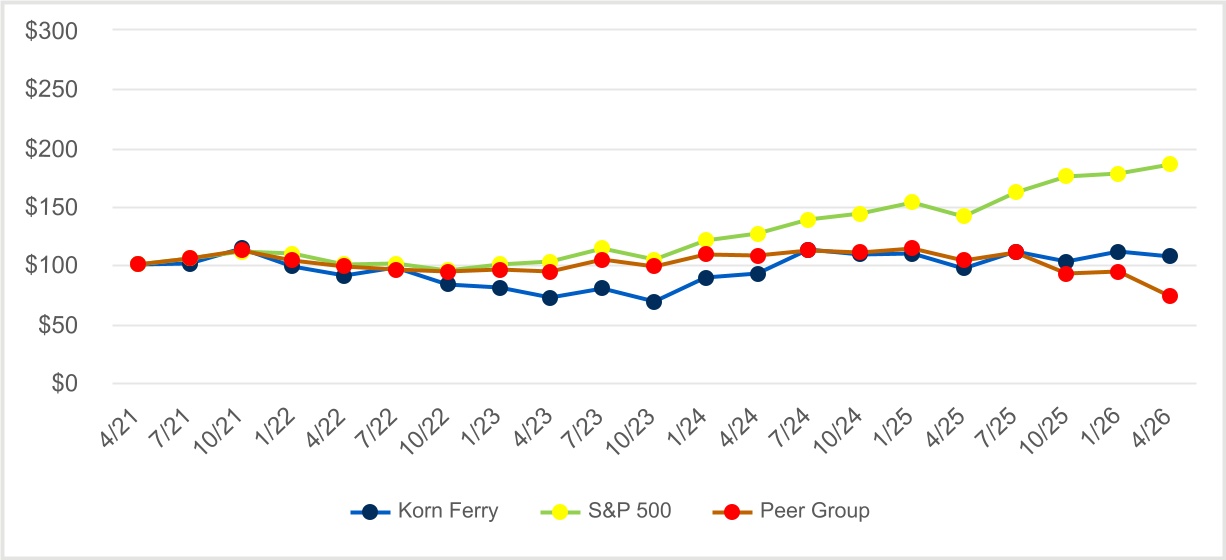
Copyright© 2026 Standard & Poor's, a division of S&P Global. All rights reserved.
_______________________________
(*)$100 invested on April 30, 2021 in stock or index, including reinvestment of dividends. Fiscal year ended April 30, 2026.
27
Capital Allocation Approach
The Company and its Board of Directors endorse a balanced approach to capital allocation. The Company’s long-term priority is to invest in growth initiatives, such as the hiring of consultants, the continued development of IP and derivative products and services, and the investment in synergistic, accretive M&A transactions that are expected to earn a return superior to the Company's cost of capital. Next, the Company’s capital allocation approach contemplates the return of a portion of excess capital to stockholders, in the form of a regular quarterly dividend, subject to the factors discussed below under “Dividends” and in more detail in the “Risk Factors” section of this Annual Report on Form 10-K. Additionally, the Company considers share repurchases on an opportunistic basis and subject to the terms of our indebtedness, as well as using excess cash to repay the Notes. See Note 11 — Long-Term Debt for a description of the Credit Agreement and indenture governing the Notes.
Dividends
On December 8, 2014, the Board of Directors (the "Board") adopted a dividend policy to distribute to our stockholders a regular quarterly cash dividend of $0.10 per share. Every quarter since the adoption of the dividend policy, the Company has declared a quarterly dividend. On June 21, 2021 and 2022, the Board increased the quarterly dividend to $0.12 per share and $0.15 per share, respectively. On June 26, 2023, the Board of the Company approved an increase of 20% in our quarterly dividend, which increased the quarterly dividend to $0.18 per share. On December 5, 2023, the Board approved an increase of 83% in the quarterly dividend, which increased the quarterly dividend to $0.33 per share. On June 12, 2024 and March 10, 2025, the Board approved an increase in our quarterly dividend, which increased the quarterly dividend to $0.37 per share and $0.48 per share, respectively. On March 5, 2026, the Board approved a 15% increase in our quarterly dividend, which increased the quarterly dividend to $0.55 per share.
The declaration and payment of future dividends under the quarterly dividend policy will be at the discretion of the Board and will depend upon many factors, including the Company’s earnings, capital requirements, financial conditions, the terms of the Company’s indebtedness and other factors that the Board may deem to be relevant. The Board may, however, amend, revoke or suspend the dividend policy at any time and for any reason.
Stock Repurchase Program
On September 18, 2025, the Board approved an increase in the Company’s stock repurchase program of $250 million, which brought our available capacity to repurchase shares in the open market or privately negotiated transactions to $331.4 million. Common stock may be repurchased from time to time in the open market or privately negotiated transactions at the Company’s discretion subject to market conditions and other factors. The Company repurchased approximately $116.1 million, $88.9 million and $52.5 million of the Company’s common stock during fiscal 2026, 2025 and 2024, respectively. Any decision to execute on our stock repurchase program will depend on our earnings, capital requirements, financial condition and other factors considered relevant by our Board. The Credit Agreement permits us to pay dividends to our stockholders and make share repurchases so long as there is no default under the Credit Agreement, the Company’s total funded debt to adjusted EBITDA ratio (as set forth in the Credit Agreement, the “consolidated net leverage ratio”) is no greater than 5.00 to 1.00, and we are in pro forma compliance with our financial covenant. Furthermore, our Notes allow the Company to pay $25.0 million of dividends per fiscal year with no restrictions plus an unlimited amount of dividends so long as the Company’s consolidated total leverage ratio is not greater than 3.50 to 1.00 and the Company is not in default under the indenture governing the Notes.
Issuer Purchases of Equity Securities
The following table summarizes common stock repurchased by us during the fourth quarter of fiscal 2026:
Total Number of Shares Purchased (1) | Average Price Paid Per Share | Total Number of Shares Purchased as Part of Publicly- Announced Programs | Approximate Dollar Value of Shares that May Yet be Purchased under the Programs(2) | ||||||||||||||||||||
| February 1, 2026 - February 28, 2026 | 159,261 | $ | 62.76 | 159,261 | $296.6 million | ||||||||||||||||||
| March 1, 2026 - March 31, 2026 | 637,181 | $ | 62.30 | 635,000 | $257.0 million | ||||||||||||||||||
| April 1, 2026 - April 30, 2026 | 446,197 | $ | 65.60 | 446,197 | $227.7 million | ||||||||||||||||||
| Total | 1,242,639 | $ | 63.55 | 1,240,458 | |||||||||||||||||||
_______________________________
(1)Represents withholding of 2,181 shares to cover taxes on vested restricted shares, in addition to shares purchased as part of a publicly announced program.
(2)On September 18, 2025, our Board approved an increase to the share repurchase program of $250 million. The shares can be repurchased in open market transactions or privately negotiated transactions at the Company's discretion. The share repurchase program has no expiration date. We repurchased approximately $78.8 million of the Company's common stock under the program during the fourth quarter of fiscal 2026.
Item 6. Reserved
28
Item 7. Management’s Discussion and Analysis of Financial Condition and Results of Operations
Forward-Looking Statements
This Annual Report on Form 10-K may contain certain statements that we believe are, or may be considered to be, “forward-looking” statements, within the meaning of Section 27A of the Securities Act of 1933, as amended, and Section 21E of the Securities Exchange Act of 1934, as amended (the “Exchange Act”). These forward-looking statements generally can be identified by use of statements that include phrases such as “believe,” “expect,” “anticipate,” “intend,” “plan,” “foresee,” “may,” “will,” “likely,” “estimates,” “potential,” “continue” or other similar words or phrases. Similarly, statements that describe our objectives, plans or goals, including the timing and anticipated impacts of our business strategy, expected demand for and relevance of our products and services, and expected results of our business diversification strategy, are also forward-looking statements. These forward-looking statements are subject to risks and uncertainties that could cause our actual results or outcomes, or the timing of our results or outcomes, to differ materially from those contemplated by the relevant forward-looking statement. The principal risk factors that could cause actual performance, results, outcomes and timing and future actions to differ materially from the forward-looking statements include, but are not limited to, those relating to global and local political and or economic developments in or affecting countries where we have operations, such as inflation, trade wars, global slowdowns, or recessions, competition, geopolitical tensions, shifts in global trade patterns, changes in demand for our services as a result of automation, dependence on and costs of attracting and retaining qualified and experienced consultants, impact of inflationary pressures on our profitability, maintaining our relationships with customers and suppliers and retaining key employees, maintaining our brand name and professional reputation, potential legal liability and regulatory developments, portability of client relationships, consolidation of or within the industries we serve, changes and developments in governmental laws and regulations, evolving investor and customer expectations with regard to corporate responsibility matters, currency fluctuations in our international operations, risks related to growth, alignment of our cost structure, including as a result of workforce, real estate, and other restructuring initiatives, restrictions imposed by off-limits agreements, reliance on information processing systems, cyber security vulnerabilities or events, changes to data security, data privacy, and data protection laws, dependence on third parties for the execution of critical functions, limited protection of our intellectual property (“IP”), our ability to enhance and develop new technology, including artificial intelligence (“AI”), our ability to successfully recover from a disaster or other business continuity problems, employment liability risk, an impairment in the carrying value of goodwill and other intangible assets, the impact of treaties or regulations on our business and our Company, deferred tax assets that we may not be able to use, our ability to develop new products and services, changes in our accounting estimates and assumptions, the utilization and billing rates of our consultants, seasonality, the use of social media platforms, the ability to effect acquisitions and integrate acquired businesses, resulting organizational changes, our indebtedness, the ultimate magnitude and duration of any future pandemics or similar outbreaks, and related restrictions and operational requirements that apply to our business and the businesses of our clients, and any related negative impacts on our business, employees, customers and our ability to provide services in affected regions, and the matters disclosed under the heading “Risk Factors” in the Company’s Exchange Act reports, including Item 1A included in this Annual Report on Form 10-K. Readers are urged to consider these factors carefully in evaluating the forward-looking statements. The forward-looking statements included in this Annual Report on Form 10-K are made only as of the date of this Annual Report on Form 10-K, and we undertake no obligation to publicly update these forward-looking statements to reflect subsequent events, circumstances or otherwise, except as required by law.
The following presentation of management’s discussion and analysis of our financial condition and results of operations should be read together with our consolidated financial statements and related notes included in this Annual Report on Form 10-K. We also make available on the Investor Relations portion of our website earnings slides and other important information, which we encourage you to review.
Executive Summary
Korn Ferry (referred to herein as the “Company” or in the first-person notations “we,” “our” and “us”) is a global consulting firm that powers individual and business performance. The impact we create spans entire organizations, but it always starts with people.
In every market cycle and every technology shift, strategy sets direction, but people make it happen. They lead, adapt, innovate and execute the work that moves organizations forward.
For more than 50 years, we studied how people and organizations perform. With decades of workforce intelligence and real-world experience, we've built a deep understanding of what drives organizational success, what gets in the way and what needs to change. We put that insight into practice every day.
Korn Ferry works across the full organization—from strategy and leadership to hiring, development, rewards and the roles, skills and workforce models needed for the future. While many firms address individual parts of that system, we look across and connect them. By aligning leaders, teams, and organizations around a common definition of success, we help organizations make better decisions, execute with confidence and achieve stronger outcomes.
Our business is organized around three connected elements: Foundational Assets, Capabilities, and Integrated Solutions. Together, they allow us to apply what we know, deploy the right expertise and combine capabilities to address high-priority business challenges.
29
Our Foundational Assets are the proprietary data, science and IP that inform our work and help clients make better people and organizational decisions.
Our Capabilities are the areas of expertise we bring to clients.
•Organization Strategy: Aligning people, processes, structures and operating models to support business goals.
•Assessment & Succession: Evaluating potential, readiness and fit to guide hiring, promotion, mobility and succession decisions.
•Talent Acquisition: Sourcing and hiring talent across all levels through executive search, professional recruiting, interim talent and Recruitment Process Outsourcing ("RPO").
•Leadership & Professional Development: Developing leaders and building critical skills through coaching, experiential learning and scalable digital programs.
•Total Rewards: Designing compensation, benefits, recognition and pay transparency strategies that support performance and reflect evolving regulatory and business priorities.
•Board and Chief Executive Officer ("CEO") Services: Advising boards and CEOs on leadership transitions, governance, succession and long-term planning.
Our Integrated Solutions combine multiple Capabilities to address high-priority business challenges.
Korn Ferry serves clients through strategic account partnerships and flexible engagement models tailored to client needs. Core to this is our Marquee and Diamond Accounts Program (the “Program”)—a structured approach to managing long-term relationships with many of the world’s most complex organizations.
Clients within the Program are supported by dedicated account leaders who coordinate engagement across Korn Ferry’s portfolio. This model supports consistent delivery, a deeper understanding of client priorities and broader access to the firm's capabilities. As of fiscal year-end 2026, our 350 Marquee and Diamond accounts represented approximately 40% of consolidated fee revenue—more than double their contribution at the Program’s inception.
Korn Ferry delivers services through five solution areas. These solutions reflect the breadth of our expertise and correspond to eight reportable segments supported by centralized corporate functions that help connect expertise, intelligence and delivery across the firm, driving alignment, connectivity and scale. The five solution areas are the following:
1.Consulting helps clients design and implement the talent strategies, organizational structures, and workforce capabilities and rewards to drive growth. Our consulting teams collaborate across Korn Ferry to deliver integrated solutions that support end-to-end transformation—from strategy through execution.
2.Digital develops and manages the technology, data, platform, and AI capabilities that power Talent Suite and help us unlock the value of our Foundational Assets. Working closely with our Solution teams, Digital enables consultants and clients to access and apply our insights through embedded and subscription-based offerings.
3.Executive Search delivers industry-leading executive recruitment across global markets, powered by decades of expertise and deep industry/sector specialization and our own top-tier executive search professionals. We help organizations recruit board-level, C-suite and senior executive talent, using proprietary assessments, leadership benchmarks and deep functional insight to identify leaders who align with strategy, culture and long-term priorities. This solution is managed and reported on a geographic basis and represents four of the Company’s reportable segments (Executive Search North America, Executive Search Europe, Middle East and Africa ("EMEA"), Executive Search Asia Pacific ("APAC") and Executive Search Latin America).
4.Professional Search & Interim focuses on scalable, high impact recruiting and interim talent solutions at the professional level that offer flexibility and speed in dynamic business environments. We help clients rapidly place permanent professionals and senior/professional interim leaders across business-critical functions such as Finance and Accounting, IT, Human Resources and Operations.
5.RPO provides high-volume, outsourced hiring solutions that deliver end-to-end talent acquisition services for enterprise clients. These programs are delivered through global Talent Delivery Centers, using a technology-enabled platform and are designed and managed to align with each client’s business objectives, leveraging our IP, data, science and deep talent expertise. Advanced technology and AI-driven tools are used to enhance the platform to drive scale, efficiency and quality, while offering an engaging experience for candidates throughout the hiring process.
Performance Highlights in fiscal 2026 include:
▪Fee revenue was $2,907.5 million, an increase of 7% year-over-year, led by Professional Search & Interim, Executive Search and Consulting.
30
▪Net income attributable to Korn Ferry was $277.4 million, with a margin of 9.5%, an increase of 50 basis points ("bps") compared to the year-ago period.
▪Adjusted EBITDA was $497.8 million in fiscal 2026, with a margin of 17.1%.
▪Diluted earnings per share was $5.22 in fiscal 2026.
▪Our fiscal 2026 Marquee and Diamond Accounts fee revenue generated approximately 40% of our consolidated fee revenue and grew 8% compared to fiscal year 2025.
▪We have built strong client loyalty, with approximately 82% of the assignments performed during fiscal 2026 having been on behalf of clients for whom we had conducted assignments in the previous three fiscal years.
▪More than 75% of our fee revenues were generated from clients that have utilized multiple solutions.
▪Approximately 80% of the executive searches we performed in fiscal 2026 were for board level, chief executive and other senior executive and general management positions. Our more than 3,700 search engagement clients in fiscal 2026 included many of the world’s largest and most prestigious public and private companies.
The Company evaluates performance and allocates resources based on the chief operating decision maker’s review of (1) fee revenue and (2) adjusted earnings before interest, taxes, depreciation and amortization (“Adjusted EBITDA”). To the extent that such charges occur, Adjusted EBITDA excludes restructuring charges, integration/acquisition costs, certain separation costs and certain non-cash charges (goodwill, intangible asset, gain on modification of office lease and other impairment charges). For fiscal 2026, Adjusted EBITDA excluded $4.4 million of integration/acquisition costs and $13.9 million of gain on the modification of an office lease. For fiscal 2025, Adjusted EBITDA excluded $8.8 million of integration/acquisition costs, $4.6 million of management separation charges due to contractual obligations upon an executive's death, $2.5 million of impairment of right-of-use assets, $1.9 million of restructuring charges, net, and $0.5 million of impairment of fixed assets. For fiscal 2024, Adjusted EBITDA excluded $68.6 million of restructuring charges, net, $14.9 million of integration/acquisition costs, $1.6 million impairment of right-of-use assets and $1.6 million impairment of fixed assets.
Consolidated and subtotals of Executive Search Adjusted EBITDA and Adjusted EBITDA margin are non-GAAP financial measures and have limitations as analytical tools. They should not be viewed as a substitute for financial information determined in accordance with United States (“U.S.”) generally accepted accounting principles (“GAAP”) and should not be considered in isolation or as a substitute for analysis of the Company’s results as reported under GAAP. In addition, they may not necessarily be comparable to non-GAAP performance measures that may be presented by other companies.
Management believes the presentation of these non-GAAP financial measures provides meaningful supplemental information regarding Korn Ferry’s performance by excluding certain charges, items of income and other items that may not be indicative of Korn Ferry’s ongoing operating results. The use of these non-GAAP financial measures facilitates comparisons to Korn Ferry’s historical performance and the identification of operating trends that may otherwise be distorted by the factors discussed above. Korn Ferry includes these non-GAAP financial measures because management believes it is useful to investors in allowing for greater transparency with respect to supplemental information used by management in its evaluation of Korn Ferry’s ongoing operations and financial and operational decision-making. The accounting policies for the reportable segments are the same as those described in the summary of significant accounting policies in the accompanying consolidated financial statements, except that the above noted items are excluded to arrive at Adjusted EBITDA. Management further believes that Adjusted EBITDA is useful to investors because it is frequently used by investors and other interested parties to measure operating performance among companies with different capital structures, effective tax rates and tax attributes and capitalized asset values, all of which can vary substantially from company to company.
Critical Accounting Policies
The following discussion and analysis of our financial condition and results of operations are based on our consolidated financial statements. Preparation of our periodic filings requires us to make estimates and assumptions that affect the reported amount of assets and liabilities and disclosure of contingent assets and liabilities at the date of our financial statements and the reported amounts of revenue and expenses during the reporting period. Actual results could differ from those estimates and assumptions and changes in the estimates are reported in current operations as new information is learned or upon the amounts becoming fixed and determinable. In preparing our consolidated financial statements and accounting for the underlying transactions and balances, we apply our accounting policies as disclosed in the notes to our consolidated financial statements. We consider the policies discussed below as critical to an understanding of our consolidated financial statements because their application places the most significant demands on management’s judgment and estimates. Specific risks for these critical accounting policies are described in the following paragraphs. Senior management has discussed the development, selection and key assumptions of the critical accounting estimates with the Audit Committee of the Board of Directors.
Revenue Recognition. Substantially all fee revenue is derived from talent and organizational consulting services and digital sales, stand-alone or as part of a solution, fees for professional services related to executive and professional recruitment performed on a retained basis, interim services and RPO.
31
Revenue is recognized when control of the goods and services is transferred to the customer in an amount that reflects the consideration we expect to be entitled to in exchange for those goods and services. Revenue contracts with customers are evaluated based on the five-step model outlined in Accounting Standards Codification (“ASC”) 606 (“ASC 606”), Revenue from Contracts with Customers: (1) identify the contract with a customer; (2) identify the performance obligation(s) in the contract; (3) determine the transaction price; (4) allocate the transaction price to the separate performance obligation(s); and (5) recognize revenue when (or as) each performance obligation is satisfied.
Consulting fee revenue is primarily recognized as services are rendered, measured by total hours incurred as a percentage of the total estimated hours at completion. It is possible that updated estimates for consulting engagements may vary from initial estimates with such updates being recognized in the period of determination. Depending on the timing of billings and services rendered, we accrue or defer revenue as appropriate.
Digital fee revenue is generated from IP-based software products enabling large-scale talent programs for pay, talent development, engagement, and assessment and is consumed directly by an end user or indirectly through a consulting engagement. Revenue is recognized as services are delivered and we have a legally enforceable right to payment. Revenue also comes from the sale of our product subscriptions, which are considered symbolic IP due to the dynamic nature of the content. As a result, revenue is recognized over the term of the contract. Functional IP licenses grant customers the right to use IP content via the delivery of a flat file. Because the IP content license has significant stand-alone functionality, revenue is recognized upon delivery and when an enforceable right to payment exists.
Fee revenue from executive and professional search activities is generally one-third of the estimated first-year cash compensation of the placed candidate, plus a percentage of the fee to cover indirect engagement-related expenses. In addition to the search retainer, an uptick fee is billed when the actual compensation awarded by the client for a placement is higher than the estimated compensation. In the aggregate, upticks have been a relatively consistent percentage of the original estimated fee; therefore, we estimate upticks using the expected value method based on historical data on a portfolio basis. In a standard search engagement, there is one performance obligation, which is the promise to undertake a search. We generally recognize such revenue over the course of a search and when we are legally entitled to payment as outlined in the billing terms of the contract. Any revenues associated with services that are provided on a contingent basis are recognized once the contingency is resolved, as this is when control is transferred to the customer. These assumptions determine the timing of revenue recognition for the reported period. In addition to talent acquisition for permanent placement roles, the Professional Search & Interim segment also offers recruitment services for interim roles. Interim roles are short-term in duration, generally less than 12 months. Generally, each interim role is a separate performance obligation. We recognize fee revenue over the duration that the interim resources’ services are provided which also aligns to the contracted invoicing plan and enforceable right to payment.
RPO fee revenue is generated through two distinct phases: 1) the implementation phase and 2) the post-implementation recruitment phase. The fees associated with the implementation phase are recognized over the period that the related implementation services are provided. The post-implementation recruitment phase represents end-to-end recruiting services to clients for which there are both fixed and variable fees, which are recognized over the period that the related recruiting services are performed.
32
Results of Operations
The following table summarizes the results of our operations as a percentage of fee revenue:
(Numbers may not total exactly due to rounding)
| Year Ended April 30, | |||||||||||||||||
| 2026 | 2025 | 2024 | |||||||||||||||
| Fee revenue | 100.0 | % | 100.0 | % | 100.0 | % | |||||||||||
| Reimbursed out-of-pocket engagement expenses | 1.1 | 1.1 | 1.2 | ||||||||||||||
| Total revenue | 101.1 | 101.1 | 101.2 | ||||||||||||||
| Compensation and benefits | 64.2 | 64.4 | 66.8 | ||||||||||||||
| General and administrative expenses | 8.5 | 9.5 | 9.4 | ||||||||||||||
| Reimbursed expenses | 1.1 | 1.1 | 1.2 | ||||||||||||||
| Cost of services | 11.0 | 10.4 | 10.9 | ||||||||||||||
| Depreciation and amortization | 3.4 | 2.9 | 2.8 | ||||||||||||||
| Restructuring charges, net | — | 0.1 | 2.5 | ||||||||||||||
Other Income, net | 1.2 | 0.7 | 1.1 | ||||||||||||||
Interest expense, net | 0.7 | 0.8 | 0.8 | ||||||||||||||
Income tax provision | 3.7 | 3.4 | 1.8 | ||||||||||||||
| Net income | 9.7 | % | 9.2 | % | 6.2 | % | |||||||||||
| Net income attributable to Korn Ferry | 9.5 | % | 9.0 | % | 6.1 | % | |||||||||||
The following tables summarize the results of our operations:
(Numbers may not total exactly due to rounding)
| Year Ended April 30, | |||||||||||||||||||||||||||||||||||
| 2026 | 2025 | 2024 | |||||||||||||||||||||||||||||||||
| Dollars | % | Dollars | % | Dollars | % | ||||||||||||||||||||||||||||||
| (dollars in thousands) | |||||||||||||||||||||||||||||||||||
| Fee revenue | |||||||||||||||||||||||||||||||||||
| Consulting | $ | 691,654 | 23.8 | % | $ | 662,708 | 24.3 | % | $ | 695,007 | 25.1 | % | |||||||||||||||||||||||
| Digital | 363,523 | 12.5 | 363,530 | 13.3 | 366,699 | 13.3 | |||||||||||||||||||||||||||||
| Executive Search: | |||||||||||||||||||||||||||||||||||
| North America | 583,394 | 20.0 | 535,921 | 19.6 | 506,927 | 18.4 | |||||||||||||||||||||||||||||
| EMEA | 215,134 | 7.4 | 194,088 | 7.1 | 184,516 | 6.7 | |||||||||||||||||||||||||||||
| Asia Pacific | 97,527 | 3.4 | 87,337 | 3.2 | 85,863 | 3.1 | |||||||||||||||||||||||||||||
| Latin America | 28,049 | 1.0 | 28,862 | 1.1 | 28,937 | 1.0 | |||||||||||||||||||||||||||||
| Total Executive Search | 924,104 | 31.8 | 846,208 | 31.0 | 806,243 | 29.2 | |||||||||||||||||||||||||||||
| Professional Search & Interim | 561,077 | 19.3 | 503,515 | 18.4 | 540,615 | 19.6 | |||||||||||||||||||||||||||||
| RPO | 367,111 | 12.6 | 354,127 | 13.0 | 354,107 | 12.8 | |||||||||||||||||||||||||||||
| Total fee revenue | 2,907,469 | 100.0 | % | 2,730,088 | 100.0 | % | 2,762,671 | 100.0 | % | ||||||||||||||||||||||||||
| Reimbursed out-of-pocket engagement expense | 31,172 | 30,998 | 32,834 | ||||||||||||||||||||||||||||||||
| Total revenue | $ | 2,938,641 | $ | 2,761,086 | $ | 2,795,505 | |||||||||||||||||||||||||||||
In the tables that follow, the Company presents a subtotal for Executive Search Adjusted EBITDA and a single percentage for Executive Search Adjusted EBITDA margin, which reflects the aggregate of all of the individual Executive Search Regions. These figures are non-GAAP financial measures and are presented as they are consistent with the Company’s solutions areas and are financial metrics used by the Company’s investor base.
33
| Year Ended April 30, | |||||||||||||||||||||||||||||||||||
| 2026 | 2025 | 2024 | |||||||||||||||||||||||||||||||||
| Consolidated | |||||||||||||||||||||||||||||||||||
(dollars in thousands) | |||||||||||||||||||||||||||||||||||
| Fee revenue | $ | 2,907,469 | 100.0 | % | $ | 2,730,088 | 100.0 | % | $ | 2,762,671 | 100.0 | % | |||||||||||||||||||||||
| Total revenue | $ | 2,938,641 | 101.1 | % | $ | 2,761,086 | 101.1 | % | $ | 2,795,505 | 101.2 | % | |||||||||||||||||||||||
| Net income attributable to Korn Ferry | $ | 277,434 | 9.5 | % | $ | 246,062 | 9.0 | % | $ | 169,154 | 6.1 | % | |||||||||||||||||||||||
| Net income attributable to noncontrolling interest | 3,386 | 0.1 | 5,014 | 0.2 | 3,407 | 0.1 | |||||||||||||||||||||||||||||
| Interest expense, net | 19,998 | 0.7 | 20,363 | 0.8 | 20,968 | 0.8 | |||||||||||||||||||||||||||||
| Income tax provision | 107,630 | 3.7 | 93,836 | 3.4 | 50,081 | 1.8 | |||||||||||||||||||||||||||||
| Depreciation and amortization | 98,844 | 3.4 | 80,287 | 2.9 | 77,966 | 2.8 | |||||||||||||||||||||||||||||
| Integration/acquisition costs | 4,420 | 0.2 | 8,837 | 0.3 | 14,866 | 0.5 | |||||||||||||||||||||||||||||
| Management separation charges | — | — | 4,614 | 0.2 | — | — | |||||||||||||||||||||||||||||
| Restructuring charges, net | — | — | 1,892 | 0.1 | 68,558 | 2.5 | |||||||||||||||||||||||||||||
| Impairment of fixed assets | — | — | 509 | 0.0 | 1,575 | 0.1 | |||||||||||||||||||||||||||||
| Impairment of right-of-use assets | — | — | 2,452 | 0.1 | 1,629 | 0.1 | |||||||||||||||||||||||||||||
Gain on modification of office lease | (13,907) | (0.5) | — | — | — | — | |||||||||||||||||||||||||||||
| Adjusted EBITDA | $ | 497,805 | 17.1 | % | $ | 463,866 | 17.0 | % | $ | 408,204 | 14.8 | % | |||||||||||||||||||||||
| Year Ended April 30, 2026 | ||||||||||||||||||||||||||
| (dollars in thousands) | ||||||||||||||||||||||||||
Net income attributable to Korn Ferry | Net income attributable to Korn Ferry margin | |||||||||||||||||||||||||
Consolidated | $ | 277,434 | 9.5 | % | ||||||||||||||||||||||
| Fee revenue | Total revenue | Adjusted EBITDA | Adjusted EBITDA margin | |||||||||||||||||||||||
| Consulting | $ | 691,654 | $ | 704,129 | $ | 118,413 | 17.1 | % | ||||||||||||||||||
| Digital | 363,523 | 364,383 | 113,129 | 31.1 | % | |||||||||||||||||||||
| Executive Search: | ||||||||||||||||||||||||||
| North America | 583,394 | 589,313 | 173,703 | 29.8 | % | |||||||||||||||||||||
| EMEA | 215,134 | 216,517 | 36,572 | 17.0 | % | |||||||||||||||||||||
| Asia Pacific | 97,527 | 98,138 | 21,475 | 22.0 | % | |||||||||||||||||||||
| Latin America | 28,049 | 28,092 | 5,603 | 20.0 | % | |||||||||||||||||||||
| Total Executive Search | 924,104 | 932,060 | 237,353 | 25.7 | % | |||||||||||||||||||||
| Professional Search & Interim | 561,077 | 566,253 | 121,156 | 21.6 | % | |||||||||||||||||||||
| RPO | 367,111 | 371,816 | 57,658 | 15.7 | % | |||||||||||||||||||||
| Corporate | — | — | (149,904) | |||||||||||||||||||||||
| Consolidated | $ | 2,907,469 | $ | 2,938,641 | $ | 497,805 | 17.1 | % | ||||||||||||||||||
34
| Year Ended April 30, 2025 | ||||||||||||||||||||||||||
| (dollars in thousands) | ||||||||||||||||||||||||||
| Net income attributable to Korn Ferry | Net income attributable to Korn Ferry margin | |||||||||||||||||||||||||
| Consolidated | $ | 246,062 | 9.0 | % | ||||||||||||||||||||||
| Fee revenue | Total revenue | Adjusted EBITDA | Adjusted EBITDA margin | |||||||||||||||||||||||
| Consulting | $ | 662,708 | $ | 674,070 | $ | 115,481 | 17.4 | % | ||||||||||||||||||
| Digital | 363,530 | 363,727 | 112,696 | 31.0 | % | |||||||||||||||||||||
| Executive Search: | ||||||||||||||||||||||||||
| North America | 535,921 | 542,068 | 148,242 | 27.7 | % | |||||||||||||||||||||
| EMEA | 194,088 | 195,268 | 31,689 | 16.3 | % | |||||||||||||||||||||
| Asia Pacific | 87,337 | 87,840 | 18,119 | 20.7 | % | |||||||||||||||||||||
| Latin America | 28,862 | 28,876 | 8,149 | 28.2 | % | |||||||||||||||||||||
| Total Executive Search | 846,208 | 854,052 | 206,199 | 24.4 | % | |||||||||||||||||||||
| Professional Search & Interim | 503,515 | 507,246 | 107,600 | 21.4 | % | |||||||||||||||||||||
| RPO | 354,127 | 361,991 | 52,635 | 14.9 | % | |||||||||||||||||||||
| Corporate | — | — | (130,745) | |||||||||||||||||||||||
| Consolidated | $ | 2,730,088 | $ | 2,761,086 | $ | 463,866 | 17.0 | % | ||||||||||||||||||
| Year Ended April 30, 2024 | ||||||||||||||||||||||||||
| (dollars in thousands) | ||||||||||||||||||||||||||
| Net income attributable to Korn Ferry | Net income attributable to Korn Ferry margin | |||||||||||||||||||||||||
| Consolidated | $ | 169,154 | 6.1 | % | ||||||||||||||||||||||
| Fee revenue | Total revenue | Adjusted EBITDA | Adjusted EBITDA margin | |||||||||||||||||||||||
| Consulting | $ | 695,007 | $ | 706,805 | $ | 114,260 | 16.4 | % | ||||||||||||||||||
| Digital | 366,699 | 366,924 | 108,669 | 29.6 | % | |||||||||||||||||||||
| Executive Search: | ||||||||||||||||||||||||||
| North America | 506,927 | 513,545 | 120,710 | 23.8 | % | |||||||||||||||||||||
| EMEA | 184,516 | 185,552 | 25,902 | 14.0 | % | |||||||||||||||||||||
| Asia Pacific | 85,863 | 86,273 | 18,923 | 22.0 | % | |||||||||||||||||||||
| Latin America | 28,937 | 28,956 | 5,571 | 19.3 | % | |||||||||||||||||||||
| Total Executive Search | 806,243 | 814,326 | 171,106 | 21.2 | % | |||||||||||||||||||||
| Professional Search & Interim | 540,615 | 544,453 | 101,868 | 18.8 | % | |||||||||||||||||||||
| RPO | 354,107 | 362,997 | 40,399 | 11.4 | % | |||||||||||||||||||||
| Corporate | — | — | (128,098) | |||||||||||||||||||||||
| Consolidated | $ | 2,762,671 | $ | 2,795,505 | $ | 408,204 | 14.8 | % | ||||||||||||||||||
Our Annual Report on Form 10-K for the year ended April 30, 2025 includes a discussion and analysis of our financial condition and results of operations for fiscal 2025 compared to fiscal 2024 in Item 7 of Part II, "Management's Discussion and Analysis of Financial Condition and Results of Operations."
35
Fiscal 2026 Compared to Fiscal 2025
Fee Revenue
Fee Revenue. Fee revenue increased by $177.4 million, or 7%, to $2,907.5 million in fiscal 2026 compared to $2,730.1 million in fiscal 2025. Exchange rates favorably impacted fee revenue by $48.1 million, or 2%, in fiscal 2026 compared to fiscal 2025. The increase in fee revenue was due to higher fee revenues in Professional Search & Interim, Executive Search North America, Executive Search EMEA, Consulting and RPO.
Consulting. Consulting reported fee revenue of $691.7 million in fiscal 2026, an increase of $29.0 million, or 4%, compared to $662.7 million in fiscal 2025. Exchange rates favorably impacted fee revenue by $12.9 million, or 2%, in fiscal 2026 compared to fiscal 2025. The increase in fee revenue was primarily driven by an increase in demand for our assessment & succession, organizational strategy and leadership development offerings.
Digital. Digital reported fee revenue of $363.5 million in fiscal 2026, essentially flat compared to $363.5 million in fiscal 2025. Exchange rates favorably impacted fee revenue by $9.7 million, or 3%, in fiscal 2026 compared to fiscal 2025.
Executive Search North America. Executive Search North America reported fee revenue of $583.4 million in fiscal 2026, an increase of $47.5 million, or 9%, compared to $535.9 million in fiscal 2025. North America’s fee revenue increased primarily due to a 6% increase in the weighted-average fee billed per engagement (calculated using local currency) and a 3% increase in the number of engagements billed in fiscal 2026 compared to fiscal 2025.
Executive Search EMEA. Executive Search EMEA reported fee revenue of $215.1 million in fiscal 2026, an increase of $21.0 million, or 11%, compared to $194.1 million in fiscal 2025. Exchange rates favorably impacted fee revenue by $11.8 million, or 6%, in fiscal 2026 compared to fiscal 2025. The increase in fee revenue was primarily due to a 6% increase in the number of engagements billed and a 5% increase in the weighted-average fee billed per engagement in fiscal 2026 compared to fiscal 2025.
Executive Search Asia Pacific. Executive Search Asia Pacific reported fee revenue of $97.5 million in fiscal 2026, an increase of $10.2 million, or 12%, compared to $87.3 million in fiscal 2025. The increase in fee revenue was primarily due to an 8% increase in the number of engagements billed and a 3% increase in weighted-average fee billed per engagement (calculated using local currency) in fiscal 2026 compared to fiscal 2025.
Executive Search Latin America. Executive Search Latin America reported fee revenue of $28.0 million in fiscal 2026, a decrease of $0.9 million, or 3%, compared to $28.9 million in fiscal 2025. Exchange rates favorably impacted fee revenue by $1.2 million, or 4%, in fiscal 2026 compared to fiscal 2025.
Professional Search & Interim. Professional Search & Interim reported fee revenue of $561.1 million in fiscal 2026, an increase of $57.6 million, or 11%, compared to $503.5 million in fiscal 2025. Exchange rates favorably impacted fee revenue by $6.0 million, or 1%, in fiscal 2026 compared to fiscal 2025. Interim fee revenue increased by $39.0 million primarily due to the acquisition of Trilogy International ("Trilogy") effective November 1, 2024. The rest of the increase was due to higher fee revenue in Permanent placement of $18.6 million in fiscal 2026 compared to fiscal 2025 due to an increase in the weighted-average fee billed per engagement.
RPO. RPO reported fee revenue of $367.1 million in fiscal 2026, an increase of $13.0 million, or 4%, compared to $354.1 million in fiscal 2025. Exchange rates favorably impacted fee revenue by $5.5 million, or 2%, in fiscal 2026 compared to fiscal 2025. The increase in fee revenue was primarily due to new logo clients in North America.
Compensation and Benefits
Compensation and benefits expense increased by $109.0 million, or 6%, to $1,867.0 million in fiscal 2026 from $1,758.0 million in fiscal 2025. Exchange rates unfavorably impacted compensation and benefits by $31.6 million, or 2%, in fiscal 2026 compared to fiscal 2025. The increase in compensation and benefits expense was primarily due to an increase in performance-related bonus expense of $33.6 million due to higher fee revenue in fiscal 2026 compared to fiscal 2025. Also contributing to the increase were higher salaries and related payroll taxes, deferred compensation expense and severance-related expenses of $29.2 million, $22.7 million and $12.2 million, respectively, in fiscal 2026 compared to fiscal 2025.
Consulting compensation and benefits expense increased by $17.7 million, or 4%, to $476.1 million in fiscal 2026 from $458.4 million in fiscal 2025. Exchange rates unfavorably impacted compensation and benefits by $10.0 million, or 2%, in fiscal 2026 compared to fiscal 2025. The increase in compensation and benefits expense was primarily due to increases of $15.7 million in performance-related bonus expense due to higher segment fee revenue in fiscal 2026 compared to fiscal 2025, $4.2 million in severance-related costs, and higher deferred compensation expense of $3.7 million in fiscal 2026 compared to fiscal 2025. The increase was partially offset by a decrease of $6.7 million in restricted stock compensation expense in fiscal 2026 compared to fiscal 2025.
Digital compensation and benefits expense was $179.5 million in both fiscal 2026 and fiscal 2025. Exchange rates unfavorably impacted compensation and benefits by $4.4 million, or 2%, in fiscal 2026 compared to fiscal 2025.
36
Executive Search North America compensation and benefits expense increased by $39.7 million, or 11%, to $402.0 million in fiscal 2026 compared to $362.3 million in fiscal 2025. Compensation and benefits expense increased primarily due to an increase of $24.3 million in performance-related bonus expense due to higher segment fee revenue in fiscal 2026 compared to fiscal 2025. Also contributing to the increase was $13.9 million more in deferred compensation expense in fiscal 2026 compared to fiscal 2025.
Executive Search EMEA compensation and benefits expense increased by $14.9 million, or 10%, to $160.3 million in fiscal 2026 compared to $145.4 million in fiscal 2025. Exchange rates unfavorably impacted compensation and benefits by $9.0 million, or 6%, in fiscal 2026 compared to fiscal 2025. Compensation and benefits expense increased primarily due to an increase of $9.5 million in salaries and related payroll taxes as a result of a 5% increase in average headcount in fiscal 2026 compared to fiscal 2025. Also contributing to the increase were $3.0 million more in amortization of long-term awards and an increase in performance-related bonus expense of $2.5 million due to higher segment fee revenue in fiscal 2026 compared to fiscal 2025.
Executive Search Asia Pacific compensation and benefits expense increased by $5.2 million, or 8%, to $66.9 million in fiscal 2026 compared to $61.7 million in fiscal 2025. The increase in compensation and benefits expense was primarily due to an increase in performance-related bonus expense of $4.2 million due to higher segment fee revenue in fiscal 2026 compared to fiscal 2025 and an increase of $1.1 million in salaries and related payroll taxes in fiscal 2026 compared to fiscal 2025.
Executive Search Latin America compensation and benefits expense increased by $0.8 million, or 4%, to $19.0 million in fiscal 2026 compared to $18.2 million in fiscal 2025.
Professional Search & Interim compensation and benefits expense increased by $13.9 million, or 7%, to $205.5 million in fiscal 2026 compared to $191.6 million in fiscal 2025. Exchange rates unfavorably impacted compensation and benefits by $2.2 million, or 1%, in fiscal 2026 compared to fiscal 2025. The increase in compensation and benefits expense was primarily due to an increase in salaries and related payroll taxes of $6.7 million in fiscal 2026 compared to fiscal 2025. Also contributing to the increase were higher severance-related expenses of $3.2 million and commission expense of $2.8 million in fiscal 2026 compared to fiscal 2025.
RPO compensation and benefits expense increased by $8.4 million, or 3%, to $277.4 million in fiscal 2026 from $269.0 million in fiscal 2025. Exchange rates unfavorably impacted compensation and benefits by $4.3 million, or 2%, in fiscal 2026 compared to fiscal 2025. The increase in compensation and benefits expense was primarily due to the increases in use of outside contractors to support the increase on segment fee revenue, severance-related expenses, and salaries and related payroll taxes of $3.8 million, $1.9 million and $1.8 million, respectively, in fiscal 2026 compared to fiscal 2025.
Corporate compensation and benefits expense increased by $8.5 million, or 12%, to $80.4 million in fiscal 2026 compared to $71.9 million in fiscal 2025. The increase was primarily due to increases of $3.8 million in restricted stock compensation expense, $2.7 million in salaries and related payroll taxes and $1.0 million in deferred compensation expense in fiscal 2026 compared to fiscal 2025.
General and Administrative Expenses
General and administrative expenses decreased by $10.8 million, or 4%, to $247.7 million in fiscal 2026 compared to $258.5 million in fiscal 2025. Exchange rates unfavorably impacted general and administrative expenses by $4.3 million, or 2%, in fiscal 2026 compared to fiscal 2025. The decrease in general and administrative expenses was primarily due to a gain from the modification of an office lease of $13.9 million in fiscal 2026 compared to fiscal 2025. Further contributing to the decrease were decreases of $4.4 million in bad debt expense and $3.4 million in integration and acquisition costs in fiscal 2026 compared to fiscal 2025, as well as impairment charges of $3.0 million associated primarily with the reduction of the Company's real estate footprint in fiscal 2025. These decreases were partially offset by increases in marketing and business development expenses and computer software licenses of $11.2 million and $3.6 million, respectively, in fiscal 2026 compared to fiscal 2025.
Consulting general and administrative expenses decreased by $2.9 million, or 6%, to $48.6 million in fiscal 2026 compared to $51.5 million in fiscal 2025. The decrease in general and administrative expenses was primarily due to a gain from the modification of an office lease of $4.1 million in fiscal 2026 compared to fiscal 2025. The decrease was partially offset by an increase in marketing and business development expenses of $1.4 million in fiscal 2026 compared to fiscal 2025.
Digital general and administrative expenses increased by $0.6 million, or 2%, to $39.7 million in fiscal 2026 compared to $39.1 million in fiscal 2025.
Executive Search North America general and administrative expenses decreased by $9.2 million, or 26%, to $26.7 million in fiscal 2026 from $35.9 million in fiscal 2025. The decrease in general and administrative expenses was primarily due to lower legal and other professional fees of $5.1 million in fiscal 2026 compared to fiscal 2025. Also contributing to the decrease was impairment charges of $2.6 million associated with the reduction of the Company's real estate footprint in fiscal 2025.
37
Executive Search EMEA general and administrative expenses decreased by $2.5 million, or 15%, to $14.5 million in fiscal 2026 from $17.0 million in fiscal 2025. The decrease in general and administrative expenses was primarily due to a gain from the modification of an office lease of $3.7 million in fiscal 2026. This decrease was partially offset by the impact of foreign currency, with a foreign currency loss of $0.1 million in fiscal 2026 compared to a foreign currency gain of $0.5 million in fiscal 2025.
Executive Search Asia Pacific general and administrative expenses increased by $1.2 million, or 15%, to $9.0 million in fiscal 2026 from $7.8 million in fiscal 2025. The increase in general and administrative expenses was primarily due to an increase of $1.0 million in bad debt expense in fiscal 2026 compared to fiscal 2025.
Executive Search Latin America general and administrative expenses increased by $1.1 million, or 44%, to $3.6 million in fiscal 2026 from $2.5 million in fiscal 2025. The increase in general and administrative expenses was primarily due to the impact of foreign currency, with a foreign currency loss of $0.3 million in fiscal 2026 compared to a foreign currency gain of $1.1 million in fiscal 2025.
Professional Search & Interim general and administrative expenses decreased by $4.2 million, or 21%, to $15.9 million in fiscal 2026 from $20.1 million in fiscal 2025. The decrease in general and administrative expenses was primarily due to a gain from the modification of an office lease of $2.6 million in fiscal 2026 and a decrease of $1.7 million in bad debt expense in fiscal 2026 compared to fiscal 2025.
RPO general and administrative expenses decreased by $3.8 million, or 18%, to $17.4 million in fiscal 2026 from $21.2 million in fiscal 2025. The decrease in general and administrative expenses was primarily due to a decrease of $3.0 million in bad debt expense in fiscal 2026 compared to fiscal 2025 and a gain from the modification of an office lease of $1.5 million in fiscal 2026.
Corporate general and administrative expenses increased by $9.0 million, or 14%, to $72.3 million in fiscal 2026 compared to $63.3 million in fiscal 2025. The increase in general and administrative expenses was primarily due to increases in marketing and business development expenses and legal and other professional fees of $10.1 million and $2.1 million, respectively, in fiscal 2026 compared to fiscal 2025. These increases were partially offset by a decrease in integration and acquisition costs of $2.8 million in fiscal 2026 compared to fiscal 2025.
Cost of Services Expense
Cost of services expense consists of contractor and product costs related to the delivery of various services and products through Consulting, Digital, Professional Search & Interim and RPO. Cost of services expense was $319.2 million in fiscal 2026, an increase of $34.1 million, or 12%, compared to $285.1 million in fiscal 2025. Professional Search & Interim accounted for $30.3 million of the increase due to an increase in fee revenue in the segment as a significant amount of interim services performed had a higher cost of service expense as compared to the Company's other segments.
Depreciation and Amortization Expenses
Depreciation and amortization expenses were $98.8 million in fiscal 2026, an increase of $18.5 million, or 23%, compared to $80.3 million in fiscal 2025. The increase was primarily due to the accelerated depreciation associated with the decision to sunset our Digital platform with the replacement of our Korn Ferry Talent Suite combined with technology investments made in the current and prior year in our Digital segment.
Restructuring Charges, Net
During the second quarter of fiscal 2024, we implemented a plan intended to eliminate excess capacity resulting from a challenging macroeconomic business environment impacting demand. During fiscal 2025, we recorded an adjustment to the previously recorded restructuring accruals of $1.9 million. There were no restructuring charges during fiscal 2026.
Net Income Attributable to Korn Ferry
Net income attributable to Korn Ferry was $277.4 million in fiscal 2026, an increase of $31.3 million, or 13%, compared to $246.1 million in fiscal 2025. The increase in net income attributable to Korn Ferry was primarily due to an increase in fee revenue of $177.4 million, partially offset by increases in compensation and benefits expense of $109.0 million and cost of services expense of $34.1 million in fiscal 2026 compared to fiscal 2025. Net income attributable to Korn Ferry, as a percentage of fee revenue, was 10% and 9% in fiscal 2026 and 2025, respectively.
Adjusted EBITDA
Adjusted EBITDA was $497.8 million in fiscal 2026, an increase of $33.9 million, or 7%, compared to $463.9 million in fiscal 2025. The increase in Adjusted EBITDA was driven by an increase in fee revenue, partially offset by increases in compensation and benefit expense (excluding management separation charges and integration/acquisition costs) and cost of services expense in fiscal 2026 compared to fiscal 2025. Adjusted EBITDA, as a percentage of fee revenue, was 17.1% in both fiscal 2026 and 2025.
38
Consulting Adjusted EBITDA was $118.4 million in fiscal 2026, an increase of $2.9 million, or 3%, compared to $115.5 million in fiscal 2025. The increase in Adjusted EBITDA was primarily driven by an increase in fee revenue, partially offset by increases in compensation and benefits expense (excluding management separation charges) and cost of services expense in fiscal 2026 compared to fiscal 2025. Consulting Adjusted EBITDA, as a percentage of fee revenue, was 17% in both fiscal 2026 and fiscal 2025.
Digital Adjusted EBITDA was $113.1 million in fiscal 2026, essentially flat, compared to $112.7 million in fiscal 2025. Digital Adjusted EBITDA, as a percentage of fee revenue, was 31% in both fiscal 2026 and fiscal 2025.
Executive Search North America Adjusted EBITDA increased by $25.5 million, or 17%, to $173.7 million in fiscal 2026 compared to $148.2 million in fiscal 2025. The increase in Adjusted EBITDA was primarily driven by increases in fee revenue and other income, net coupled with lower general and administrative expenses (excluding impairment of right-of-use assets and fixed assets), partially offset by an increase in compensation and benefits expense in fiscal 2026 compared to fiscal 2025. Executive Search North America Adjusted EBITDA, as a percentage of fee revenue, was 30% in fiscal 2026 compared to 28% in fiscal 2025.
Executive Search EMEA Adjusted EBITDA increased by $4.9 million, or 15%, to $36.6 million in fiscal 2026 compared to $31.7 million in fiscal 2025. The increase in Adjusted EBITDA was primarily driven by an increase in fee revenue, partially offset by higher compensation and benefits expense and an increase in general and administrative expenses (excluding gain from modification of an office lease) in fiscal 2026 compared to fiscal 2025. Executive Search EMEA Adjusted EBITDA, as a percentage of fee revenue, was 17% in fiscal 2026 compared to 16% in fiscal 2025.
Executive Search Asia Pacific Adjusted EBITDA increased by $3.4 million, or 19%, to $21.5 million in fiscal 2026 compared to $18.1 million in fiscal 2025. The increase in Adjusted EBITDA was primarily driven by an increase in fee revenue, partially offset by increases in compensation and benefits expense and general and administrative expenses in fiscal 2026 compared to fiscal 2025. Executive Search Asia Pacific Adjusted EBITDA, as a percentage of fee revenue, was 22% in fiscal 2026 compared to 21% in fiscal 2025.
Executive Search Latin America Adjusted EBITDA decreased by $2.5 million, or 31%, to $5.6 million in fiscal 2026 compared to $8.1 million in fiscal 2025. The decrease in Adjusted EBITDA was primarily driven by increases in general and administrative expenses and compensation and benefits expense, coupled with a decrease in fee revenue in fiscal 2026 compared to fiscal 2025. Executive Search Latin America Adjusted EBITDA, as a percentage of fee revenue, was 20% in fiscal 2026 compared to 28% in fiscal 2025.
Professional Search & Interim Adjusted EBITDA was $121.2 million in fiscal 2026, an increase of $13.6 million, or 13%, compared to $107.6 million in fiscal 2025. The increase in Adjusted EBITDA was driven by an increase in fee revenue, partially offset by increases in cost of services expense and compensation and benefits expense (excluding integration/acquisition costs). Professional Search & Interim Adjusted EBITDA, as a percentage of fee revenue, was 22% in fiscal 2026 compared to 21% in fiscal 2025.
RPO Adjusted EBITDA was $57.7 million in fiscal 2026, an increase of $5.1 million, or 10%, compared to $52.6 million in fiscal 2025. The increase in Adjusted EBITDA was primarily driven by an increase in fee revenue, partially offset by an increase in compensation and benefits expense in fiscal 2026 compared to fiscal 2025. RPO Adjusted EBITDA, as a percentage of fee revenue, was 16% in fiscal 2026 compared to 15% in fiscal 2025.
Other Income, Net
Other income, net was $33.7 million in fiscal 2026 compared to $19.0 million in fiscal 2025. The difference was primarily due to an increase in the gains generated from the increase in fair value of our marketable securities that are held in trust for the settlement of the Company's obligations under the ECAP in fiscal 2026 compared to fiscal 2025.
Interest Expense, Net
Interest expense, net primarily relates to our Notes issued in December 2019, borrowings under our COLI policies and interest cost related to our deferred compensation plans, which are partially offset by interest earned on cash and cash equivalent balances. Interest expense, net was $20.0 million in fiscal 2026 compared to $20.4 million in fiscal 2025.
Income Tax Provision
The provision for income tax was $107.6 million in fiscal 2026 compared to $93.8 million in fiscal 2025. This reflects a 27.7% effective tax rate for fiscal 2026 compared to a 27.2% effective tax rate for fiscal 2025. The effective tax rate was primarily impacted by U.S. state income taxes and jurisdictional mix of earnings, which generally create variability in our effective tax rate over time.
On July 4, 2025, House Resolution 1, commonly referred to as the One Big Beautiful Bill Act (the "Act") was enacted into law. Key provisions of the Act include the extension and modification of certain provisions of the Tax Cuts and Jobs Act of 2017, changes to bonus depreciation, adjustments to business interest expense limitations, and modifications to the treatment of research and development expenditures. The Act has multiple effective dates, with certain provisions effective in our fiscal 2026 and others becoming effective in fiscal 2027. We have reflected the effect of the Act within the provision for income taxes and the deferred tax balances. The Act did not materially impact our effective tax rate.
39
Net Income Attributable to Noncontrolling Interest
Net income attributable to noncontrolling interest represents the portion of a subsidiary’s net earnings that is attributable to shares of such subsidiary not held by Korn Ferry that are included in the consolidated statements of income. Net income attributable to noncontrolling interest was $3.4 million and $5.0 million in fiscal 2026 and fiscal 2025, respectively.
Liquidity and Capital Resources
The Company and its Board of Directors (the "Board") endorse a balanced approach to capital allocation. The Company’s long-term priority is to invest in growth initiatives, such as the hiring of consultants, the continued development of IP and derivative products and services and the investment in synergistic, accretive merger and acquisition transactions that are expected to earn a return that is superior to the Company's cost of capital. Next, the Company’s capital allocation approach contemplates the return of a portion of excess capital to stockholders, in the form of a regular quarterly dividend, subject to the factors discussed below and in the “Risk Factors” section of this Annual Report on Form 10-K. Additionally, the Company considers share repurchases on an opportunistic basis and subject to the terms of our Credit Agreement (defined below) and Notes, as well as using excess cash to repay the Notes.
On December 16, 2019, we completed a private placement of the Notes with a $400.0 million principal amount pursuant to Rule 144A and Regulation S under the Securities Act of 1933, as amended. The Notes were issued with a $4.5 million discount and will mature December 15, 2027, with interest payable semi-annually in arrears on June 15 and December 15 of each year, that commenced on June 15, 2020. The Notes represent senior unsecured obligations that rank equally in right of payment to all existing and future senior unsecured indebtedness. We may redeem the Notes prior to maturity, subject to certain limitations and premiums defined in the indenture governing the Notes. The Notes are guaranteed by each of our existing and future wholly owned domestic subsidiaries to the extent such subsidiaries guarantee our obligations under the Credit Agreement (defined below). The indenture governing the Notes requires that, upon the occurrence of both a Change of Control and a Rating Decline (each as defined in the indenture), we shall make an offer to purchase all of the Notes at 101% of their principal amount, and accrued and unpaid interest. As of April 30, 2026, the fair value of the Notes was $396.5 million, which is based on borrowing rates currently required of notes with similar terms, maturity and credit risk.
On July 1, 2025, we entered into a Credit Agreement (the “Credit Agreement”) with Wells Fargo Bank, National Association as administrative agent and other lender parties thereto. The Credit Agreement provides for an $850.0 million five-year senior secured revolving credit facility (the “Facility”). The Credit Agreement also provides that, under certain circumstances, we may incur term loans or increase the aggregate principal amount of revolving commitments by an aggregate amount of up to $600.0 million plus an unlimited amount subject to a consolidated secured net leverage ratio of 3.25 to 1.00. The Credit Agreement replaced a previous credit agreement dated as of December 16, 2019 (as amended, amended and restated or otherwise modified, the “Prior Credit Agreement”) with Bank of America, National Association as administrative agent and other lenders party thereto. We repaid all outstanding obligations under the Prior Credit Agreement, and expenses and fees in connection therewith. See Note 11 — Long-Term Debt for a further description of the Credit Agreement. The Company had a total of $845.7 million available under the Facility and $645.6 million available under the Prior Credit Agreement as of April 30, 2026 and 2025, respectively, after $4.3 million and $4.4 million of standby letters of credit were issued as of April 30, 2026 and 2025, respectively. The Company had a total of $15.5 million and $13.1 million of standby letters with other financial institutions as of April 30, 2026 and 2025, respectively. The standby letters of credit were generally issued as a result of entering into office premise leases.
On December 8, 2014, the Board adopted a dividend policy to distribute to our stockholders a regular quarterly cash dividend of $0.10 per share. Every quarter since the adoption of the dividend policy, the Company has declared a quarterly dividend. On June 21, 2021 and 2022, the Board increased the quarterly dividend to $0.12 per share and $0.15 per share, respectively. On June 26, 2023, the Board approved an increase of 20% in the quarterly dividend, which increased the quarterly dividend to $0.18 per share. On December 5, 2023, the Board approved an increase of 83% in the quarterly dividend, which increased the quarterly dividend to $0.33 per share. On June 12, 2024, the Board approved an increase in the quarterly dividend to $0.37 per share. On March 10, 2025, the Board approved a further increase of 30% in the quarterly dividend, which increased the quarterly dividend to $0.48 per share. On March 5, 2026, the Board approved a 15% increase in the quarterly dividend, which increased the quarterly dividend to $0.55 per share. The Credit Agreement permits us to pay dividends to our stockholders and make share repurchases so long as there is no default under the Credit Agreement, our total funded debt to adjusted EBITDA ratio (as set forth in the Credit Agreement, the “consolidated net leverage ratio”) is no greater than 5.00 to 1.00, and we are in pro forma compliance with our financial covenants that require the Company to maintain a consolidated secured net leverage ratio of not greater than 3.75 to 1.00 (which may be temporarily increased to 4.25 following certain material acquisitions under certain circumstances) (the "Financial Covenant"). Furthermore, our Notes allow us to pay $25.0 million of dividends per fiscal year with no restrictions plus an unlimited amount of dividends so long as our consolidated total leverage ratio is not greater than 3.50 to 1.00, and there is no default under the indenture governing the Notes. The declaration and payment of future dividends under the quarterly dividend program will be at the discretion of the Board and will depend upon many factors, including our earnings, capital requirements, financial conditions, the terms of our indebtedness and other factors our Board may deem to be relevant. Our Board may, however, amend, revoke or suspend our dividend policy at any time and for any reason.
40
On September 18, 2025, our Board approved an increase to the share repurchase program of $250.0 million, which at the time brought our available capacity to repurchase shares in the open market or privately negotiated transactions to $331.4 million. The Company repurchased approximately $116.1 million and $88.9 million of the Company’s stock during fiscal 2026 and fiscal 2025, respectively. As of April 30, 2026, $227.7 million remained available for common stock repurchases under our share repurchase program. Any decision to continue to execute our currently outstanding share repurchase program will depend on our earnings, capital requirements, financial condition and other factors considered relevant by our Board.
Our primary source of liquidity is the fee revenue generated from our operations, supplemented by our borrowing capacity under our Credit Agreement. Our performance is subject to the general level of economic activity in the geographic regions and the industries we service. We believe, based on current economic conditions, that our cash on hand and funds from operations and the Credit Agreement will be sufficient to meet anticipated working capital, capital expenditures, general corporate requirements, debt repayments, share repurchases and dividend payments under our dividend policy during the next 12 months and thereafter for the foreseeable future. However, if the national or global economy, credit market conditions and/or labor markets were to deteriorate in the future, including as a result of ongoing macroeconomic uncertainty due to inflation and a potential recession, such changes have put and could continue to put, further negative pressure on demand for our services and affect our operating cash flows. If these conditions were to persist over an extended period of time, we may incur negative cash flows and it might require us to access additional borrowings under the Credit Agreement to meet our capital needs and/or discontinue our share repurchases and dividend policy.
Cash and cash equivalents and marketable securities were $1,381.5 million and $1,277.0 million as of April 30, 2026 and 2025, respectively. Net of amounts held in trust for deferred compensation plans and accrued bonuses, cash and cash equivalents and marketable securities were $728.9 million and $667.3 million at April 30, 2026 and 2025, respectively. As of April 30, 2026 and 2025, we held $432.3 million and $405.2 million, respectively, of cash and cash equivalents in foreign locations, net of amounts held in trust for deferred compensation plans and to pay accrued bonuses. Cash and cash equivalents consist of cash and highly liquid investments purchased with original maturities of three months or less. Marketable securities consist of mutual funds and investments in commercial paper, corporate notes/bonds and U.S. Treasury and Agency securities. The primary objectives of our investment in mutual funds are to meet the obligations under certain of our deferred compensation plans, while the commercial paper, corporate notes/bonds and U.S. Treasury and Agency securities are available for general corporate purposes.
As of April 30, 2026 and 2025, marketable securities of $286.0 million and $270.0 million, respectively, included equity securities of $243.6 million (net of gross unrealized gains of $42.7 million and gross unrealized losses of $1.4 million) and $230.4 million (net of gross unrealized gains of $27.7 million and gross unrealized losses of $0.6 million), respectively, and were held in trust for settlement of our obligations under certain deferred compensation plans, of which $230.2 million and $218.0 million, respectively, are classified as non-current. These marketable securities were held to satisfy vested obligations totaling $222.1 million and $205.3 million as of April 30, 2026 and 2025, respectively. Unvested obligations under the deferred compensation plans totaled $18.9 million and $19.5 million as of April 30, 2026 and 2025, respectively.
Our working capital (current assets less current liabilities) was $924.0 million as of April 30, 2026 and $794.5 million as of April 30, 2025. The net increase in our working capital of $129.5 million as of April 30, 2026 compared to April 30, 2025 was primarily attributable to an increase in cash and cash equivalents, as well as increases in income taxes and other receivables and prepaid expenses and other assets. These increases were partially offset by an increase in compensation and benefits payable. The increase in cash and cash equivalents was primarily due to cash from operations, partially offset by payments of annual bonuses earned in fiscal 2025 and paid during the first quarter of fiscal 2026, purchase of property and equipment, repurchases of common stock and dividends paid to shareholders. Income taxes and other receivables increased primarily due to lease incentives we expect to receive within a year due to the modification of an office lease that we entered into in the second quarter of fiscal 2026 and large tax payments made in fiscal 2026. Prepaid expenses and other assets increased primarily due to an increase in prepaid advertising of sponsorship events and timing of payment of computer software licenses costs. Compensation and benefits payable increased primarily due to higher performance-related bonus accrued for as a result of higher fee revenue in fiscal 2026 compared to fiscal 2025 and an increase in deferred compensation liability due within a year. Cash provided by operating activities was $414.2 million in fiscal 2026 compared to $364.4 million in fiscal 2025.
Cash used in investing activities was $98.7 million in fiscal 2026 compared to $125.5 million in fiscal 2025. The decrease from cash used in investing activities was primarily due to $44.4 million in cash paid for the acquisition of Trilogy in fiscal 2025 and an increase in proceeds received from sales/maturities of marketable securities net of purchases of $13.6 million in fiscal 2026 compared to fiscal 2025. The decrease was partially offset by an increase in the purchase of property and equipment of $27.4 million in fiscal 2026 compared to fiscal 2025 and a decrease in proceeds from life insurance policies of $3.9 million.
Cash used in financing activities was $238.4 million in fiscal 2026 compared to $190.7 million in fiscal 2025. The increase in cash used in financing activities was primarily due to higher repurchases of the Company’s common stock of $26.9 million and an increase in dividends paid to stockholders of $21.0 million in fiscal 2026 compared to fiscal 2025.
41
Off-Balance Sheet Arrangements
We have no off-balance sheet arrangements and have not entered into any transactions involving unconsolidated, special purpose entities.
Contractual Obligations
Contractual obligations represent future cash commitments and liabilities under agreements with third parties and exclude contingent liabilities for which we cannot reasonably predict future payment. The following table represents our contractual obligations as of April 30, 2026:
| Payments Due in: | |||||||||||||||||||||||||||||||||||
Note (1) | Total | Less Than 1 Year | 1-3 Years | 3-5 Years | More Than 5 Years | ||||||||||||||||||||||||||||||
| (in thousands) | |||||||||||||||||||||||||||||||||||
| Operating lease commitments | 15 | $ | 246,318 | $ | 38,459 | $ | 69,866 | $ | 45,750 | $ | 92,243 | ||||||||||||||||||||||||
| Finance lease commitments | 15 | 4,916 | 2,104 | 2,496 | 316 | — | |||||||||||||||||||||||||||||
Interest payments on COLI loans (2) | 11 | 26,678 | 4,285 | 8,570 | 7,517 | 6,306 | |||||||||||||||||||||||||||||
| Long-term debt | 11 | 400,000 | — | 400,000 | — | — | |||||||||||||||||||||||||||||
Estimated interest on long-term debt (3) | 11 | 37,000 | 18,500 | 18,500 | — | — | |||||||||||||||||||||||||||||
| Total | $ | 714,912 | $ | 63,348 | $ | 499,432 | $ | 53,583 | $ | 98,549 | |||||||||||||||||||||||||
_______________________________
(1)See the corresponding Note in the accompanying consolidated financial statements in Item 15.
(2)Assumes COLI loans remain outstanding until receipt of death benefits on COLI policies and applies current interest rates on COLI loans ranging from 4.76% to 8.00% with total death benefits payable, net of loans under COLI contracts of $604.6 million at April 30, 2026.
(3)Interest on the Notes payable semi-annually in arrears on June 15 and December 15 of each year, commenced on June 15, 2020.
In addition to the contractual obligations above, we have liabilities related to certain employee benefit plans. These liabilities are recorded in our consolidated balance sheets. The obligations related to these employee benefit plans are described in Note 6—Deferred Compensation and Retirement Plans, in the Notes to our Consolidated Financial Statements in this Annual Report on Form 10-K.
Lastly, we have contingent commitments under certain employment agreements that are payable upon involuntary termination without cause, as described in Note 17—Commitments and Contingencies, in the Notes to our Consolidated Financial Statements in this Annual Report on Form 10-K.
Cash Surrender Value of Company Owned Life Insurance Policies, Net of Loans
We purchased COLI policies or contracts insuring the lives of certain employees eligible to participate in the deferred compensation and pension plans as a means of funding benefits under such plans. As of April 30, 2026 and 2025, we held contracts with gross cash surrender value of $361.2 million and $325.5 million, respectively. Total outstanding borrowings against the CSV of COLI contracts were $72.2 million and $72.8 million as of April 30, 2026 and 2025, respectively. Such borrowings do not require annual principal repayments, bear interest primarily at variable rates and are secured by the CSV of COLI contracts. At April 30, 2026 and 2025, the net cash value of these policies was $289.1 million and $252.6 million, respectively. Total death benefits payable, net of loans under COLI contracts, were $604.6 million and $592.8 million at April 30, 2026 and 2025, respectively.
Other than the factors discussed in this section, we are not aware of any other trends, demands or commitments that would materially affect liquidity or those that relate to our resources as of April 30, 2026.
Accounting Developments
Recently Adopted Accounting Standards
In December 2023, the Financial Accounting Standards Board ("FASB") issued an amendment to the accounting update for income taxes disclosures. The new amendments provide improvements to annual income tax disclosures by requiring specific categories in the rate reconciliation and disaggregated information for income taxes paid. The amendment is effective for annual periods beginning after December 15, 2024, and can be applied on a prospective or retrospective basis. We adopted this guidance on a prospective basis in fiscal 2026 and it did not have a material impact on the consolidated financial statements.
42
Recent Accounting Standards - Not Yet Adopted
In November 2024, the FASB issued an accounting update that requires public companies to disclose, in the notes to financial statements, specified information about certain costs and expenses at each interim and annual reporting period. This update is effective for annual reporting periods beginning after December 15, 2026, and interim reporting periods beginning after December 15, 2027. We will adopt this guidance in fiscal 2028 and in the interim periods beginning in fiscal 2029. The adoption of this guidance is not anticipated to have a material impact on the consolidated financial statements.
In July 2025, the FASB issued an amendment to the accounting update for measurement of credit losses for accounts receivable and contract assets. The amendment provides an accounting policy election when estimating expected credit losses for current accounts receivable and current contract assets arising from transactions accounted for under ASC 606. The amendment will be effective for annual reporting periods beginning after December 15, 2025, and interim reporting periods within those annual reporting periods. Early adoption is permitted in both interim and annual reporting periods in which the financial statements have not yet been issued or made available for issuance. We will adopt this guidance in the interim periods beginning in fiscal 2027. The adoption of this guidance is not anticipated to have a material impact on our consolidated financial statements.
In September 2025, the FASB issued an amendment to the accounting update for internal-use software. The new amendment removes all references to prescriptive and sequential software development stages and requires the Company to start capitalizing software costs when (1) management has authorized and committed to funding the software project and (2) it is probable that the project will be completed and the software will be used to perform the function intended. The amendment is effective for annual reporting periods beginning after December 15, 2027, and interim reporting periods within those annual reporting periods. Early adoption is permitted as of the beginning of an annual reporting period. We are currently evaluating the impact of this accounting guidance on our consolidated financial statements.
Item 7A. Quantitative and Qualitative Disclosures About Market Risk
As a result of our global operating activities, we are exposed to certain market risks, including foreign currency exchange fluctuations and fluctuations in interest rates. We manage our exposure to these risks in the normal course of our business as described below.
Foreign Currency Risk
Substantially all our foreign subsidiaries’ operations are measured in their local currencies. Assets and liabilities are translated into U.S. dollars at the rates of exchange in effect at the end of each reporting period and revenue and expenses are translated at daily rates of exchange during the reporting period. Resulting translation adjustments are reported as a component of accumulated other comprehensive loss, net on our consolidated balance sheets.
Transactions denominated in a currency other than the reporting entity’s functional currency may give rise to foreign currency gains or losses that impact our results of operations. Historically, we have not realized significant foreign currency gains or losses on such transactions. During fiscal 2026, 2025 and 2024, we recorded foreign currency losses of $4.2 million, $2.8 million and $4.5 million, respectively, in general and administrative expenses in the consolidated statements of income.
Our exposure to foreign currency exchange rates is primarily driven by fluctuations involving most major global currencies. Based on the ten largest exposure balances as of April 30, 2026, by notional value (including the U.S. Dollar, Canadian Dollar, Pound Sterling, Euro, Singapore Dollar), a 10% increase or decrease in the value of these currencies could result in a foreign exchange gain or loss of $17.0 million. We have a program that primarily utilizes foreign currency forward contracts to offset the risks associated with the effects of certain foreign currency exposures. These foreign currency forward contracts are neither used for trading purposes nor are they designated as hedging instruments pursuant to ASC 815, Derivatives and Hedging.
Interest Rate Risk
Our exposure to interest rate risk is limited to our Facility, borrowings against the CSV of COLI contracts and to a lesser extent our fixed income debt securities. As of April 30, 2026, there were no amounts outstanding under the Facility. At our option, loans issued under the Credit Agreement bear interest at either Term Secured Overnight Financing Rate ("SOFR") or an alternate base rate, in each case plus the applicable interest rate margin. The interest rate applicable to loans outstanding under the Credit Agreement may fluctuate between Term SOFR, plus 1.125% per annum to 2.00% per annum, in the case of Term SOFR borrowings (or between the alternate base rate plus 0.125% per annum and the alternate base rate plus 1.00% per annum, in the alternative), based upon our total funded debt to adjusted EBITDA ratio (as set forth in the Credit Agreement, the “consolidated net leverage ratio”) at such time. In addition, we are required to pay the lenders a quarterly commitment fee ranging from 0.175% to 0.300% per annum on the average daily unused amount of the Facility, based upon our consolidated net leverage ratio at such time, and fees relating to the issuance of letters of credit.
We had $72.2 million and $72.8 million of borrowings against the CSV of COLI contracts as of April 30, 2026 and 2025, respectively, bearing interest primarily at variable rates. We have sought to minimize the risk of fluctuations in these variable rates by the fact that we receive a corresponding adjustment to our borrowed funds crediting rate, which has the effect of increasing the CSV on our COLI contracts.
43
Item 8. Financial Statements and Supplementary Data
See Consolidated Financial Statements beginning on page F-1 of this Annual Report on Form 10-K.
Item 9. Changes in and Disagreements With Accountants on Accounting and Financial Disclosure
Not applicable.
Item 9A. Controls and Procedures
a)Evaluation of Disclosure Controls and Procedures.
As of the end of the period covered by this Annual Report on Form 10-K, management, our Chief Executive Officer and Chief Financial Officer evaluated the effectiveness of the design and operation of our disclosure controls and procedures and internal controls over financial reporting. Based on their evaluation of our disclosure controls and procedures conducted as of the end of the period covered by this Annual Report on Form 10-K, our Chief Executive Officer and Chief Financial Officer have concluded that our disclosure controls and procedures (as defined in Rules 13a-15(e) and 15d-15(e) under the Exchange Act of 1934 (the “Exchange Act”)) were effective as of April 30, 2026.
b)Changes in Internal Control over Financial Reporting.
There were no changes in our internal control over financial reporting during the fourth fiscal quarter that have materially affected or are reasonably likely to materially affect our internal control over financial reporting. See Management’s Report on Internal Control Over Financial Reporting and Report of Independent Registered Public Accounting Firm on Internal Control Over Financial Reporting on pages F-2 and F-3, respectively.
Item 9B. Other Information
Trading Plans
Our directors and Section 16 officers may from time to time enter into plans or other arrangements for the purchase or sale of our shares that are intended to satisfy the affirmative defense conditions of Rule 10b5-1(c) or may represent a non-Rule 10b5-1 trading arrangement under the Exchange Act. During the quarter ended April 30, 2026, no director or Section 16 officer adopted terminated
Item 9C. Disclosures Regarding Foreign Jurisdictions that Prevent Inspections
Not applicable.
44
PART III.
Item 10. Directors, Executive Officers and Corporate Governance
The information required by this Item will be included under the captions “The Board of Directors,” "Culture of Integrity and Code of Business Conduct and Ethics," "Board Committees," "Other Policies," and, when applicable, “Delinquent Section 16(a) Reports” in our 2026 Proxy Statement and is incorporated herein by reference. The information under the heading “Information about our Executive Officers” in Part I of this Annual Report on Form 10-K is also incorporated by reference in this section.
We have adopted a “Code of Business Conduct and Ethics” that applies to all of our directors, officers and employees, including our principal executive officer (who is our Chief Executive Officer), principal financial officer, and principal accounting officer (who is our Chief Financial Officer) and senior financial officers, or persons performing similar functions. The Code of Business Conduct and Ethics is available on the Investor Relations portion of our website at http://ir.kornferry.com. If, or when, applicable we will disclose amendments to certain provisions of the Code of Business Conduct and Ethics and waivers of the Code of Business Conduct and Ethics granted to executive officers and directors on our website within four business days following the date of the amendment or waiver.
Item 11. Executive Compensation
The information required by this Item will be included under the captions “Compensation Discussion and Analysis,” “Compensation of Executive Officers and Directors” and "Assessment of Risk Related to Compensation Programs" in our 2026 Proxy Statement and is incorporated herein by reference.
Item 12. Security Ownership of Certain Beneficial Owners and Management and Related Stockholder Matters
The information required by this Item will be included under the captions “Security Ownership of Certain Beneficial Owners and Management” and "Equity Compensation Plan Information" in our 2026 Proxy Statement and is incorporated herein by reference.
Item 13 . Certain Relationships and Related Transactions, and Director Independence
The information required by this Item will be included under the captions “Certain Relationships and Related Transactions," "Related Person Transaction Approval Policy," "Director Independence" and "Board Committees" in our 2026 Proxy Statement and is incorporated herein by reference.
Item 14. Principal Accountant Fees and Services
The information required by this Item will be included under the captions “Fees Paid to Ernst & Young” and “Audit Committee Pre-Approval Policies and Procedures” in our 2026 Proxy Statement and is incorporated herein by reference.
45
PART IV.
Item 15. Exhibits and Financial Statement Schedules
Financial Statements.
a)The following documents are filed as part of this report:
| 1. | Index to Financial Statements: | Page | ||||||
| See Consolidated Financial Statements included as part of this Annual Report on Form 10-K. | F-1 | |||||||
| 2. | Index to Financial Statement Schedules: | |||||||
| All schedules have been omitted because the required information is included in the financial statements or notes thereto, or because it is not required. | _ | |||||||
| 3. | Index to Exhibits: | |||||||
| See exhibits listed under Part (b) below. | ||||||||
b)Exhibits:
| Exhibit Number | Description | |||||||
| 2.1+ | ||||||||
| 2.2+ | ||||||||
| 2.3+ | ||||||||
| 3.1 | ||||||||
| 3.2+ | ||||||||
| 4.1+ | ||||||||
| 4.2+ | ||||||||
| 4.3+ | ||||||||
| 10.1*+ | ||||||||
| 10.2*+ | ||||||||
| 10.3*+ | ||||||||
| 10.4*+ | ||||||||
| 10.5*+ | ||||||||
| 10.6*+ | ||||||||
| 10.7*+ | ||||||||
| 10.8*+ | ||||||||
| 10.9*+ | ||||||||
46
| 10.10*+ | ||||||||
| 10.11*+ | ||||||||
| 10.12*+ | ||||||||
| 10.13*+ | ||||||||
| 10.14*+ | ||||||||
| 10.15*+ | ||||||||
| 10.16*+ | ||||||||
| 10.17*+ | ||||||||
| 10.18*+ | ||||||||
| 10.19*+ | ||||||||
| 10.20*+ | ||||||||
| 10.21*+ | ||||||||
| 10.22*+ | ||||||||
| 10.23*+ | ||||||||
| 10.24*+ | ||||||||
| 10.25*+ | ||||||||
| 10.26*+ | ||||||||
| 10.27*+ | ||||||||
10.28*+ | ||||||||
10.29*+ | ||||||||
10.30*+ | ||||||||
10.31*+ | ||||||||
10.32+ | ||||||||
10.33*+ | ||||||||
10.34*+ | ||||||||
10.35*+ | ||||||||
47
10.36*+ | ||||||||
10.37*+ | ||||||||
10.38*+ | ||||||||
10.39*+ | ||||||||
10.40+ | ||||||||
10.41*+ | ||||||||
| 10.42*+ | ||||||||
10.43*+ | ||||||||
10.44*+ | ||||||||
10.45*+ | ||||||||
10.46*+ | ||||||||
10.47*+ | ||||||||
10.48*+ | ||||||||
10.49*+ | ||||||||
10.50*+ | ||||||||
10.51*+ | ||||||||
| 10.52*+ | ||||||||
| 10.53*+ | ||||||||
| 10.54+ | ||||||||
| 10.55*+ | ||||||||
| 19.1 | ||||||||
| 21.1 | ||||||||
| 23.1 | ||||||||
| 24.1 | ||||||||
| 31.1 | ||||||||
| 31.2 | ||||||||
| 32.1 | ||||||||
97.1+ | ||||||||
| 101.INS | Inline XBRL Instance Document – the instance document does not appear in the Interactive Data File because XBRL tags are embedded within the Inline XBRL document. | |||||||
| 101.SCH | Inline XBRL Taxonomy Extension Schema Document. | |||||||
48
| 101.CAL | Inline XBRL Taxonomy Extension Calculation Linkbase Document. | |||||||
| 101.DEF | Inline XBRL Taxonomy Extension Definition Linkbase Document. | |||||||
| 101.LAB | Inline XBRL Taxonomy Extension Label Linkbase Document. | |||||||
| 101.PRE | Inline XBRL Taxonomy Extension Presentation Linkbase Document. | |||||||
| 104 | This cover page from the Company’s Annual Report on Form 10-K for the year ended April 30, 2026, had been formatted in Inline XBRL and included as Exhibit 101. | |||||||
_______________________________
* Management contract, compensatory plan or arrangement.
+ Incorporated herein by reference.
Item 16. Form 10-K Summary
None
49
SIGNATURES
Pursuant to the requirements of Section 13 or 15(d) of the Securities Exchange Act of 1934, as amended, the registrant has duly caused this report to be signed on its behalf by the undersigned, thereunto duly authorized.
| Korn Ferry | |||||
| By: | /s/ Robert P. Rozek | ||||
| Robert P. Rozek | |||||
| Executive Vice President, Chief Financial Officer and Chief Corporate Officer | |||||
Date: June 26, 2026
POWER OF ATTORNEY
KNOW ALL MEN BY THESE PRESENTS, that each of the undersigned officers and directors of the registrant hereby constitutes and appoints Jonathan M. Kuai and Gary D. Burnison, and each of them, as lawful attorney-in-fact and agent for each of the undersigned (with full power of substitution and resubstitution, for and in the name, place and stead of each of the undersigned officers and directors), to sign and file with the Securities and Exchange Commission under the Securities Exchange Act of 1934, as amended, any and all amendments, supplements and exhibits to this report and any and all other documents in connection therewith, hereby granting unto said attorneys-in-fact, and each of them, full power and authority to do and perform each and every act and thing necessary or desirable to be done in order to effectuate the same as fully and to all intents and purposes as each of the undersigned might or could do if personally present, hereby ratifying and confirming all that said attorneys-in-fact and agents, or any of them, or any of their substitutes, may do or cause to be done by virtue hereof.
Pursuant to the requirements of the Securities Exchange Act of 1934, as amended, this report has been signed below by the following persons on behalf of the registrant and in the capacities and on the dates indicated.
| Signature | Title | Date | ||||||||||||
| /s/ JERRY P. LEAMON | Chairman of the Board and Director | June 26, 2026 | ||||||||||||
| Jerry P. Leamon | ||||||||||||||
| /s/ GARY D. BURNISON | President & Chief Executive Officer (Principal Executive Officer) and Director | June 26, 2026 | ||||||||||||
| Gary D. Burnison | ||||||||||||||
| /s/ ROBERT P. ROZEK | Executive Vice President, Chief Financial Officer and Chief Corporate Officer (Principal Financial Officer and Principal Accounting Officer) | June 26, 2026 | ||||||||||||
| Robert P. Rozek | ||||||||||||||
| /s/ DOYLE N. BENEBY | Director | June 26, 2026 | ||||||||||||
| Doyle N. Beneby | ||||||||||||||
| /s/ LAURA M. BISHOP | Director | June 26, 2026 | ||||||||||||
| Laura M. Bishop | ||||||||||||||
/s/ MATTHEW J. ESPE | Director | June 26, 2026 | ||||||||||||
Matthew J. Espe | ||||||||||||||
/s/ RUSSELL A. HAGEY | Director | June 26, 2026 | ||||||||||||
Russell A. Hagey | ||||||||||||||
| /s/ ANGEL R. MARTINEZ | Director | June 26, 2026 | ||||||||||||
| Angel R. Martinez | ||||||||||||||
| /s/ LORI J. ROBINSON | Director | June 26, 2026 | ||||||||||||
| Lori J. Robinson | ||||||||||||||
/s/ PETER A. SHIMER | Director | June 26, 2026 | ||||||||||||
Peter A. Shimer | ||||||||||||||
50
KORN FERRY AND SUBSIDIARIES
INDEX TO CONSOLIDATED FINANCIAL STATEMENTS
APRIL 30, 2026
APRIL 30, 2026
F-1
MANAGEMENT’S REPORT ON INTERNAL CONTROL OVER FINANCIAL REPORTING
Management of Korn Ferry (the “Company”) is responsible for establishing and maintaining adequate internal control over financial reporting and for the assessment of the effectiveness of internal control over financial reporting. As defined by the Securities and Exchange Commission, internal control over financial reporting is a process designed by, or supervised by, the issuer’s principal executive and principal financial officers, and effected by the issuer’s board of directors, management and other personnel, to provide reasonable assurance regarding the reliability of financial reporting and the preparation of financial statements for external purposes in accordance with U.S. generally accepted accounting principles.
The Company’s internal control over financial reporting is supported by written policies and procedures, that (1) pertain to the maintenance of records that, in reasonable detail, accurately and fairly reflect the transactions and dispositions of the Company’s assets; (2) provide reasonable assurance that transactions are recorded as necessary to permit preparation of financial statements in accordance with generally accepted accounting principles, and that receipts and expenditures of the Company are being made only in accordance with authorizations of the Company’s management and directors; and (3) provide reasonable assurance regarding prevention or timely detection of unauthorized acquisition, use or disposition of the Company’s assets that could have a material effect on the financial statements.
Because of its inherent limitations, internal control over financial reporting may not prevent or detect misstatements. Projections of any evaluation of effectiveness to future periods are subject to the risk that controls may become inadequate because of changes in conditions, or that the degree of compliance with the policies or procedures may deteriorate.
In connection with the preparation of the Company’s annual financial statements, management of the Company has undertaken an assessment of the effectiveness of the Company’s internal control over financial reporting as of April 30, 2026 based on criteria established in Internal Control – Integrated Framework (2013) issued by the Committee of Sponsoring Organizations of the Treadway Commission. Management’s assessment included an evaluation of the design of the Company’s internal control over financial reporting and testing of the operational effectiveness of the Company’s internal control over financial reporting.
Based on this assessment, management did not identify any material weakness in the Company’s internal control over financial reporting, and management has concluded that the Company’s internal control over financial reporting was effective as of April 30, 2026.
Ernst & Young LLP, the independent registered public accounting firm that audited the Company’s financial statements for the year ended April 30, 2026 included in this Annual Report on Form 10-K, has issued an audit report on the effectiveness of the Company’s internal control over financial reporting as of April 30, 2026, a copy of which is included in this Annual Report on Form 10-K.
June 26, 2026
F-2
Report of Independent Registered Public Accounting Firm
To the Stockholders and the Board of Directors of Korn Ferry
Opinion on Internal Control Over Financial Reporting
We have audited Korn Ferry and subsidiaries’ internal control over financial reporting as of April 30, 2026, based on criteria established in Internal Control—Integrated Framework issued by the Committee of Sponsoring Organizations of the Treadway Commission (2013 framework) (the COSO criteria). In our opinion, Korn Ferry and subsidiaries (the Company) maintained, in all material respects, effective internal control over financial reporting as of April 30, 2026, based on the COSO criteria.
We also have audited, in accordance with the standards of the Public Company Accounting Oversight Board (United States) (PCAOB), the consolidated balance sheets of the Company as of April 30, 2026 and 2025, the related consolidated statements of income, comprehensive income, stockholders' equity and cash flows for each of the three years in the period ended April 30, 2026, and the related notes and our report dated June 26, 2026 expressed an unqualified opinion thereon.
Basis for Opinion
The Company’s management is responsible for maintaining effective internal control over financial reporting and for its assessment of the effectiveness of internal control over financial reporting included in the accompanying Management’s Report on Internal Control over Financial Reporting. Our responsibility is to express an opinion on the Company’s internal control over financial reporting based on our audit. We are a public accounting firm registered with the PCAOB and are required to be independent with respect to the Company in accordance with the U.S. federal securities laws and the applicable rules and regulations of the Securities and Exchange Commission and the PCAOB.
We conducted our audit in accordance with the standards of the PCAOB. Those standards require that we plan and perform the audit to obtain reasonable assurance about whether effective internal control over financial reporting was maintained in all material respects.
Our audit included obtaining an understanding of internal control over financial reporting, assessing the risk that a material weakness exists, testing and evaluating the design and operating effectiveness of internal control based on the assessed risk, and performing such other procedures as we considered necessary in the circumstances. We believe that our audit provides a reasonable basis for our opinion.
Definition and Limitations of Internal Control Over Financial Reporting
A company’s internal control over financial reporting is a process designed to provide reasonable assurance regarding the reliability of financial reporting and the preparation of financial statements for external purposes in accordance with generally accepted accounting principles. A company’s internal control over financial reporting includes those policies and procedures that (1) pertain to the maintenance of records that, in reasonable detail, accurately and fairly reflect the transactions and dispositions of the assets of the company; (2) provide reasonable assurance that transactions are recorded as necessary to permit preparation of financial statements in accordance with generally accepted accounting principles, and that receipts and expenditures of the company are being made only in accordance with authorizations of management and directors of the company; and (3) provide reasonable assurance regarding prevention or timely detection of unauthorized acquisition, use, or disposition of the company’s assets that could have a material effect on the financial statements.
Because of its inherent limitations, internal control over financial reporting may not prevent or detect misstatements. Also, projections of any evaluation of effectiveness to future periods are subject to the risk that controls may become inadequate because of changes in conditions, or that the degree of compliance with the policies or procedures may deteriorate.
/s/ Ernst & Young LLP
June 26, 2026
F-3
Report of Independent Registered Public Accounting Firm
To the Stockholders and the Board of Directors of Korn Ferry
Opinion on the Financial Statements
We have audited the accompanying consolidated balance sheets of Korn Ferry and subsidiaries (the Company) as of April 30, 2026 and 2025, the related consolidated statements of income, comprehensive income, stockholders' equity and cash flows for each of the three years in the period ended April 30, 2026, and the related notes (collectively referred to as the “consolidated financial statements”). In our opinion, the consolidated financial statements present fairly, in all material respects, the financial position of the Company at April 30, 2026 and 2025, and the results of its operations and its cash flows for each of the three years in the period ended April 30, 2026, in conformity with U.S. generally accepted accounting principles.
We also have audited, in accordance with the standards of the Public Company Accounting Oversight Board (United States) (PCAOB), the Company's internal control over financial reporting as of April 30, 2026, based on criteria established in Internal Control-Integrated Framework issued by the Committee of Sponsoring Organizations of the Treadway Commission (2013 framework), and our report dated June 26, 2026 expressed an unqualified opinion thereon.
Basis for Opinion
These financial statements are the responsibility of the Company's management. Our responsibility is to express an opinion on the Company’s financial statements based on our audits. We are a public accounting firm registered with the PCAOB and are required to be independent with respect to the Company in accordance with the U.S. federal securities laws and the applicable rules and regulations of the Securities and Exchange Commission and the PCAOB.
We conducted our audits in accordance with the standards of the PCAOB. Those standards require that we plan and perform the audit to obtain reasonable assurance about whether the financial statements are free of material misstatement, whether due to error or fraud. Our audits included performing procedures to assess the risks of material misstatement of the financial statements, whether due to error or fraud, and performing procedures that respond to those risks. Such procedures included examining, on a test basis, evidence regarding the amounts and disclosures in the financial statements. Our audits also included evaluating the accounting principles used and significant estimates made by management, as well as evaluating the overall presentation of the financial statements. We believe that our audits provide a reasonable basis for our opinion.
Critical Audit Matter
The critical audit matter communicated below is a matter arising from the current period audit of the financial statements that was communicated or required to be communicated to the audit committee and that: (1) relates to accounts or disclosures that are material to the financial statements and (2) involved our especially challenging, subjective or complex judgments. The communication of the critical audit matter does not alter in any way our opinion on the consolidated financial statements, taken as a whole, and we are not, by communicating the critical audit matter below, providing a separate opinion on the critical audit matter or on the accounts or disclosures to which it relates.
Consulting Revenue Recognition | |||||
| Description of the Matter | As described in Note 1 to the consolidated financial statements, Consulting fee revenue is primarily recognized as services are rendered, measured by total hours incurred as a percentage of the total estimated hours at completion. Updated estimates for Consulting engagements may vary from initial estimates and are recognized in the period of determination. Auditing Consulting revenue recognition involves a higher level of audit effort due to the complexity of the contracts and a greater degree of audit judgement needed to test the underlying data supporting management's estimate of total hours estimated at completion. | ||||
F-4
| How We Addressed the Matter in Our Audit | We obtained an understanding, evaluated the design and tested the operating effectiveness of the Company’s processes and controls related to the recognition of Consulting revenue, including, among others, controls over management review of contractual terms, management’s determination of when control of goods and services are transferred to customers as well as management’s review of the accuracy and completeness of underlying data used in the estimate mentioned above. Our audit procedures included, among others, testing a sample of contracts to determine whether terms that may affect revenue recognition were identified and properly considered, performance obligations were appropriately identified in the Company’s evaluation of the accounting for the contracts and revenue was recognized as services were rendered. In addition, we tested management's estimate of total estimated hours at completion by comparing the data used in the estimate to time reports for work completed to date, recalculated the percentage of completion and assessed the reasonableness of management’s estimates to complete based on an understanding of the current status of the contracts. We also performed analysis over contracts completed during the year to determine whether there were significant changes in the estimate from initiation to completion of contracts. | ||||
/s/ Ernst & Young LLP
We have served as the Company’s auditor since 2002.
Los Angeles, California
June 26, 2026
F-5
KORN FERRY AND SUBSIDIARIES
CONSOLIDATED BALANCE SHEETS
| April 30, | |||||||||||
| 2026 | 2025 | ||||||||||
| (in thousands, except per share data) | |||||||||||
| ASSETS | |||||||||||
| Cash and cash equivalents | $ | $ | |||||||||
| Marketable securities | |||||||||||
Receivables due from clients, net of allowance for doubtful accounts of $ | |||||||||||
| Income taxes and other receivables | |||||||||||
| Unearned compensation | |||||||||||
| Prepaid expenses and other assets | |||||||||||
| Total current assets | |||||||||||
| Marketable securities, non-current | |||||||||||
| Property and equipment, net | |||||||||||
| Operating lease right-of-use assets, net | |||||||||||
| Cash surrender value of company-owned life insurance policies, net of loans | |||||||||||
| Deferred income taxes | |||||||||||
| Goodwill | |||||||||||
| Intangible assets, net | |||||||||||
| Unearned compensation, non-current | |||||||||||
| Investments and other assets | |||||||||||
| Total assets | $ | $ | |||||||||
| LIABILITIES AND STOCKHOLDERS’ EQUITY | |||||||||||
| Accounts payable | $ | $ | |||||||||
| Income taxes payable | |||||||||||
| Compensation and benefits payable | |||||||||||
| Operating lease liability, current | |||||||||||
| Other accrued liabilities | |||||||||||
| Total current liabilities | |||||||||||
| Deferred compensation and other retirement plans | |||||||||||
| Operating lease liability, non-current | |||||||||||
| Long-term debt | |||||||||||
| Deferred tax liabilities | |||||||||||
| Other liabilities | |||||||||||
| Total liabilities | |||||||||||
| Commitments and contingencies | |||||||||||
| Stockholders' equity | |||||||||||
Common stock: $ | |||||||||||
| Retained earnings | |||||||||||
| Accumulated other comprehensive loss, net | ( | ( | |||||||||
| Total Korn Ferry stockholders' equity | |||||||||||
| Noncontrolling interest | |||||||||||
| Total stockholders' equity | |||||||||||
| Total liabilities and stockholders' equity | $ | $ | |||||||||
The accompanying notes are an integral part of these consolidated financial statements.
F-6
KORN FERRY AND SUBSIDIARIES
CONSOLIDATED STATEMENTS OF INCOME
| Year Ended April 30, | |||||||||||||||||
| 2026 | 2025 | 2024 | |||||||||||||||
| (in thousands, except per share data) | |||||||||||||||||
| Fee revenue | $ | $ | $ | ||||||||||||||
| Reimbursed out-of-pocket engagement expenses | |||||||||||||||||
| Total revenue | |||||||||||||||||
| Compensation and benefits | |||||||||||||||||
| General and administrative expenses | |||||||||||||||||
| Reimbursed expenses | |||||||||||||||||
| Cost of services | |||||||||||||||||
| Depreciation and amortization | |||||||||||||||||
| Restructuring charges, net | |||||||||||||||||
| Total operating expenses | |||||||||||||||||
| Operating income | |||||||||||||||||
Other income, net | |||||||||||||||||
| Interest expense, net | ( | ( | ( | ||||||||||||||
| Income before provision for income taxes | |||||||||||||||||
| Income tax provision | |||||||||||||||||
| Net income | |||||||||||||||||
| Net income attributable to noncontrolling interest | ( | ( | ( | ||||||||||||||
| Net income attributable to Korn Ferry | $ | $ | $ | ||||||||||||||
| Earnings per common share attributable to Korn Ferry: | |||||||||||||||||
| Basic | $ | $ | $ | ||||||||||||||
| Diluted | $ | $ | $ | ||||||||||||||
| Weighted-average common shares outstanding: | |||||||||||||||||
| Basic | |||||||||||||||||
| Diluted | |||||||||||||||||
The accompanying notes are an integral part of these consolidated financial statements.
F-7
KORN FERRY AND SUBSIDIARIES
CONSOLIDATED STATEMENTS OF COMPREHENSIVE INCOME
| Year Ended April 30, | |||||||||||||||||
| 2026 | 2025 | 2024 | |||||||||||||||
| (in thousands) | |||||||||||||||||
| Net income | $ | $ | $ | ||||||||||||||
Other comprehensive income (loss): | |||||||||||||||||
| Foreign currency translation adjustments | ( | ||||||||||||||||
| Deferred compensation and pension plan adjustments, net of tax | ( | ||||||||||||||||
Net unrealized (loss) gain on marketable securities, net of tax | ( | ||||||||||||||||
| Comprehensive income | |||||||||||||||||
| Less: comprehensive income attributable to noncontrolling interest | ( | ( | ( | ||||||||||||||
| Comprehensive income attributable to Korn Ferry | $ | $ | $ | ||||||||||||||
The accompanying notes are an integral part of these consolidated financial statements.
F-8
KORN FERRY AND SUBSIDIARIES
CONSOLIDATED STATEMENTS OF STOCKHOLDERS’ EQUITY
| Common Stock | Retained Earnings | Accumulated Other Comprehensive Loss, Net | Total Korn Ferry Stockholders' Equity | Noncontrolling Interest | Total Stockholders' Equity | ||||||||||||||||||||||||||||||||||||
| Shares | Amount | ||||||||||||||||||||||||||||||||||||||||
| (in thousands) | |||||||||||||||||||||||||||||||||||||||||
Balance at May 1, 2023 | $ | $ | $ | ( | $ | $ | $ | ||||||||||||||||||||||||||||||||||
| Net income | — | — | — | ||||||||||||||||||||||||||||||||||||||
Other comprehensive (loss) income | — | — | — | ( | ( | ( | |||||||||||||||||||||||||||||||||||
| Dividends paid to shareholders | — | — | ( | — | ( | — | ( | ||||||||||||||||||||||||||||||||||
| Dividends paid to noncontrolling interest | — | — | — | — | — | ( | ( | ||||||||||||||||||||||||||||||||||
| Purchase of stock | ( | ( | — | — | ( | — | ( | ||||||||||||||||||||||||||||||||||
| Issuance of stock | — | — | — | ||||||||||||||||||||||||||||||||||||||
| Stock-based compensation | — | — | — | — | |||||||||||||||||||||||||||||||||||||
Balance at April 30, 2024 | ( | ||||||||||||||||||||||||||||||||||||||||
| Net income | — | — | — | ||||||||||||||||||||||||||||||||||||||
Other comprehensive income (loss) | — | — | — | ( | |||||||||||||||||||||||||||||||||||||
| Dividends paid to shareholders | — | — | ( | — | ( | — | ( | ||||||||||||||||||||||||||||||||||
| Dividends paid to noncontrolling interest | — | — | — | — | — | ( | ( | ||||||||||||||||||||||||||||||||||
| Purchase of stock | ( | ( | — | — | ( | — | ( | ||||||||||||||||||||||||||||||||||
| Issuance of stock | — | — | — | ||||||||||||||||||||||||||||||||||||||
| Stock-based compensation | — | — | — | — | |||||||||||||||||||||||||||||||||||||
Balance at April 30, 2025 | ( | ||||||||||||||||||||||||||||||||||||||||
| Net income | — | — | — | ||||||||||||||||||||||||||||||||||||||
| Other comprehensive income | — | — | — | ||||||||||||||||||||||||||||||||||||||
| Dividends paid to shareholders | — | — | ( | — | ( | — | ( | ||||||||||||||||||||||||||||||||||
| Dividends paid to noncontrolling interest | — | — | — | — | — | ( | ( | ||||||||||||||||||||||||||||||||||
| Purchase of stock | ( | ( | — | — | ( | — | ( | ||||||||||||||||||||||||||||||||||
| Issuance of stock | — | — | — | ||||||||||||||||||||||||||||||||||||||
| Stock-based compensation | — | — | — | — | |||||||||||||||||||||||||||||||||||||
Balance at April 30, 2026 | $ | $ | $ | ( | $ | $ | $ | ||||||||||||||||||||||||||||||||||
The accompanying notes are an integral part of these consolidated financial statements.
F-9
KORN FERRY AND SUBSIDIARIES
CONSOLIDATED STATEMENTS OF CASH FLOWS
| Year Ended April 30, | |||||||||||||||||
| 2026 | 2025 | 2024 | |||||||||||||||
| (in thousands) | |||||||||||||||||
| Cash flows from operating activities: | |||||||||||||||||
| Net income | $ | $ | $ | ||||||||||||||
| Adjustments to reconcile net income to net cash provided by operating activities: | |||||||||||||||||
| Depreciation and amortization | |||||||||||||||||
| Stock-based compensation expense | |||||||||||||||||
| Provision for doubtful accounts | |||||||||||||||||
Gain on marketable securities | ( | ( | ( | ||||||||||||||
Gain on modification of office lease | ( | ||||||||||||||||
| Gain on cash surrender value of life insurance policies | ( | ( | ( | ||||||||||||||
| Deferred income taxes | ( | ( | |||||||||||||||
| Impairment of right-of-use assets | |||||||||||||||||
| Impairment of fixed assets | |||||||||||||||||
| Change in other assets and liabilities: | |||||||||||||||||
| Deferred compensation | |||||||||||||||||
| Accounts payable and accrued liabilities | ( | ( | |||||||||||||||
| Receivables due from clients | ( | ( | |||||||||||||||
| Income taxes and other receivables | ( | ||||||||||||||||
| Prepaid expenses and other assets | ( | ( | |||||||||||||||
| Unearned compensation | ( | ( | |||||||||||||||
| Income taxes payable | ( | ( | |||||||||||||||
| Other | ( | ( | ( | ||||||||||||||
| Net cash provided by operating activities | |||||||||||||||||
| Cash flows from investing activities: | |||||||||||||||||
| Purchase of property and equipment | ( | ( | ( | ||||||||||||||
| Proceeds from sales/maturities of marketable securities | |||||||||||||||||
| Purchase of marketable securities | ( | ( | ( | ||||||||||||||
| Premium on company-owned life insurance policies | ( | ( | ( | ||||||||||||||
| Proceeds from life insurance policies | |||||||||||||||||
| Cash paid for acquisitions, net of cash acquired | ( | ||||||||||||||||
| Dividends received from unconsolidated subsidiaries | |||||||||||||||||
| Net cash used in investing activities | ( | ( | ( | ||||||||||||||
| Cash flows from financing activities: | |||||||||||||||||
| Dividends paid to shareholders | ( | ( | ( | ||||||||||||||
| Repurchases of common stock | ( | ( | ( | ||||||||||||||
| Payments of tax withholdings on restricted stock | ( | ( | ( | ||||||||||||||
Proceeds from issuance of common stock in connection with an employee stock purchase plan | |||||||||||||||||
| Dividends paid to noncontrolling interest | ( | ( | ( | ||||||||||||||
| Principal payments on finance leases | ( | ( | ( | ||||||||||||||
| Payments on life insurance policy loans | ( | ( | ( | ||||||||||||||
| Net cash used in financing activities | ( | ( | ( | ||||||||||||||
| Effect of exchange rate changes on cash and cash equivalents | ( | ||||||||||||||||
Net increase in cash and cash equivalents | |||||||||||||||||
| Cash and cash equivalents at beginning of year | |||||||||||||||||
| Cash and cash equivalents at end of the year | $ | $ | $ | ||||||||||||||
| Supplemental cash flow information: | |||||||||||||||||
| Cash used to pay interest | $ | $ | $ | ||||||||||||||
| Cash used to pay income taxes, net of refunds | $ | $ | $ | ||||||||||||||
The accompanying notes are an integral part of these consolidated financial statements.
F-10
KORN FERRY AND SUBSIDIARIES
NOTES TO CONSOLIDATED FINANCIAL STATEMENTS
April 30, 2026
April 30, 2026
1. Organization and Summary of Significant Accounting Policies
Nature of Business
Korn Ferry, a Delaware corporation, and its subsidiaries (the “Company”) is a global consulting firm that powers individual and business performance. The impact the Company creates spans entire organizations, but it always starts with people. Korn Ferry works across the full organization—from strategy and leadership to hiring, development, rewards, and the roles, skills and workforce models needed for the future. While many firms address individual parts of that system, Korn Ferry looks across and connects them. By aligning leaders, teams and organizations around a common definition of success, Korn Ferry helps organizations make better decisions, execute with confidence and achieve stronger outcomes.
Korn Ferry delivers its services through five solution areas, and together, these areas comprise eight reportable segments, supported by a centralized corporate function that helps connect expertise, intelligence, and delivery across the firm, driving alignment, connectivity and scale. The five solution areas are the following:
1.Consulting helps clients design and implement the talent strategies, organizational structures, and workforce capabilities and rewards to drive growth. The consulting teams collaborate across Korn Ferry to deliver integrated solutions that support end-to-end transformation—from strategy through execution.
2.Digital develops and manages the technology, data, platform, and AI capabilities that power Talent Suite and help the Company unlock the value of Korn Ferry's Foundational Assets. Working closely with the Solution teams, Digital enables consultants and clients to access and apply Korn Ferry's insights through embedded and subscription-based offerings.
3.Executive Search delivers industry-leading executive recruitment across global markets, powered by decades of expertise and deep industry/sector specialization and Korn Ferry’s own top-tier executive search professionals. The Company helps organizations recruit board-level, C-suite and senior executive talent, using proprietary assessments, leadership benchmarks and deep functional insight to identify leaders who align with strategy, culture and long-term priorities. This solution is managed and reported on a geographic basis and represents four of the Company’s reportable segments (Executive Search North America, Executive Search Europe, Middle East and Africa (“EMEA”), Executive Search Asia Pacific ("APAC") and Executive Search Latin America).
4.Professional Search & Interim focuses on scalable, high impact recruiting and interim talent solutions at the professional level that offer flexibility and speed in dynamic business environments. Korn Ferry helps clients rapidly place permanent professionals and senior/professional interim leaders across business-critical functions such as Finance and Accounting, IT, HR and Operations.
5.Recruitment Process Outsourcing ("RPO") provides high-volume, outsourced hiring solutions that deliver end-to-end talent acquisition services for enterprise clients. These programs are delivered through global Talent Delivery Centers, using a technology-enabled platform and are designed and managed to align with each client’s business objectives, leveraging Korn Ferry’s IP, data, science and deep talent expertise. Advanced technology and artificial intelligence ("AI")-driven tools are used to enhance the platform to drive scale, efficiency and quality, while offering an engaging experience for candidates throughout the hiring process.
Basis of Consolidation and Presentation
The consolidated financial statements include the accounts of the Company and its wholly and majority owned/controlled domestic and international subsidiaries. All intercompany balances and transactions have been eliminated in consolidation. The preparation of the consolidated financial statements conform with United States (“U.S.”) generally accepted accounting principles (“GAAP”) and prevailing practice within the Company's industry.
The Company has control of a Mexican subsidiary and consolidates the operations of this subsidiary. Noncontrolling interest, which represents the Mexican partners’ 51 % interest in the Mexican subsidiary, is reflected on the Company’s consolidated financial statements.
The Company considers events or transactions that occur after the balance sheet date but before the consolidated financial statements are issued to provide additional evidence relative to certain estimates or to identify matters that require additional disclosures.
Use of Estimates and Uncertainties
The preparation of the consolidated financial statements in conformity with GAAP requires management to make estimates and assumptions that affect the reported amounts of assets and liabilities and disclosure of contingent assets and liabilities at the date of the consolidated financial statements and the reported amounts of revenue and expenses during the reporting period. Actual results could materially differ from these estimates, and changes in estimates are reported in current operations as new information is learned or upon the amounts becoming fixed or determinable.
F-11
KORN FERRY AND SUBSIDIARIES
NOTES TO CONSOLIDATED FINANCIAL STATEMENTS
April 30, 2026 (continued)
Revenue Recognition
Substantially all fee revenue is derived from talent and organizational consulting services and digital sales, stand-alone or as part of a solution, fees for professional services related to executive and professional recruitment performed on a retained basis, interim services and RPO.
Revenue is recognized when control of the goods and services is transferred to the customer in an amount that reflects the consideration the Company expects to be entitled to in exchange for those goods and services. Revenue contracts with customers are evaluated based on the five-step model outlined in Accounting Standards Codification (“ASC”) 606 (“ASC 606”), Revenue from Contracts with Customers: 1) identify the contract with a customer; 2) identify the performance obligation(s) in the contract; 3) determine the transaction price; 4) allocate the transaction price to the separate performance obligation(s); and 5) recognize revenue when (or as) each performance obligation is satisfied.
Consulting fee revenue is primarily recognized as services are rendered, measured by total hours incurred as a percentage of the total estimated hours at completion. It is possible that updated estimates for consulting engagements may vary from initial estimates with such updates being recognized in the period of determination. Depending on the timing of billings and services rendered, the Company accrues or defers revenue as appropriate.
Digital fee revenue is generated from IP-based software products enabling large-scale talent programs for pay, talent development, engagement, and assessment and is consumed directly by an end user or indirectly through a consulting engagement. Revenue is recognized as services are delivered and the Company has a legally enforceable right to payment. Revenue also comes from the sale of the Company’s product subscriptions, which are considered symbolic IP due to the dynamic nature of the content. As a result, revenue is recognized over the term of the contract. Functional IP licenses grant customers the right to use IP content via the delivery of a flat file. Because the IP content license has significant stand-alone functionality, revenue is recognized upon delivery and when an enforceable right to payment exists.
Fee revenue from executive and professional search activities is generally one-third of the estimated first-year cash compensation of the placed candidate, plus a percentage of the fee to cover indirect engagement-related expenses. In addition to the search retainer, an uptick fee is billed when the actual compensation awarded by the client for a placement is higher than the estimated compensation. In the aggregate, upticks have been a relatively consistent percentage of the original estimated fee; therefore, the Company estimates upticks using the expected value method based on historical data on a portfolio basis. In a standard search engagement, there is one performance obligation, which is the promise to undertake a search. The Company generally recognizes such revenue over the course of a search and when it is legally entitled to payment as outlined in the billing terms of the contract. Any revenues associated with services that are provided on a contingent basis are recognized once the contingency is resolved, as this is when control is transferred to the customer. These assumptions determine the timing of revenue recognition for the reported period. In addition to talent acquisition for permanent placement roles, the Professional Search & Interim segment also offers recruitment services for interim roles. Interim roles are short-term in duration, generally less than 12 months. Generally, each interim role is a separate performance obligation. The Company recognizes fee revenue over the duration that the interim resources’ services are provided which also aligns to the contracted invoicing plan and enforceable right to payment.
Reimbursements
The Company incurs certain out-of-pocket expenses that are reimbursed by its clients, which are accounted for as revenue in the consolidated statements of income.
Allowance for Doubtful Accounts
An allowance is established for doubtful accounts by taking a charge to general and administrative expenses. The Company’s expected credit loss allowance methodology for accounts receivable is developed using historical collection experience, current and future economic and market conditions and a review of the current status of customers’ trade accounts receivable. Due to the short-term nature of such receivables, the estimate of the amount of accounts receivable that may not be collected is primarily based on historical loss-rate experience. When required, the Company adjusts the loss-rate methodology to account for current conditions and reasonable and supportable expectations of future economic and market conditions. The Company generally assesses future economic conditions for a period of sixty to ninety days, which corresponds with the contractual life of its accounts receivable. After the Company exhausts its collection efforts, the amount of the allowance is reduced for balances written off as uncollectible.
F-12
KORN FERRY AND SUBSIDIARIES
NOTES TO CONSOLIDATED FINANCIAL STATEMENTS
April 30, 2026 (continued)
Cash and Cash Equivalents
The Company considers all highly liquid investments with original maturities of three months or less from the date of purchase to be cash equivalents. As of April 30, 2026 and 2025, the Company’s investments in cash equivalents consisted of money market funds and as of April 30, 2025 also consisted of commercial paper with initial maturity of less than 90 days for which market prices are readily available. The Company maintains its cash and cash equivalents in bank accounts that exceed federally insured FDIC limits. The Company has not experienced any losses in such accounts.
Marketable Securities
The Company currently has investments in marketable securities and mutual funds that are classified as either equity securities or available-for-sale debt securities. The classification of the investments in these marketable securities and mutual funds is assessed upon purchase and reassessed at each reporting period. These investments are recorded at fair value and are classified as marketable securities in the accompanying consolidated balance sheets. The investments that the Company may sell within the next 12 months are carried as current assets.
The Company invests in mutual funds (for which market prices are readily available) that are held in trust to satisfy obligations under the Company’s deferred compensation plans. Such investments are classified as equity securities and mirror the employees’ investment elections in their deemed accounts in the Executive Capital Accumulation Plan and similar plans in Asia Pacific and Canada (collectively, “ECAP”) from a pre-determined set of securities. Realized gains (losses) on marketable securities are determined by specific identification. Interest is recognized on an accrual basis; dividends are recorded as earned on the ex-dividend date. Interest, dividend income and the changes in fair value in marketable securities are recorded in the accompanying consolidated statements of income in other income, net.
Fair Value of Financial Instruments
Fair value is the price the Company would receive to sell an asset or transfer a liability (exit price) in an orderly transaction between market participants. For those assets and liabilities recorded or disclosed at fair value, the Company determines the fair value based upon the quoted market price, if available. If a quoted market price is not available for identical assets, the fair value is based upon the quoted market price of similar assets. The fair values are assigned a level within the fair value hierarchy as defined below:
▪Level 1: Observable inputs such as quoted prices (unadjusted) in active markets that are accessible at the measurement date for identical, unrestricted assets or liabilities.
▪Level 2: Inputs other than quoted prices that are observable for the asset or liability, either directly or indirectly. These include quoted prices for similar assets or liabilities in active markets and quoted prices for identical or similar assets or liabilities in markets that are not active.
▪Level 3: Unobservable inputs that reflect the reporting entity’s own assumptions.
F-13
KORN FERRY AND SUBSIDIARIES
NOTES TO CONSOLIDATED FINANCIAL STATEMENTS
April 30, 2026 (continued)
Foreign Currency Forward Contracts Not Designated as Hedges
The Company has established a program that primarily utilizes foreign currency forward contracts to offset the risks associated with the effects of certain foreign currency exposures primarily originating from intercompany balances due to cross border work performed in the ordinary course of business. These foreign currency forward contracts are neither used for trading purposes nor are they designated as hedging instruments pursuant to ASC 815, Derivatives and Hedging. Accordingly, the fair value of these contracts is recorded as of the end of the reporting period in the accompanying consolidated balance sheets, while the change in fair value is recorded in the accompanying consolidated statements of income.
Business Acquisitions
Business acquisitions are accounted for under the acquisition method. The acquisition method requires the reporting entity to identify the acquirer, determine the acquisition date, recognize and measure the identifiable assets acquired, the liabilities assumed and any noncontrolling interest in the acquired entity, and recognize and measure goodwill or a gain from the purchase. The acquiree’s results are included in the Company’s consolidated financial statements from the date of acquisition. Identifiable assets acquired and liabilities assumed are recorded at their fair values and the excess of the purchase price over the amounts recognized is recorded as goodwill, or if the fair value of the assets acquired exceeds the purchase price consideration, a bargain purchase gain is recorded. Among other things, goodwill arises because the purchase prices for businesses acquired reflect a number of factors including the future earnings and cash flow potential of the businesses, the multiple to earnings, cash flow and other factors at which similar businesses have been purchased by other acquirers, the competitive nature of the processes by which the Company acquired the businesses, avoidance of the time and costs which would be required (and the associated risks that would be encountered) to enhance the Company's existing product offerings to key target markets and enter into new and profitable businesses and the complementary strategic fit and resulting synergies these businesses bring to existing operations. Adjustments to fair value assessments that existed about the assets and liabilities at the acquisition date are generally recorded as a purchase price adjustment to goodwill over the measurement period (not longer than 12 months). The acquisition method also requires that acquisition-related transaction and post-acquisition restructuring costs be charged to expense as incurred and requires the Company to recognize and measure at fair value identifiable assets and liabilities including those arising from contingencies and contingent consideration in a business combination.
Leases
The Company determines if an arrangement is a lease at inception. Operating leases are included in operating lease right-of-use (“ROU”) assets and current and non-current operating lease liability, in the consolidated balance sheets. Finance leases are included in property and equipment, net, other accrued liabilities and other liabilities in the consolidated balance sheets.
ROU assets represent the Company's right to use an underlying asset for the lease term, and the lease liabilities represent the Company's obligation to make lease payments arising from the lease. Operating lease ROU assets and operating lease liabilities are recognized based on the present value of the future minimum lease payments over the lease term on the commencement date. As most of the Company’s leases do not provide an implicit rate, the Company uses its estimated incremental borrowing rate based on the information available at the commencement date in determining the present value of future payments. The operating lease ROU asset also includes any lease payments made and excludes lease incentives and initial direct costs incurred. Lease terms may include options to extend or terminate the lease when it is reasonably certain that the Company will exercise that option. Lease expense for minimum lease payments is recognized on a straight-line basis over the lease term, with variable lease payments recognized in the periods in which they are incurred.
The Company has lease agreements with lease and non-lease components. For all leases with non-lease components the Company accounts for the lease and non-lease components as a single lease component.
Property and Equipment, Net
F-14
KORN FERRY AND SUBSIDIARIES
NOTES TO CONSOLIDATED FINANCIAL STATEMENTS
April 30, 2026 (continued)
Impairment of Long-Lived Assets
During fiscal 2025 and 2024, the Company reduced its real estate footprint and as a result, the Company recognized an impairment charge of the ROU assets of $2.5 million and $1.6 million, respectively, and an impairment of leasehold improvements and furniture and fixtures of $0.2 million and $0.1 million, respectively, recorded in the accompanying consolidated statements of income in general and administrative expenses. During fiscal 2025 and 2024, the Company also recognized a software impairment charge in the Digital segment of $0.4 million and $1.5 million, respectively, which was recorded in the accompanying consolidated statements of income in general administrative expenses. There were no impairments of long-lived assets recorded during fiscal 2026.
Goodwill and Intangible Assets
Goodwill represents the excess of the purchase price over the net assets acquired. Goodwill is tested for impairment annually and more frequently if events or changes in circumstances indicate that it is more likely than not that the asset is impaired. Results of the annual qualitative test performed as of February 1, 2026, indicated that the fair value of each of the reporting units exceeded its carrying value and no indicators of impairment were identified. As a result, no impairment charge was recognized. As of April 30, 2026 and 2025, there were no
Intangible assets primarily consist of customer lists, non-compete agreements, proprietary databases and IP. Intangible assets are recorded at their estimated fair value at the date of acquisition and are amortized in a pattern in which the asset is consumed if that pattern can be reliably determined, or using the straight-line method over their estimated useful lives, which range from to 24 years. For intangible assets subject to amortization, an impairment loss is recognized if the carrying amount of the intangible assets is not recoverable and exceeds fair value. The carrying amount of the intangible assets is considered not recoverable if it exceeds the sum of the undiscounted cash flows expected to result from use of the asset. The Company reviewed its intangible assets and did not
Compensation and Benefits Expense
Compensation and benefits expense in the accompanying consolidated statements of income consist of compensation and benefits paid to consultants (employees who originate business), executive officers and administrative and support personnel. The most significant portions of this expense are salaries and the amounts paid under the annual performance-related bonus plan to employees. The portion of the expense applicable to salaries is comprised of amounts earned by employees during a reporting period. The portion of the expenses applicable to annual performance-related bonuses refers to the Company’s annual employee performance-related bonus with respect to a fiscal year, the amount of which is communicated and paid to each eligible employee following the completion of the fiscal year.
At the end of each fiscal year, annual performance-related bonuses take into account final individual consultant productivity (including referred work), Company/solution results, including profitability, the achievement of strategic objectives, the results of individual performance appraisals, competitive forces and the current and future economic conditions. Accordingly, each quarter the Company reevaluates the assumptions used to estimate annual performance-related bonus liability and adjusts the carrying amount of the liability recorded on the consolidated balance sheet and reports any changes in the estimate in current operations.
F-15
KORN FERRY AND SUBSIDIARIES
NOTES TO CONSOLIDATED FINANCIAL STATEMENTS
April 30, 2026 (continued)
Deferred Compensation and Pension Plans
The Company estimates the present value of the future benefits payable under the deferred compensation and pension plans as of the estimated payment commencement date. The Company also estimates the remaining number of years a participant will be employed by the Company. Then, each year during the period of estimated employment, the Company accrues a liability and recognizes expense for a portion of the future benefit using the unit credit cost method for the Senior Executive Incentive Plan (“SEIP”), Wealth Accumulation Plan (“WAP”), Enhanced Wealth Accumulation Plan (“EWAP”) and Worldwide Executive Benefit Plan (“WEB”) and the pension plan acquired under Hay Group, while the medical and life insurance plan and Long Term Performance Unit Plan (“LTPU Plan”) uses the projected unit credit cost method. The amounts charged to operations are made up of service and interest costs and the expected return on plan assets. Actuarial gains and losses are initially recorded in accumulated other comprehensive loss. The actuarial gains/losses included in accumulated other comprehensive loss are amortized to the consolidated statements of income, if at the beginning of the year, the amount exceeds 10 % of the greater of the projected benefit obligation and market-related plan assets. The amortization included in periodic benefit cost is divided by the average remaining service of inactive plan participants, or the period for which benefits will be paid, if shorter. The expected return on plan assets takes into account the current fair value of plan assets and reflects the Company’s estimate for trust asset returns given the current asset allocation and any expected changes to the asset allocation and current and future market conditions.
In calculating the accrual for future benefit payments, management has made assumptions regarding employee turnover, participant vesting, violation of non-competition provisions and the discount rate. Management periodically reevaluates all assumptions. If assumptions change in future reporting periods, the changes may impact the measurement and recognition of benefit liabilities and related compensation expense.
Executive Capital Accumulation Plan
The Company, under the ECAP, makes discretionary contributions and such contributions may be granted to key employees annually based on the employee’s performance. Certain key management may also receive Company contributions upon commencement of employment. The Company amortizes these contributions on a straight-line basis as they vest, generally over a five-year period. The amounts that are expected to be paid to employees over the next 12 months are classified as a current liability included in compensation and benefits payable in the accompanying consolidated balance sheets.
Cash Surrender Value of Life Insurance
The Company purchased COLI policies or contracts insuring the lives of certain employees eligible to participate in certain of the deferred compensation and pension plans as a means of funding benefits under such plans. The Company purchased both fixed and variable life insurance contracts and does not purchase “split-dollar” life insurance policy contracts. The CSV of these COLI contracts are carried at the amounts that would be realized if the contract were surrendered at the balance sheet date, net of the outstanding loans from the insurer. The Company has the intention and ability to continue to hold these COLI policies and contracts. Additionally, the loans secured by the policies do not have any scheduled payment terms and the Company also does not intend to repay the loans outstanding on these policies until death benefits under the policy have been realized. Accordingly, the investment in COLI is classified as long-term in the accompanying consolidated balance sheets.
Restructuring Charges, Net
The Company accounts for its restructuring charges as a liability when the obligations are incurred and records such charges at fair value. Changes in the estimates of the restructuring charges are recorded in the period the change is determined.
F-16
KORN FERRY AND SUBSIDIARIES
NOTES TO CONSOLIDATED FINANCIAL STATEMENTS
April 30, 2026 (continued)
Earnings Per Share
The Company treats unvested share-based payment awards that have non-forfeitable rights to dividends prior to vesting as a separate class of securities in calculating earnings per share. The Company has granted and expects to continue to grant to certain employees under its restricted stock agreements, grants that contain non-forfeitable rights to dividends. Such grants are considered participating securities. Therefore, the Company is required to apply the two-class method in calculating earnings per share. The two-class method of computing earnings per share is an earnings allocation formula that determines earnings per share for each class of common stock and participating security according to dividends declared (or accumulated) and participation rights in undistributed earnings. The dilutive effect of participating securities is calculated using the more dilutive of the treasury method or the two-class method.
Basic earnings per common share was computed using the two-class method by dividing basic net earnings attributable to common stockholders by the weighted-average number of common shares outstanding. Diluted earnings per common share was computed using the two-class method by dividing diluted net earnings attributable to common stockholders by the weighted-average number of common shares outstanding plus dilutive common equivalent shares. Dilutive common equivalent shares include all in-the-money outstanding options or other contracts to issue common stock as if they were exercised or converted. Financial instruments that are not in the form of common stock, but when converted into common stock increase earnings per share, are anti-dilutive and are not included in the computation of diluted earnings per share.
Stock-Based Compensation
Translation of Foreign Currencies
Income Taxes
There are two components of income tax expense: current and deferred. Current income tax expense (benefit) approximates taxes to be paid or refunded for the current period. Deferred income tax expense (benefit) results from changes in deferred tax assets and liabilities between periods. These gross deferred tax assets and liabilities represent decreases or increases in taxes expected to be paid in the future because of future reversals of temporary differences in the basis of assets and liabilities as measured by tax laws and their basis as reported in the consolidated financial statements. Deferred tax assets are also recognized for tax attributes such as net operating loss carryforwards and tax credit carryforwards. Deferred tax assets and deferred tax liabilities are presented net on the consolidated balance sheets by tax jurisdiction. Valuation allowances are then recorded to reduce deferred tax assets to the amounts management concludes are more likely than not to be realized.
Income tax benefits are recognized and measured based upon a two-step model: (1) a tax position must be more-likely-than-not to be sustained based solely on its technical merits in order to be recognized and (2) the benefit is measured as the largest dollar amount of that position that is more-likely-than-not to be sustained upon settlement. The difference between the benefit recognized for a position and the tax benefit claimed on a tax return is referred to as an unrecognized tax benefit. The Company records income tax-related interest and penalties within income tax expense.
Concentration of Credit Risk
Financial instruments that potentially subject the Company to concentrations of credit risk consist principally of cash, cash equivalents, investments, foreign currency forward contracts, receivables due from clients and net CSV due from insurance companies, which are discussed above. Cash equivalents include investments in money market securities and may include commercial papers and U.S. Treasury and Agency securities, while investments include mutual funds, commercial papers, corporate notes/bonds and U.S. Treasury and Agency securities. Investments are diversified throughout many industries and geographic regions. The Company maintains its cash and cash equivalents in bank accounts that exceed federally insured FDIC limits. The Company has not experienced any losses in such accounts. The Company conducts periodic reviews of its customers’ financial condition and customer payment practices to minimize collection risk on accounts receivable. As of April 30, 2026 and 2025, the Company had no other significant credit concentrations.
F-17
KORN FERRY AND SUBSIDIARIES
NOTES TO CONSOLIDATED FINANCIAL STATEMENTS
April 30, 2026 (continued)
Advertising Costs
Advertising costs are expensed as incurred, except for certain sponsorship arrangements which are capitalized and amortized over the period in which the related economic benefits are expected to be realized. Advertising costs to be expensed within one year are included in prepaid expenses and other assets, while advertising costs anticipated to be expensed beyond one year are included in investments and other assets in the accompanying consolidated balance sheets. Included in general and administrative expenses in the Company's consolidated statements of income were advertising expense of $31.5 million, $25.9 million and $23.9 million in fiscal 2026, 2025 and 2024, respectively.
Recently Adopted Accounting Standards
In December 2023, the Financial Accounting Standards Board ("FASB") issued an amendment to the accounting standard update for income taxes disclosures ("ASU 2023-09"). The new amendment provides improvements to annual income tax disclosures by requiring specific categories in the rate reconciliation and disaggregated information for income taxes paid. The amendment is effective for annual periods beginning after December 15, 2024, and can be applied on a prospective or retrospective basis. The Company adopted this guidance on a prospective basis in fiscal 2026 and it did not have a material impact on the consolidated financial statements.
Recent Accounting Standards - Not Yet Adopted
In November 2024, the FASB issued an accounting update that requires public companies to disclose, in the notes to financial statements, specified information about certain costs and expenses at each interim and annual reporting period. This update is effective for annual reporting periods beginning after December 15, 2026, and interim reporting periods beginning after December 15, 2027. The Company will adopt this guidance in fiscal 2028 and in the interim periods beginning in fiscal 2029. The adoption of this guidance is not anticipated to have a material impact on the consolidated financial statements.
In July 2025, the FASB issued an amendment to the accounting update for measurement of credit losses for accounts receivable and contract assets. The amendment provides an accounting policy election when estimating expected credit losses for current accounts receivable and current contract assets arising from transactions accounted for under ASC 606. The amendment will be effective for annual reporting periods beginning after December 15, 2025, and interim reporting periods within those annual reporting periods. Early adoption is permitted in both interim and annual reporting periods in which the financial statements have not yet been issued or made available for issuance. The Company will adopt this guidance in the interim periods beginning in fiscal 2027. The adoption of this guidance is not anticipated to have a material impact on the consolidated financial statements.
In September 2025, the FASB issued an amendment to the accounting update for internal-use software. The new amendment removes all references to prescriptive and sequential software development stages and requires the Company to start capitalizing software costs when 1) management has authorized and committed to funding the software project and 2) it is probable that the project will be completed and the software will be used to perform the function intended. The amendment is effective for annual reporting periods beginning after December 15, 2027, and interim reporting periods within those annual reporting periods. Early adoption is permitted as of the beginning of an annual reporting period. The Company is currently evaluating the impact of this accounting guidance on the consolidated financial statements.
F-18
KORN FERRY AND SUBSIDIARIES
NOTES TO CONSOLIDATED FINANCIAL STATEMENTS
April 30, 2026 (continued)
2. Basic and Diluted Earnings Per Share
The following table summarizes basic and diluted earnings per common share attributable to common stockholders:
| Year Ended April 30, | |||||||||||||||||
| 2026 | 2025 | 2024 | |||||||||||||||
| (in thousands, except per share data) | |||||||||||||||||
| Net income attributable to Korn Ferry | $ | $ | $ | ||||||||||||||
| Less: distributed and undistributed earnings to nonvested restricted stockholders | |||||||||||||||||
| Basic net earnings attributable to common stockholders | |||||||||||||||||
| Add: undistributed earnings to nonvested restricted stockholders | |||||||||||||||||
| Less: reallocation of undistributed earnings to nonvested restricted stockholders | |||||||||||||||||
| Diluted net earnings attributable to common stockholders | $ | $ | $ | ||||||||||||||
| Weighted-average common shares outstanding: | |||||||||||||||||
| Basic weighted-average number of common shares outstanding | |||||||||||||||||
| Effect of dilutive securities: | |||||||||||||||||
| Restricted stock | |||||||||||||||||
| ESPP | |||||||||||||||||
| Diluted weighted-average number of common shares outstanding | |||||||||||||||||
| Net earnings per common share: | |||||||||||||||||
| Basic earnings per share | $ | $ | $ | ||||||||||||||
| Diluted earnings per share | $ | $ | $ | ||||||||||||||
During fiscal 2026, 2025 and 2024, restricted stock awards of 0.6 million shares, 0.7 million shares and 1.0 million shares, respectively, were outstanding but not included in the computation of diluted earnings per share because they were anti-dilutive.
3. Comprehensive Income
Comprehensive income is comprised of net income and all changes to stockholders’ equity, except those changes resulting from investments by stockholders (changes in paid-in capital) and distributions to stockholders (dividends) and is reported in the accompanying consolidated statements of comprehensive income. Accumulated other comprehensive loss, net of taxes, is recorded as a component of stockholders’ equity.
The components of accumulated other comprehensive loss, net were as follows:
| April 30, | |||||||||||
| 2026 | 2025 | ||||||||||
| (in thousands) | |||||||||||
| Foreign currency translation adjustments | $ | ( | $ | ( | |||||||
| Deferred compensation and pension plan adjustments, net of taxes | |||||||||||
| Marketable securities unrealized (loss) gain, net of tax | ( | ||||||||||
| Accumulated other comprehensive loss, net | $ | ( | $ | ( | |||||||
F-19
KORN FERRY AND SUBSIDIARIES
NOTES TO CONSOLIDATED FINANCIAL STATEMENTS
April 30, 2026 (continued)
The following table summarizes the changes in each component of accumulated other comprehensive loss, net:
| Foreign Currency Translation | Deferred Compensation and Pension Plan (1) | Unrealized (Losses) Gains on Marketable Securities (2) | Accumulated Other Comprehensive Loss | ||||||||||||||||||||
| (in thousands) | |||||||||||||||||||||||
Balance as of May 1, 2023 | $ | ( | $ | $ | ( | $ | ( | ||||||||||||||||
Unrealized (losses) gains arising during the period | ( | ( | |||||||||||||||||||||
| Reclassification of realized net losses to net income | |||||||||||||||||||||||
Balance as of April 30, 2024 | ( | ( | ( | ||||||||||||||||||||
Unrealized gains (losses) arising during the period | ( | ||||||||||||||||||||||
Reclassification of realized net gains to net income | ( | ( | ( | ||||||||||||||||||||
Balance as of April 30, 2025 | ( | ( | |||||||||||||||||||||
Unrealized gains (losses) arising during the period | ( | ||||||||||||||||||||||
Reclassification of realized net gains to net income | ( | ( | ( | ||||||||||||||||||||
Balance as of April 30, 2026 | $ | ( | $ | $ | ( | $ | ( | ||||||||||||||||
_______________________________
(1)The tax effects on unrealized gains (losses) were $0.3 million, $(0.3 ) million and $1.3 million as of April 30, 2026, 2025 and 2024, respectively. The tax effects on reclassifications of realized net (gains) losses were $(0.1 ) million and $0.1 million as of April 30, 2025 and 2024, respectively.
(2)The tax effects on unrealized gains was $0.1 million as of April 30, 2024.
4. Employee Stock Plans
Stock-Based Compensation
The following table summarizes the components of stock-based compensation expense recognized in the Company’s consolidated statements of income for the periods indicated:
| Year Ended April 30, | |||||||||||||||||
| 2026 | 2025 | 2024 | |||||||||||||||
| (in thousands) | |||||||||||||||||
| Restricted stock | $ | $ | $ | ||||||||||||||
| ESPP | |||||||||||||||||
| Total stock-based compensation expense | $ | $ | $ | ||||||||||||||
Stock Incentive Plan
At the Company's 2024 Annual Meeting of Stockholders, held on September 25, 2024, the Company's stockholders approved the Korn Ferry Amended and Restated 2022 Stock Incentive Plan (the "Plan"), which among other things, increased the total number of shares of the Company's common stock available for stock-based awards by 1,900,000 shares, leaving 2,848,558 shares available for issuance and extended the term of the Plan to September 25, 2034. The Plan requires a minimum one-year vesting for all future awards, and provides for the grant of awards to eligible participants, designated as either nonqualified or incentive stock options, restricted stock and restricted stock units, any of which may be market-based, and incentive bonuses, which may be paid in cash or stock or a combination thereof.
Restricted Stock
The Company grants time-based restricted stock awards to executive officers and other senior employees that generally vest over a four-year period. In addition, certain key management members typically receive time-based restricted stock awards upon commencement of employment and may receive them annually in conjunction with the Company’s performance review. Time-based restricted stock awards are granted at a price equal to fair value, which is determined based on the closing price of the Company’s common stock on the grant date. The Company recognizes compensation expense for time-based restricted stock awards on a straight-line basis over the vesting period.
F-20
KORN FERRY AND SUBSIDIARIES
NOTES TO CONSOLIDATED FINANCIAL STATEMENTS
April 30, 2026 (continued)
The Company also grants market-based restricted stock units to executive officers and other senior employees. The market-based units vest after three years depending upon the Company’s total stockholder return over the three-year performance period relative to other companies in its selected peer group. The fair value of these market-based restricted stock units are determined by using extensive market data that is based on historical Company and peer group information. The Company recognizes compensation expense for market-based restricted stock units on a straight-line basis over the vesting period.
Restricted stock activity is summarized below:
| April 30, | |||||||||||||||||||||||||||||||||||
| 2026 | 2025 | 2024 | |||||||||||||||||||||||||||||||||
| Shares | Weighted- Average Grant Date Fair Value | Shares | Weighted- Average Grant Date Fair Value | Shares | Weighted- Average Grant Date Fair Value | ||||||||||||||||||||||||||||||
| (in thousands, except per share data) | |||||||||||||||||||||||||||||||||||
| Non-vested, beginning of year | $ | $ | $ | ||||||||||||||||||||||||||||||||
| Granted | $ | $ | $ | ||||||||||||||||||||||||||||||||
| Vested | ( | $ | ( | $ | ( | $ | |||||||||||||||||||||||||||||
| Forfeited | ( | $ | ( | $ | ( | $ | |||||||||||||||||||||||||||||
| Non-vested, end of year | $ | $ | $ | ||||||||||||||||||||||||||||||||
As of April 30, 2026, there were 0.8 million shares outstanding relating to market-based restricted stock units with total unrecognized compensation totaling $26.6 million.
As of April 30, 2026, there was $77.7 million of total unrecognized compensation cost related to all non-vested awards of restricted stock, which is expected to be recognized over a weighted-average period of 2.3 years. During fiscal 2026, 2025 and 2024, 261,325 shares of restricted stock totaling $19.2 million, 262,930 shares of restricted stock totaling $17.4 million, and 212,204 shares of restricted stock totaling $10.7 million, respectively, were repurchased by the Company, at the option of the employee, to pay for taxes related to the vesting of restricted stock.
Employee Stock Purchase Plan
The Company has an ESPP that, in accordance with Section 423 of the Internal Revenue Code, allows eligible employees to authorize payroll deductions of up to 15 % of their salary to purchase shares of the Company’s common stock. According to the plan the purchase price of the shares purchased could not be less than 85 % or more than 100 % of the fair market price of the common stock on the last day of the enrollment period. At the Company's 2022 Annual Meeting of Stockholders, held on September 22, 2022, the Company's stockholders approved the Korn Ferry Amended and Restated Employee Stock Purchase Plan, which, among other things, increased the total number of shares of the Company's common stock that may be purchased thereunder by 1,500,000 shares. Employees may not purchase more than $25,000 in stock during any calendar year. The maximum number of shares that may be issued under the ESPP is 4.5 million shares. During fiscal 2026, 2025, and 2024, employees purchased 119,512 shares at an average price of $62.89 per share, 129,940 shares at an average price of $60.56 per share and 173,671 shares at an average price of $48.06 per share, respectively. As of April 30, 2026, the ESPP had approximately 1.4 million shares remaining available for future issuance.
Common Stock
During fiscal 2026, 2025 and 2024, the Company repurchased (on the open market or through privately negotiated transactions) 1,790,225 shares of the Company’s common stock for $116.1 million, 1,276,500 shares for $88.9 million and 930,000 shares for $52.5 million, respectively.
Cash Dividends
The following table shows the Company's cash dividend declared per share for the periods indicated:
| Year Ended April 30, | |||||||||||||||||
| 2026 | 2025 | 2024 | |||||||||||||||
Cash dividends declared per share | $ | $ | $ | ||||||||||||||
F-21
KORN FERRY AND SUBSIDIARIES
NOTES TO CONSOLIDATED FINANCIAL STATEMENTS
April 30, 2026 (continued)
5. Financial Instruments
The following tables show the Company’s financial instruments and balance sheet classification as of April 30, 2026 and 2025:
| April 30, 2026 | |||||||||||||||||||||||||||||||||||||||||||||||
| Fair Value Measurement | Balance Sheet Classification | ||||||||||||||||||||||||||||||||||||||||||||||
| Cost | Unrealized Gains | Unrealized Losses | Fair Value | Cash and Cash Equivalents | Marketable Securities, Current | Marketable Securities, Non-current | Income Taxes & Other Receivables | ||||||||||||||||||||||||||||||||||||||||
| (in thousands) | |||||||||||||||||||||||||||||||||||||||||||||||
| Changes in Fair Value Recorded in | |||||||||||||||||||||||||||||||||||||||||||||||
Other Comprehensive Income | |||||||||||||||||||||||||||||||||||||||||||||||
| Level 2: | |||||||||||||||||||||||||||||||||||||||||||||||
| Commercial paper | $ | $ | $ | ( | $ | $ | $ | $ | $ | ||||||||||||||||||||||||||||||||||||||
| Corporate notes/bonds | ( | ||||||||||||||||||||||||||||||||||||||||||||||
| U.S. Treasury and Agency Securities | |||||||||||||||||||||||||||||||||||||||||||||||
| Total debt investments | $ | $ | $ | ( | $ | $ | $ | $ | $ | ||||||||||||||||||||||||||||||||||||||
| Changes in Fair Value Recorded in | |||||||||||||||||||||||||||||||||||||||||||||||
| Net Income | |||||||||||||||||||||||||||||||||||||||||||||||
| Level 1: | |||||||||||||||||||||||||||||||||||||||||||||||
Mutual funds (1) | $ | $ | $ | $ | $ | ||||||||||||||||||||||||||||||||||||||||||
| Total equity investments | $ | $ | $ | $ | $ | ||||||||||||||||||||||||||||||||||||||||||
| Cash | $ | $ | $ | $ | $ | ||||||||||||||||||||||||||||||||||||||||||
| Money market funds | |||||||||||||||||||||||||||||||||||||||||||||||
| Level 2: | |||||||||||||||||||||||||||||||||||||||||||||||
| Foreign currency forward contracts | |||||||||||||||||||||||||||||||||||||||||||||||
| Total | $ | $ | $ | $ | $ | ||||||||||||||||||||||||||||||||||||||||||
F-22
KORN FERRY AND SUBSIDIARIES
NOTES TO CONSOLIDATED FINANCIAL STATEMENTS
April 30, 2026 (continued)
| April 30, 2025 | |||||||||||||||||||||||||||||||||||||||||||||||
| Fair Value Measurement | Balance Sheet Classification | ||||||||||||||||||||||||||||||||||||||||||||||
| Cost | Unrealized Gains | Unrealized Losses | Fair Value | Cash and Cash Equivalents | Marketable Securities, Current | Marketable Securities, Non-current | Income Taxes and Other Receivables | ||||||||||||||||||||||||||||||||||||||||
| (in thousands) | |||||||||||||||||||||||||||||||||||||||||||||||
| Changes in Fair Value Recorded in | |||||||||||||||||||||||||||||||||||||||||||||||
Other Comprehensive Income | |||||||||||||||||||||||||||||||||||||||||||||||
| Level 2: | |||||||||||||||||||||||||||||||||||||||||||||||
| Commercial paper | $ | $ | $ | ( | $ | $ | $ | $ | $ | ||||||||||||||||||||||||||||||||||||||
| Corporate notes/bonds | ( | ||||||||||||||||||||||||||||||||||||||||||||||
| U.S. Treasury and Agency Securities | |||||||||||||||||||||||||||||||||||||||||||||||
| Total debt investments | $ | $ | $ | ( | $ | $ | $ | $ | $ | ||||||||||||||||||||||||||||||||||||||
| Changes in Fair Value Recorded in | |||||||||||||||||||||||||||||||||||||||||||||||
| Net Income | |||||||||||||||||||||||||||||||||||||||||||||||
| Level 1: | |||||||||||||||||||||||||||||||||||||||||||||||
Mutual funds (1) | $ | $ | $ | $ | $ | ||||||||||||||||||||||||||||||||||||||||||
| Total equity investments | $ | $ | $ | $ | $ | ||||||||||||||||||||||||||||||||||||||||||
| Cash | $ | $ | $ | $ | $ | ||||||||||||||||||||||||||||||||||||||||||
| Money market funds | |||||||||||||||||||||||||||||||||||||||||||||||
| Level 2: | |||||||||||||||||||||||||||||||||||||||||||||||
| Foreign currency forward contracts | |||||||||||||||||||||||||||||||||||||||||||||||
| Total | $ | $ | $ | $ | $ | ||||||||||||||||||||||||||||||||||||||||||
_______________________________
Investments in marketable securities classified as available-for-sale securities are made based on the Company’s investment policy, which restricts the types of investments that can be made. As of April 30, 2026 and 2025 marketable securities classified as available-for-sale consisted of commercial paper, corporate notes/bonds, and U.S. Treasury and Agency securities, for which market prices for similar assets are readily available. Investments that have an original maturity of 90 days or less and are considered highly liquid investments are classified as cash equivalents. As of April 30, 2026, available-for-sale marketable securities had remaining maturities ranging from less than 1 month to 24 months. During fiscal 2026, 2025 and 2024, there were $31.4 million, $32.7 million and $38.1 million in sales/maturities of available-for-sale marketable securities, respectively. Investments in marketable securities that are held in trust for settlement of the Company’s vested obligations under the ECAP are equity securities and are based upon the investment selections the employee elects from a pre-determined set of securities in the ECAP and the Company invests in equity securities to mirror these elections. As of April 30, 2026 and 2025, the Company’s investments in equity securities consisted of mutual funds for which market prices are readily available. Unrealized gains that relate to equity securities still held as of April 30, 2026, 2025 and 2024 were $14.6 million, $1.3 million and $25.1 million, respectively.
6. Deferred Compensation and Retirement Plans
The Company has several deferred compensation and retirement plans for eligible consultants and vice presidents that provide defined benefits to participants based on the deferral of current compensation or contributions made by the Company subject to vesting and retirement or termination provisions.
F-23
KORN FERRY AND SUBSIDIARIES
NOTES TO CONSOLIDATED FINANCIAL STATEMENTS
April 30, 2026 (continued)
The total benefit obligations for these plans were as follows:
| Year Ended April 30, | |||||||||||
| 2026 | 2025 | ||||||||||
| (in thousands) | |||||||||||
| Deferred compensation and pension plans | $ | $ | |||||||||
| Medical and Life Insurance plan | |||||||||||
| International retirement plans | |||||||||||
| Executive Capital Accumulation Plan | |||||||||||
| Total benefit obligation | |||||||||||
Less: current portion of benefit obligation (1) | ( | ( | |||||||||
| Non-current benefit obligation | $ | $ | |||||||||
_______________________________
(1)Current portion of benefit obligation is included in Compensation and benefits payable in the consolidated balance sheet.
Deferred Compensation and Pension Plans
The EWAP was established in fiscal 1994, which replaced the WAP. Certain vice presidents elected to participate in a “deferral unit” that required the participant to contribute a portion of their compensation for an eight year period, or in some cases, make an after-tax contribution, in return for defined benefit payments from the Company over a fifteen year period at retirement age of 65 or later. Participants were able to acquire additional “deferral units” every five years . Vice presidents who did not choose to roll over their WAP units into the EWAP continue to be covered under the earlier version in which participants generally vest and commence receipt of benefit payments at retirement age of 65. In June 2003, the Company amended the EWAP and WAP, so as not to allow new participants or the purchase of additional deferral units by existing participants.
In conjunction with the acquisition of Hay Group, the Company acquired multiple pension and savings plans covering certain of its employees worldwide. Among these plans is a defined benefit pension plan for certain employees in the U.S. The assets of this plan are held separately from the assets of the sponsors in self-administered funds.
On July 8, 2016, the Company established the LTPU Plan in order to promote the success of the Company by providing a select group of management and highly compensated employees with nonqualified supplemental retirement benefits as an additional means to attract, motivate and retain such employees. A unit award has a base value of either $25,000 or $50,000 for the purpose of determining the payment that would be made upon early termination for a partially vested unit award. The units vest 25 % on each anniversary date with the unit becoming fully vested on the fourth anniversary of the grant date, subject to the participant’s continued service as of each anniversary date. Each vested unit award will pay out an annual benefit of either $10,000 , $12,500 or $25,000 for each of five years commencing on the seventh anniversary of the grant date.
F-24
KORN FERRY AND SUBSIDIARIES
NOTES TO CONSOLIDATED FINANCIAL STATEMENTS
April 30, 2026 (continued)
Deferred Compensation and Pension Plans
The following tables reconcile the benefit obligation for the deferred compensation and pension plans:
| Year Ended April 30, | |||||||||||
| 2026 | 2025 | ||||||||||
| (in thousands) | |||||||||||
| Change in benefit obligation: | |||||||||||
| Benefit obligation, beginning of year | $ | $ | |||||||||
| Service cost | |||||||||||
| Interest cost | |||||||||||
| Actuarial loss | |||||||||||
| Administrative expenses paid | ( | ( | |||||||||
| Benefits paid from plan assets | ( | ( | |||||||||
| Benefits paid from cash | ( | ( | |||||||||
| Benefit obligation, end of year | |||||||||||
| Change in fair value of plan assets: | |||||||||||
| Fair value of plan assets, beginning of year | |||||||||||
| Actual return on plan assets | |||||||||||
| Benefits paid from plan assets | ( | ( | |||||||||
| Administrative expenses paid | ( | ( | |||||||||
| Employer contributions | |||||||||||
| Fair value of plan assets, end of year | |||||||||||
Funded status and balance, end of year (1) | $ | ( | $ | ( | |||||||
| Current liability | $ | $ | |||||||||
| Non-current liability | |||||||||||
| Total liability | $ | $ | |||||||||
| Plan Assets - weighted-average asset allocation: | |||||||||||
| Debt securities | % | % | |||||||||
| Equity securities | % | % | |||||||||
| Other | % | % | |||||||||
| Total | % | % | |||||||||
_______________________________
(1)The Company purchased COLI contracts insuring the lives of certain employees eligible to participate in the deferred compensation and pension plans as a means of funding benefits under such plans. As the COLI contracts are held in trust and are not separated from the Company's general corporate assets, they are not included in the funded status. As of April 30, 2026 and 2025, the Company held contracts with gross CSV of $361.2 million and $325.5 million, offset by outstanding policy loans of $72.2 million and $72.8 million, respectively.
The pension obligation in fiscal 2026 increased compared to fiscal 2025 due to the ongoing accruals for the LTPU Plan for additional awards issued in fiscal 2026.
F-25
KORN FERRY AND SUBSIDIARIES
NOTES TO CONSOLIDATED FINANCIAL STATEMENTS
April 30, 2026 (continued)
The fair value measurements of the defined benefit plan assets fall within the following levels of the fair value hierarchy as of April 30, 2026 and 2025:
| Level 1 | Level 2 | Level 3 | Total | ||||||||||||||||||||
| (in thousands) | |||||||||||||||||||||||
April 30, 2026: | |||||||||||||||||||||||
| Mutual funds | $ | $ | $ | $ | |||||||||||||||||||
| Money market funds | |||||||||||||||||||||||
| Total | $ | $ | $ | $ | |||||||||||||||||||
April 30, 2025: | |||||||||||||||||||||||
| Mutual funds | $ | $ | $ | $ | |||||||||||||||||||
| Money market funds | |||||||||||||||||||||||
| Total | $ | $ | $ | $ | |||||||||||||||||||
Plan assets are invested in various asset classes that are expected to produce a sufficient level of diversification and investment return over the long term. The investment goal is a return on assets that is at least equal to the assumed actuarial rate of return over the long term within reasonable and prudent levels of risk. Investment policies reflect the unique circumstances of the respective plans and include requirements designed to mitigate risk including quality and diversification standards. Asset allocation targets are reviewed periodically with investment advisors to determine the appropriate investment strategies for acceptable risk levels. The Company's target allocation ranges are as follows: equity securities 40 % to 60 % and debt securities 40 % to 60 %. Korn Ferry establishes its estimated long‑term return on plan assets considering various factors, including the targeted asset allocation percentages, historic returns and expected future returns.
The components of net periodic benefits costs are as follows:
| Year Ended April 30, | |||||||||||||||||
| 2026 | 2025 | 2024 | |||||||||||||||
| (in thousands) | |||||||||||||||||
| Service cost | $ | $ | $ | ||||||||||||||
| Interest cost | |||||||||||||||||
| Amortization of actuarial loss | |||||||||||||||||
| Expected return on plan assets | ( | ( | ( | ||||||||||||||
| Net prior service credit amortization | ( | ( | ( | ||||||||||||||
Net periodic benefit cost (1) | $ | $ | $ | ||||||||||||||
_______________________________
(1)The service cost, interest cost and other components of net periodic benefit costs are included in compensation and benefits expense, interest expense, net and other income, net, respectively, on the consolidated statements of income.
The weighted-average assumptions used in calculating the benefit obligations were as follows:
| Year Ended April 30, | |||||||||||||||||
| 2026 | 2025 | 2024 | |||||||||||||||
| Discount rate, beginning of year | % | % | % | ||||||||||||||
| Discount rate, end of year | % | % | % | ||||||||||||||
| Rate of compensation increase | % | % | % | ||||||||||||||
| Expected long-term rates of return on plan assets | % | % | % | ||||||||||||||
F-26
KORN FERRY AND SUBSIDIARIES
NOTES TO CONSOLIDATED FINANCIAL STATEMENTS
April 30, 2026 (continued)
Benefit payments, which reflect expected future service, as appropriate, are expected to be paid over the next ten years as follows:
| Year Ending April 30, | Deferred Retirement Plans | |||||||
| (in thousands) | ||||||||
2027 | $ | |||||||
2028 | ||||||||
2029 | ||||||||
2030 | ||||||||
2031 | ||||||||
2032-2036 | ||||||||
Medical and Life Insurance Plan
In conjunction with the acquisition of Hay Group, the Company inherited a benefit plan which offers medical and life insurance coverage to 87 retired participants. The medical and life insurance benefit plan is closed to new entrants and is unfunded.
The following table reconciles the benefit obligation for the medical and life insurance plan:
| Year End April 30, | |||||||||||
| 2026 | 2025 | ||||||||||
| (in thousands) | |||||||||||
| Change in benefit obligation: | |||||||||||
| Benefit obligation, beginning of year | $ | $ | |||||||||
| Interest cost | |||||||||||
| Actuarial (gain) loss | ( | ||||||||||
| Benefits paid | ( | ( | |||||||||
| Participants' contributions | |||||||||||
| Benefit obligation, end of year | $ | $ | |||||||||
| Current liability | $ | $ | |||||||||
| Non-current liability | |||||||||||
| Total liability | $ | $ | |||||||||
The components of net periodic benefits costs are as follows:
| Year Ended April 30, | |||||||||||||||||
| 2026 | 2025 | 2024 | |||||||||||||||
| (in thousands) | |||||||||||||||||
| Interest cost | $ | $ | $ | ||||||||||||||
Net prior service credit amortization | ( | ( | ( | ||||||||||||||
| Amortization of actuarial gain | ( | ( | ( | ||||||||||||||
Net periodic benefit cost (1) | $ | ( | $ | ( | $ | ( | |||||||||||
_______________________________
(1)The interest cost and the other components of net periodic benefit costs are included in interest expense, net and other income, net, respectively, on the consolidated statements of income.
F-27
KORN FERRY AND SUBSIDIARIES
NOTES TO CONSOLIDATED FINANCIAL STATEMENTS
April 30, 2026 (continued)
The weighted-average assumptions used in calculating the medical and life insurance plan were as follows:
| Year Ended April 30, | |||||||||||||||||
| 2026 | 2025 | 2024 | |||||||||||||||
| Discount rate, beginning of year | % | % | % | ||||||||||||||
| Discount rate, end of year | % | % | % | ||||||||||||||
| Healthcare care cost trend rate | % | % | % | ||||||||||||||
Benefit payments, which reflect expected future service, as appropriate, are expected to be paid over the next ten years as follows:
| Year Ending April 30, | Medical and Life Insurance | |||||||
| (in thousands) | ||||||||
2027 | $ | |||||||
2028 | ||||||||
2029 | ||||||||
2030 | ||||||||
2031 | ||||||||
2032-2036 | ||||||||
International Retirement Plans
The Company also maintains various retirement plans and other miscellaneous deferred compensation arrangements in 25 foreign jurisdictions. The aggregate of the long-term benefit obligation accrued at April 30, 2026 and 2025 is $11.6 million for 3,823 participants and $13.3 million for 3,879 participants, respectively. The Company’s contribution to these plans was $16.9 million and $16.7 million in fiscal 2026 and 2025, respectively.
Executive Capital Accumulation Plan
The Company’s ECAP is intended to provide certain employees an opportunity to defer their salary and/or bonus on a pre-tax basis. In addition, the Company, as part of its compensation philosophy, makes discretionary contributions into the ECAP and such contributions may be granted to key employees annually based on the employee’s performance. Certain key members of management may also receive Company ECAP contributions upon commencement of employment. The Company amortizes these contributions on a straight-line basis over the service period, generally a five-year period. Participants have the ability to allocate their deferrals among a number of investment options and may receive their benefits at termination, retirement or ‘in service’ either in a lump sum or in quarterly installments over -to-15 years. The ECAP amounts that are expected to be paid to employees over the next 12 months are classified as a current liability included in compensation and benefits payable on the accompanying consolidated balance sheets.
The Company issued ECAP awards during fiscal 2026, 2025 and 2024 of $5.3 million, $4.2 million and $7.1 million, respectively.
The ECAP is accounted for whereby the changes in the fair value of the vested amounts owed to the participants are adjusted with a corresponding charge (or credit) to compensation and benefits costs. During fiscal 2026, 2025 and 2024, the deferred compensation liability increased; therefore, the Company recognized a compensation expense of $31.1 million, $16.6 million and $29.5 million, respectively. Offsetting the increase in compensation and benefits expense in fiscal 2026, 2025 and 2024 was an increase in the fair value of marketable securities (held in trust to satisfy obligations of the ECAP liabilities) of $31.9 million, $17.1 million and $29.8 million in fiscal 2026, 2025 and 2024, respectively, recorded in other income, net on the consolidated statements of income.
F-28
KORN FERRY AND SUBSIDIARIES
NOTES TO CONSOLIDATED FINANCIAL STATEMENTS
April 30, 2026 (continued)
Changes in ECAP liability were as follows:
| Year Ended April 30, | |||||||||||
| 2026 | 2025 | ||||||||||
| (in thousands) | |||||||||||
| Balance, beginning of year | $ | $ | |||||||||
| Employee contributions | |||||||||||
| Amortization of employer contributions | |||||||||||
Gain on investment | |||||||||||
| Employee distributions | ( | ( | |||||||||
| Exchange rate fluctuations | ( | ||||||||||
| Balance, end of year | |||||||||||
| Less: current portion | ( | ( | |||||||||
| Non-current portion | $ | $ | |||||||||
As of April 30, 2026 and 2025, the unamortized portion of the Company contributions to the ECAP was $13.8 million and $14.2 million, respectively.
Defined Contribution Plan
The Company has a defined contribution plan (“401(k) plan”) for eligible employees. Participants may contribute up to 50 % of their base compensation as defined in the plan agreement. In addition, the Company has the option to make matching contributions. The Company matches 10 % of the employee contributions each pay period up to the IRS limit (excluding catch-up contributions) and then makes an additional discretionary match after the fiscal year. The Company made $3.4 million in matching contributions during fiscal 2026. In addition, the Company intends to make an additional matching contribution relating to fiscal 2026 of $2.9 million in fiscal 2027, which are accrued in compensation and benefits payable on the consolidated balance sheet. The Company made $3.4 million in matching contributions during fiscal 2025 and an additional $2.7 million in matching contributions in fiscal 2026 related to contributions made by employees in fiscal 2025. The Company made $3.5 million in matching contributions during fiscal 2024 and an additional $2.4 million in matching contributions in fiscal 2025 related to contributions made by employees in fiscal 2024.
Company Owned Life Insurance
7. Fee Revenue
Contract Balances
A contract asset (unbilled receivables) is recorded when the Company transfers control of products or services before there is an unconditional right to payment. A contract liability (deferred revenue) is recorded when cash is received in advance of performance of the obligation. Deferred revenue represents the future performance obligations to transfer control of products or services for which the Company has already received consideration. Deferred revenue is presented in other accrued liabilities on the consolidated balance sheets.
F-29
KORN FERRY AND SUBSIDIARIES
NOTES TO CONSOLIDATED FINANCIAL STATEMENTS
April 30, 2026 (continued)
The following table outlines the Company’s contract asset and liability balances as of April 30, 2026 and 2025:
| April 30, | |||||||||||
| 2026 | 2025 | ||||||||||
| (in thousands) | |||||||||||
| Contract assets-unbilled receivables | $ | $ | |||||||||
| Contract liabilities-deferred revenue | $ | $ | |||||||||
During fiscal 2026, 2025, and 2024 the Company recognized revenue of $188.3 million, $184.9 million and $195.2 million, respectively, that were included in the contract liabilities balance at the beginning of the period.
Performance Obligations
The Company has elected to apply the practical expedient to exclude the value of unsatisfied performance obligations for contracts with a duration of one year or less, which applies to all executive search, professional search and to most of the fee revenue from the interim business. As of April 30, 2026, the aggregate transaction price allocated to the performance obligations that are unsatisfied for contracts with an expected duration of greater than one year at inception was $1,287.7 million. Of the $1,287.7 million of remaining performance obligations, the Company expects to recognize approximately $610.7 million in fiscal 2027, $394.0 million in fiscal 2028, $149.5 million in fiscal 2029 and the remaining $133.5 million in fiscal 2030 and thereafter. However, this amount should not be considered an indication of the Company’s future revenue as contracts with an initial term of one year or less are not included. Further, the Company's contract terms and conditions allow clients to increase or decrease the scope of services and such changes do not increase or decrease a performance obligation until the Company has an enforceable right to payment.
Disaggregation of Revenue
The Company disaggregates its revenue by solution area and further by region for Executive Search. This information is presented in Note 12—Segments.
The following table provides further disaggregation of fee revenue by industry:
| Year Ended April 30, | |||||||||||||||||||||||||||||||||||
| 2026 | 2025 | 2024 | |||||||||||||||||||||||||||||||||
| Dollars | % | Dollars | % | Dollars | % | ||||||||||||||||||||||||||||||
| (dollars in thousands) | |||||||||||||||||||||||||||||||||||
| Industrial | $ | % | $ | % | $ | % | |||||||||||||||||||||||||||||
| Financial Services | |||||||||||||||||||||||||||||||||||
| Life Sciences/Healthcare | |||||||||||||||||||||||||||||||||||
Technology | |||||||||||||||||||||||||||||||||||
Consumer Goods | |||||||||||||||||||||||||||||||||||
| Education/Non–Profit/General | |||||||||||||||||||||||||||||||||||
| Fee Revenue | $ | % | $ | % | $ | % | |||||||||||||||||||||||||||||
F-30
KORN FERRY AND SUBSIDIARIES
NOTES TO CONSOLIDATED FINANCIAL STATEMENTS
April 30, 2026 (continued)
8. Credit Losses
The activity in the allowance for credit losses on the Company's trade receivables is as follows:
| (in thousands) | |||||
Balance at May 1, 2023 | $ | ||||
| Provision for credit losses | |||||
| Write-offs | ( | ||||
| Recoveries of amounts previously written off | |||||
| Foreign currency translation | ( | ||||
Balance at April 30, 2024 | |||||
| Provision for credit losses | |||||
| Write-offs | ( | ||||
| Recoveries of amounts previously written off | |||||
| Foreign currency translation | ( | ||||
Balance at April 30, 2025 | |||||
| Provision for credit losses | |||||
| Write-offs | ( | ||||
| Recoveries of amounts previously written off | |||||
| Foreign currency translation | |||||
Balance at April 30, 2026 | $ | ||||
The fair value and unrealized losses on available for sale debt securities, aggregated by investment category and the length of time the security has been in an unrealized loss position as of April 30, 2026 and 2025, are as follows:
| Less Than 12 Months | 12 Months or longer | Balance Sheet Classification | |||||||||||||||||||||||||||||||||||||||
| Fair Value | Unrealized Losses | Fair Value | Unrealized Losses | Cash and Cash Equivalents | Marketable Securities, Current | Marketable Securities, Non-Current | |||||||||||||||||||||||||||||||||||
| (in thousands) | |||||||||||||||||||||||||||||||||||||||||
Balance at April 30, 2025 | |||||||||||||||||||||||||||||||||||||||||
| Commercial paper | $ | $ | $ | $ | $ | $ | $ | ||||||||||||||||||||||||||||||||||
| Corporate notes/bonds | $ | $ | $ | $ | $ | $ | $ | ||||||||||||||||||||||||||||||||||
Balance at April 30, 2026 | |||||||||||||||||||||||||||||||||||||||||
| Commercial paper | $ | $ | $ | $ | $ | $ | $ | ||||||||||||||||||||||||||||||||||
| Corporate notes/bonds | $ | $ | $ | $ | $ | $ | $ | ||||||||||||||||||||||||||||||||||
The Company only purchases high grade bonds that have a maturity from the date of purchase of no more than two years . The Company monitors the creditworthiness of its investments on a quarterly basis. The Company does not intend to sell the investments and does not believe it will be required to sell the investments before the investments mature and therefore recover the amortized cost basis.
F-31
KORN FERRY AND SUBSIDIARIES
NOTES TO CONSOLIDATED FINANCIAL STATEMENTS
April 30, 2026 (continued)
9. Income Taxes
Income from continuing operations before provision for income taxes was as follows:
| Year Ended April 30, | |||||||||||||||||
| 2026 | 2025 | 2024 | |||||||||||||||
| (in thousands) | |||||||||||||||||
| Domestic | $ | $ | $ | ||||||||||||||
| Foreign | |||||||||||||||||
| Income before provision for income taxes | $ | $ | $ | ||||||||||||||
The provision for domestic and foreign income taxes was as follows:
| Year Ended April 30, | |||||||||||||||||
| 2026 | 2025 | 2024 | |||||||||||||||
| (in thousands) | |||||||||||||||||
| Current income taxes: | |||||||||||||||||
| Federal | $ | $ | $ | ||||||||||||||
| State | |||||||||||||||||
| Foreign | |||||||||||||||||
| Current provision for income taxes | |||||||||||||||||
| Deferred income taxes: | |||||||||||||||||
| Federal | ( | ( | |||||||||||||||
| State | ( | ( | |||||||||||||||
| Foreign | ( | ||||||||||||||||
| Deferred benefit for income taxes | ( | ( | |||||||||||||||
| Total provision for income taxes | $ | $ | $ | ||||||||||||||
The reconciliation of the statutory federal income tax rate to the effective consolidated tax rate is as follows:
| Year Ended April 30, 2026 | |||||||||||
| (in thousands) | % | ||||||||||
| U.S. federal statutory income tax rate | $ | % | |||||||||
State and local income tax, net of federal income tax effect (1) | |||||||||||
Foreign tax effects (2) | |||||||||||
| Non-taxable or non-deductible items | |||||||||||
| Non-deductible officer's compensation | |||||||||||
Other (3) | ( | ( | |||||||||
Effect of cross-border tax laws | ( | ( | |||||||||
| Change in unrecognized tax benefits | |||||||||||
| Tax credits | ( | ( | |||||||||
Other (3) | ( | ( | |||||||||
| Effective income tax rate | $ | % | |||||||||
(1)For the year ended April 30, 2026, no single state or local jurisdiction accounted for more than 5% of the total income tax expense. The Company's state tax expense is primarily attributable to operations in Minnesota, New York, California, Illinois and New York City, which combined for more than 50% of this category, but none of which individually exceeded 5% of the total income tax expense.
(2)No individual foreign jurisdiction exceeded 5% of total income tax expense for fiscal 2026, either in aggregate or for any individual category of reconciling items.
(3)Reconciling items that are individually less than 5% of the total income tax expense.
F-32
KORN FERRY AND SUBSIDIARIES
NOTES TO CONSOLIDATED FINANCIAL STATEMENTS
April 30, 2026 (continued)
The reconciliation of the statutory federal income tax rate to the effective consolidated tax rate is as follows for the years ended April 30, 2025 and 2024, prior to the adoption of ASU 2023-09:
| Year Ended April 30, | |||||||||||
| 2025 | 2024 | ||||||||||
U.S. federal statutory income tax rate | % | % | |||||||||
State tax, net of federal effect | |||||||||||
Foreign tax rates differential | |||||||||||
Non-deductible officer's compensation | |||||||||||
Change in valuation allowance | ( | ( | |||||||||
Change in uncertain tax positions | ( | ||||||||||
Foreign-derived intangible income deduction | ( | ( | |||||||||
Repatriation of earnings of foreign subsidiaries | |||||||||||
R&D tax credit | ( | ( | |||||||||
Other | ( | ( | |||||||||
Effective income tax rate | % | % | |||||||||
Components of deferred tax assets and liabilities were as follows:
| April 30, | |||||||||||
| 2026 | 2025 | ||||||||||
| (in thousands) | |||||||||||
| Deferred tax assets: | |||||||||||
| Deferred compensation | $ | $ | |||||||||
| Operating lease liability | |||||||||||
| Loss carryforwards | |||||||||||
| Reserves and accruals | |||||||||||
| Allowance for doubtful accounts | |||||||||||
| Deferred revenue | |||||||||||
| Gross deferred tax assets | |||||||||||
| Deferred tax liabilities: | |||||||||||
| Operating lease, right-of-use, assets | ( | ( | |||||||||
| Intangibles and goodwill | ( | ( | |||||||||
| Property and equipment | ( | ( | |||||||||
| Prepaid expenses | ( | ( | |||||||||
Unrealized gain on marketable securities | ( | ( | |||||||||
| Other | ( | ( | |||||||||
| Gross deferred tax liabilities | ( | ( | |||||||||
| Valuation allowances | ( | ( | |||||||||
| Net deferred tax asset | $ | $ | |||||||||
F-33
KORN FERRY AND SUBSIDIARIES
NOTES TO CONSOLIDATED FINANCIAL STATEMENTS
April 30, 2026 (continued)
Deferred tax assets are reduced by a valuation allowance if it is more-likely-than-not that some portion or all of the deferred tax assets will not be realized. Management believes uncertainty exists regarding the realizability of certain deferred tax assets and has, therefore, established a valuation allowance offsetting deferred tax assets that are not more-likely-than-not to be realized. Realization of the deferred tax asset is dependent on the Company generating enough taxable income of the appropriate nature in future years. Although realization is not assured, management believes that it is more-likely-than-not that the net deferred tax assets will be realized. In fiscal 2026, the Company’s valuation allowance increased by $0.6 million primarily due to management's conclusion that deferred tax assets in certain jurisdictions, including net operating losses, were not more-likely-than-not to be realized. In fiscal 2025, the Company’s valuation allowance decreased by $3.0 million primarily due to the releases of valuation allowances against deferred tax assets, including net operating loss carryforwards, in certain foreign jurisdictions that were more-likely-than-not to be realized. In fiscal 2024, the Company's valuation allowance decreased by $12.7 million, primarily due to the release of a $9.7 million valuation allowance as a result of actions taken in connection with the global minimum tax, and other releases of valuation allowances against deferred tax assets, primarily net operating loss carryforwards, in certain foreign jurisdictions that were more-likely-than-not to be realized. Deferred tax assets and deferred tax liabilities are presented net on the consolidated balance sheets by tax jurisdiction.
The global minimum tax, which is also known as Pillar Two under the Organization for Economic Cooperation and Development framework on Base Erosion and Profit Shifting and was first applicable to Korn Ferry in fiscal 2025, did not have a material impact on the Company’s tax provision.
As of April 30, 2026, the Company had U.S. federal net operating loss carryforwards of $0.4 million, which if unutilized, will begin to expire in fiscal 2036. The Company has state net operating loss carryforwards of $17.1 million, which, if unutilized, will begin to expire in fiscal 2031. The Company also has foreign net operating loss carryforwards of $73.9 million, which, if unutilized, will begin to expire in fiscal 2027.
The Company continues to consider undistributed earnings of certain foreign subsidiaries to be indefinitely reinvested, and accordingly, has not provided deferred taxes on such earnings. While the Company does not anticipate the need to repatriate funds to the U.S. to satisfy domestic liquidity needs, it reviews cash positions regularly and, to the extent that it determines that all or a portion of foreign earnings are not indefinitely reinvested, the Company will record a deferred tax liability. The determination of the amount of the unrecognized deferred tax liability related to such undistributed earnings is not practicable.
The Company elected to treat taxes due on future U.S. inclusions in taxable income related to Global Intangible Low-Taxed Income as an expense when incurred (the “period cost method”) as opposed to factoring such amounts in the Company’s measurement of its deferred taxes (the “deferred method”).
The Company and its subsidiaries file federal and state income tax returns in the U.S. as well as in foreign jurisdictions. These income tax returns are subject to audit by the Internal Revenue Service (the “IRS”) and various state and foreign tax authorities. Currently, income tax returns of the Company’s subsidiaries are under audit in Germany, Saudi Arabia, India, United Kingdom and United States. The Company’s income tax returns are not otherwise under examination in any material jurisdiction. The statute of limitations varies by jurisdiction in which the Company operates. With few exceptions, however, the Company’s tax returns for years prior to fiscal 2019 are no longer open to examination by tax authorities (including U.S. federal, state and foreign).
Unrecognized tax benefits are the differences between the amount of benefits of tax positions taken, or expected to be taken, on a tax return and the amount of benefits recognized for financial reporting purposes. As of April 30, 2026, the Company had a liability of $13.0 million for unrecognized tax benefits.
A reconciliation of the beginning and ending balances of the unrecognized tax benefits is as follows:
| Year Ended April 30, | |||||||||||||||||
| 2026 | 2025 | 2024 | |||||||||||||||
| (in thousands) | |||||||||||||||||
| Unrecognized tax benefits, beginning of year | $ | $ | $ | ||||||||||||||
| Additions based on tax positions related to the current year | |||||||||||||||||
| Additions based on tax positions related to prior years | |||||||||||||||||
| Settlement with tax authority | ( | ||||||||||||||||
| Lapse of applicable statute of limitations | ( | ( | ( | ||||||||||||||
| Unrecognized tax benefits, end of year | $ | $ | $ | ||||||||||||||
F-34
KORN FERRY AND SUBSIDIARIES
NOTES TO CONSOLIDATED FINANCIAL STATEMENTS
April 30, 2026 (continued)
As of April 30, 2026, the Company had $13.0 million of unrecognized tax benefits. The full amount of unrecognized tax benefits would impact the effective income tax rate if recognized. The Company classifies interest and penalties related to unrecognized tax benefits as a component of the provision for income taxes. The Company had accruals of $4.0 million, $2.7 million and $2.1 million for interest related to unrecognized tax benefits as of April 30, 2026, 2025 and 2024, respectively. The Company had an accrual of $0.4 million and $0.4 million as of April 30, 2026 and 2025, respectively, for penalties related to unrecognized tax benefits. The Company recognized tax expense of $1.4 million and $0.8 million for interest and penalties related to unrecognized tax benefits during fiscal 2026 and 2025, respectively. The Company did not recognize a tax expense for interest and penalties related to unrecognized tax benefits during fiscal 2024.
Cash paid during the year for income taxes, net of refunds, is as follows:
Year Ended April 30, 2026 | ||||||||
| (in thousands) | ||||||||
| U.S. Federal | $ | |||||||
| State | ||||||||
| Foreign | ||||||||
| Canada | ||||||||
| United Kingdom | ||||||||
| United Arab Emirates | ||||||||
| Australia | ||||||||
| India | ||||||||
| Other foreign | ||||||||
Total | $ | |||||||
Cash paid for income taxes, net of refunds, were $106.9 million and $72.1 million for fiscal years 2025 and 2024, respectively.
10. Property and Equipment, Net
Property and equipment include the following:
| April 30, | |||||||||||
| 2026 | 2025 | ||||||||||
| (in thousands) | |||||||||||
Computer equipment and software (1) | $ | $ | |||||||||
| Leasehold improvements | |||||||||||
| Furniture and fixtures | |||||||||||
| Automobiles | |||||||||||
Property and equipment, gross | |||||||||||
| Less: accumulated depreciation and amortization | ( | ( | |||||||||
| Property and equipment, net | $ | $ | |||||||||
_______________________________
(1)Depreciation expense for capitalized software was $60.8 million, $41.0 million and $36.5 million during fiscal 2026, 2025 and 2024, respectively. Depreciation expense for capitalized software includes $13.8 million of accelerated depreciation associated with the decision to sunset our Digital platform during fiscal 2026. The net book value of the Company’s computer software costs included in property and equipment, net was $162.0 million and $144.0 million as of April 30, 2026 and 2025, respectively.
F-35
KORN FERRY AND SUBSIDIARIES
NOTES TO CONSOLIDATED FINANCIAL STATEMENTS
April 30, 2026 (continued)
11. Long-Term Debt
On December 16, 2019, the Company completed a private placement of 4.625 % Senior Unsecured Notes due 2027 (the “Notes”) with a $400.0 million principal amount pursuant to Rule 144A and Regulation S under the Securities Act of 1933, as amended. The Notes were issued with a $4.5 million discount and will mature December 15, 2027, with interest payable semi-annually in arrears on June 15 and December 15 of each year, commencing on June 15, 2020. The Notes represent senior unsecured obligations that rank equally in right of payment to all existing and future senior unsecured indebtedness. The Company may redeem the Notes prior to maturity, subject to certain limitations and premiums defined in the indenture governing the Notes. The Company may redeem the Notes at the principal amount, plus accrued and unpaid interest.
The Notes allow the Company to pay $25.0 million of dividends per fiscal year with no restrictions, plus an unlimited amount of dividends so long as the Company’s consolidated total leverage ratio is not greater than 3.50 to 1.00, and the Company is not in default under the indenture governing the Notes. The Notes are guaranteed by each of the Company's existing and future wholly owned domestic subsidiaries to the extent such subsidiaries guarantee the Company's credit facilities. The indenture governing the Notes requires that, upon the occurrence of both a Change of Control and a Rating Decline (each as defined in the indenture), the Company shall make an offer to purchase all of the Notes at 101 % of their principal amount, and accrued and unpaid interest. The Company used the proceeds from the offering of the Notes to repay $276.9 million outstanding under the Company’s prior revolving credit facility and to pay expenses and fees in connection therewith. The remainder of the proceeds were used for general corporate requirements. The effective interest rate on the Notes was 4.86 % as of April 30, 2026. As of April 30, 2026 and 2025, the fair value of the Notes was $396.5 million and $389.0 million, respectively, based on borrowing rates then required of notes with similar terms, maturity and credit risk. The fair value of the Notes was classified as a Level 2 measurement in the fair value hierarchy.
Long-term debt, at amortized cost, consisted of the following:
| In thousands | April 30, 2026 | April 30, 2025 | |||||||||
| Senior Unsecured Notes | $ | $ | |||||||||
| Less: Unamortized discount and issuance costs | ( | ( | |||||||||
| Long-term borrowings, net of unamortized discount and debt issuance costs | $ | $ | |||||||||
Credit Facilities
The Company was party to a credit agreement dated as of December 16, 2019 (as amended, amended and restated or otherwise modified, the “Prior Credit Agreement”) with Bank of America, National Association as administrative agent and other lenders party thereto. The Prior Credit Agreement provided for a $650.0 million five-year senior secured revolving credit facility maturing June 24, 2027 (the “Prior Facility”).
On July 1, 2025, the Company entered into a Credit Agreement (the “Credit Agreement”) with Wells Fargo Bank, National Association as administrative agent and other lender parties thereto. The Credit Agreement provides for an $850.0 million five-year senior secured revolving credit facility and other revolving commitments, as specified in the Credit Agreement (the “Facility” and together with the Prior Facility, the "Facilities"). The obligations under the Credit Agreement are secured by substantially all of the assets of the Company and those of its subsidiaries that are guarantors under the Credit Agreement. The Credit Agreement replaced the Prior Credit Agreement, and the Company repaid all outstanding obligations under the Prior Credit Agreement, and expenses and fees in connection therewith. Since the borrowing capacity under the new arrangement increased, the previously incurred unamortized and current debt issuance costs will be amortized over the life of the new arrangement.
The principal balance of the Facility, if any, is due at maturity. The Credit Agreement matures on July 1, 2030 and any unpaid principal balance is payable on this date. The Facilities may also be prepaid and terminated early by the Company at any time without premium or penalty (subject to customary breakage fees).
Amounts outstanding under the Credit Agreement will bear interest at a rate equal to, at the Company’s election, either Term SOFR plus an interest rate margin between 1.125 % per annum and 2.00 % per annum, depending on the Company’s consolidated net leverage ratio, or base rate plus an interest rate margin between 0.125 % per annum and 1.00 % per annum, depending on the Company’s consolidated net leverage ratio. In addition, the Company will be required to pay to the lenders a quarterly commitment fee ranging from 0.175 % to 0.30 % per annum on the actual daily unused amount of the Facility based upon the Company’s consolidated net leverage ratio at such time, and fees relating to the issuance of letters of credit.
F-36
KORN FERRY AND SUBSIDIARIES
NOTES TO CONSOLIDATED FINANCIAL STATEMENTS
April 30, 2026 (continued)
As of April 30, 2026 and 2025, there were no 3.6 million as of April 30, 2026 and $2.2 million under the Prior Credit Agreement as of April 30, 2025. The debt issuance costs were included in other current assets and other non-current assets on the consolidated balance sheets.
The Company had a total of $845.7 million available under the Facility and $645.6 million available under the Prior Credit Agreement as of April 30, 2026 and 2025, respectively, after $4.3 million and $4.4 million of standby letters of credit were issued as of April 30, 2026 and 2025, respectively. The Company had a total of $15.5 million and $13.1 million of standby letters with other financial institutions as of April 30, 2026 and 2025, respectively. The standby letters of credit were generally issued as a result of entering into office premise leases.
The Company has outstanding borrowings against the CSV of COLI contracts of $72.2 million and $72.8 million at April 30, 2026 and 2025, respectively. CSV reflected in the accompanying consolidated balance sheets is net of the outstanding borrowings, which are secured by the CSV of the life insurance policies. Principal payments are not scheduled and interest is payable at least annually at various fixed and variable rates ranging from 4.76 % to 8.00 %.
12. Segments
The Company has eight reportable segments: Consulting, Digital, Executive Search North America, Executive Search EMEA, Executive Search Asia Pacific, Executive Search Latin America, Professional Search & Interim and RPO.
Executive Search is managed by geographic regional leaders. Worldwide operations for Consulting, Professional Search & Interim and RPO are managed by their Chief Executive Officers while Digital is led by the President of Technology. The Executive Search geographic regional leaders, the Chief Executive Officers of Consulting, Professional Search & Interim and RPO and the President of Technology report directly to the Chief Executive Officer of the Company. The Company also operates Corporate to record global expenses.
The Company's chief executive officer is the Company's chief operating decision maker ("CODM"), which evaluates performance and allocates resources based on the review of the Company’s 1) fee revenue and 2) adjusted earnings before interest, taxes, depreciation and amortization (“Adjusted EBITDA”). To the extent that such costs or charges occur, Adjusted EBITDA excludes restructuring charges, integration/acquisition costs, certain separation costs and certain non-cash charges (goodwill, intangible asset, gain on modification of office lease and other impairment charges). The CODM is not provided asset information by reportable segment, because asset information is not used for purposes of evaluating segment performance or allocating resources among segments.
F-37
KORN FERRY AND SUBSIDIARIES
NOTES TO CONSOLIDATED FINANCIAL STATEMENTS
April 30, 2026 (continued)
Financial highlights by reportable segments are as follows:
| Year Ended April 30, 2026 | ||||||||||||||||||||||||||||||||
Executive Search | ||||||||||||||||||||||||||||||||
Consulting | Digital | North America | EMEA | Asia Pacific | Latin America | Professional Search & Interim | RPO | Corporate | Consolidated | |||||||||||||||||||||||
(in thousands) | ||||||||||||||||||||||||||||||||
| Fee revenue | $ | $ | $ | $ | $ | $ | $ | $ | $ | $ | ||||||||||||||||||||||
| Total revenue | $ | $ | $ | $ | $ | $ | $ | $ | $ | $ | ||||||||||||||||||||||
Less significant segment expenses | ||||||||||||||||||||||||||||||||
Compensation and benefits(1) | $ | $ | $ | $ | $ | $ | $ | $ | $ | |||||||||||||||||||||||
General and administrative expenses(2) | ||||||||||||||||||||||||||||||||
Cost of services | ||||||||||||||||||||||||||||||||
Other segment items(3) | ( | ( | ( | ( | ||||||||||||||||||||||||||||
Segment Adjusted EBITDA | ( | |||||||||||||||||||||||||||||||
Reconciliation of Segment Adjusted EBITDA | ||||||||||||||||||||||||||||||||
Depreciation and amortization | ||||||||||||||||||||||||||||||||
Gain on modification of office lease | ( | |||||||||||||||||||||||||||||||
Interest expense, net | ||||||||||||||||||||||||||||||||
Integration/acquisition costs | ||||||||||||||||||||||||||||||||
Income tax provision | ||||||||||||||||||||||||||||||||
Net income attributable to noncontrolling interest | ||||||||||||||||||||||||||||||||
Net income attributable to Korn Ferry | $ | |||||||||||||||||||||||||||||||
_______________________________
(1)Includes salaries and payroll taxes, employee insurance benefits, commissions, annual performance-related bonus expense, amortization of unearned compensation, stock-based compensation awards, changes in deferred compensation and pension plan liabilities and changes in CSV of COLI contracts. Excludes integration/acquisition costs as they are excluded from Adjusted EBITDA.
(2)Mainly includes premise and office expense, marketing and business development expense, bad debts, legal and other professional fees and foreign exchange gains/losses. Excludes gain on modification of office lease as it is excluded from Adjusted EBITDA.
(3)Includes reimbursed expenses and other income, net.
F-38
KORN FERRY AND SUBSIDIARIES
NOTES TO CONSOLIDATED FINANCIAL STATEMENTS
April 30, 2026 (continued)
| Year Ended April 30, 2025 | ||||||||||||||||||||||||||||||||
Executive Search | ||||||||||||||||||||||||||||||||
Consulting | Digital | North America | EMEA | Asia Pacific | Latin America | Professional Search & Interim | RPO | Corporate | Consolidated | |||||||||||||||||||||||
(in thousands) | ||||||||||||||||||||||||||||||||
| Fee revenue | $ | $ | $ | $ | $ | $ | $ | $ | $ | $ | ||||||||||||||||||||||
| Total revenue | $ | $ | $ | $ | $ | $ | $ | $ | $ | $ | ||||||||||||||||||||||
Less significant segment expenses | ||||||||||||||||||||||||||||||||
Compensation and benefits(1) | $ | $ | $ | $ | $ | $ | $ | $ | $ | |||||||||||||||||||||||
General and administrative expenses(2) | ||||||||||||||||||||||||||||||||
Cost of services | ||||||||||||||||||||||||||||||||
Other segment items(3) | ( | ( | ( | ( | ( | |||||||||||||||||||||||||||
Segment Adjusted EBITDA | ( | |||||||||||||||||||||||||||||||
Reconciliation of Segment Adjusted EBITDA | ||||||||||||||||||||||||||||||||
Depreciation and amortization | ||||||||||||||||||||||||||||||||
Restructuring charges, net | ||||||||||||||||||||||||||||||||
Interest expense, net | ||||||||||||||||||||||||||||||||
Impairment of right-to-use assets | ||||||||||||||||||||||||||||||||
Impairment of fixed assets | ||||||||||||||||||||||||||||||||
Integration/acquisition costs | ||||||||||||||||||||||||||||||||
Management separation charges | ||||||||||||||||||||||||||||||||
Income tax provision | ||||||||||||||||||||||||||||||||
Net income attributable to noncontrolling interest | ||||||||||||||||||||||||||||||||
Net income attributable to Korn Ferry | $ | |||||||||||||||||||||||||||||||
(1)Includes salaries and payroll taxes, employee insurance benefits, commissions, annual performance-related bonus expense, amortization of unearned compensation, stock-based compensation awards, changes in deferred compensation and pension plan liabilities and changes in CSV of COLI contracts. Excludes integration/acquisition costs and management separation charges as they are excluded from Adjusted EBITDA.
(2)Mainly includes premise and office expense, marketing and business development expense, bad debts, legal and other professional fees and foreign exchange gains/losses. Excludes impairment of right-of-use assets and fixed assets and integration/acquisition costs as they are excluded from Adjusted EBITDA.
(3)Includes reimbursed expenses and other income, net.
F-39
KORN FERRY AND SUBSIDIARIES
NOTES TO CONSOLIDATED FINANCIAL STATEMENTS
April 30, 2026 (continued)
| Year Ended April 30, 2024 | ||||||||||||||||||||||||||||||||
Executive Search | ||||||||||||||||||||||||||||||||
Consulting | Digital | North America | EMEA | Asia Pacific | Latin America | Professional Search & Interim | RPO | Corporate | Consolidated | |||||||||||||||||||||||
(in thousands) | ||||||||||||||||||||||||||||||||
| Fee revenue | $ | $ | $ | $ | $ | $ | $ | $ | $ | $ | ||||||||||||||||||||||
| Total revenue | $ | $ | $ | $ | $ | $ | $ | $ | $ | $ | ||||||||||||||||||||||
Less significant segment expenses | ||||||||||||||||||||||||||||||||
Compensation and benefits(1) | $ | $ | $ | $ | $ | $ | $ | $ | $ | |||||||||||||||||||||||
General and administrative expenses(2) | ||||||||||||||||||||||||||||||||
Cost of services | ||||||||||||||||||||||||||||||||
Other segment items(3) | ( | ( | ( | ( | ( | |||||||||||||||||||||||||||
Segment Adjusted EBITDA | ( | |||||||||||||||||||||||||||||||
Reconciliation of Segment Adjusted EBITDA | ||||||||||||||||||||||||||||||||
Depreciation and amortization | ||||||||||||||||||||||||||||||||
Restructuring charges, net | ||||||||||||||||||||||||||||||||
Interest expense, net | ||||||||||||||||||||||||||||||||
Impairment of right-to-use assets | ||||||||||||||||||||||||||||||||
Impairment of fixed assets | ||||||||||||||||||||||||||||||||
Integration/acquisition costs | ||||||||||||||||||||||||||||||||
Income tax provision | ||||||||||||||||||||||||||||||||
Net income attributable to noncontrolling interest | ||||||||||||||||||||||||||||||||
Net income attributable to Korn Ferry | $ | |||||||||||||||||||||||||||||||
_______________________________
(1)Includes salaries and payroll taxes, employee insurance benefits, commissions, annual performance-related bonus expense, amortization of unearned compensation, stock-based compensation awards, changes in deferred compensation and pension plan liabilities and changes in CSV of COLI contracts. Excludes integration/acquisition costs as they are excluded from Adjusted EBITDA.
(2)Mainly includes premise and office expense, marketing and business development expense, bad debts, legal and other professional fees and foreign exchange gains/losses. Excludes impairment of right-of use-assets and fixed assets and integration/acquisition costs as they are excluded from Adjusted EBITDA.
(3)Includes reimbursed expenses and other income, net.
Fee revenue attributed to an individual customer or country, other than the U.S. and United Kingdom in fiscal 2026 and 2025, and in the U.S. in fiscal 2024, did not account for more than 10% of the total fee revenue in those fiscal years. Fee revenue classified by country in which the Company derives revenues are as follows:
| Year Ended April 30, | |||||||||||||||||
| 2026 | 2025 | 2024 | |||||||||||||||
| (in thousands) | |||||||||||||||||
| U.S. | $ | $ | $ | ||||||||||||||
United Kingdom | |||||||||||||||||
| Other countries | |||||||||||||||||
| Total fee revenue | $ | $ | $ | ||||||||||||||
F-40
KORN FERRY AND SUBSIDIARIES
NOTES TO CONSOLIDATED FINANCIAL STATEMENTS
April 30, 2026 (continued)
Depreciation and amortization by reportable segments are as follows:
| Year Ended April 30, | |||||||||||||||||
| 2026 | 2025 | 2024 | |||||||||||||||
| (in thousands) | |||||||||||||||||
Consulting | $ | $ | $ | ||||||||||||||
Digital | |||||||||||||||||
Executive Search: | |||||||||||||||||
North America | |||||||||||||||||
EMEA | |||||||||||||||||
Asia Pacific | |||||||||||||||||
Latin America | |||||||||||||||||
Professional Search & Interim | |||||||||||||||||
RPO | |||||||||||||||||
Corporate | |||||||||||||||||
Total depreciation and amortization | $ | $ | $ | ||||||||||||||
Other than the U.S. and United Kingdom in fiscal 2026, 2025, and 2024, no single country had over 10% of the total long-lived assets, excluding financial instruments and tax assets. Long-lived assets, excluding financial instruments and tax assets, classified by location of the controlling statutory country are as follows:
| Year Ended April 30, | |||||||||||||||||
| 2026 | 2025 | 2024 | |||||||||||||||
| (in thousands) | |||||||||||||||||
U.S.(1) | $ | $ | $ | ||||||||||||||
| United Kingdom | |||||||||||||||||
| Other countries | |||||||||||||||||
| Total long-lived assets | $ | $ | $ | ||||||||||||||
_______________________________
(1)Includes Corporate long-lived assets.
Change in Reportable Segments in Fiscal 2027
Effective May 1, 2026 for the Company's fiscal year 2027, the Company realigned its organizational structure by geography into three reportable segments: (i) The Americas, (ii) EMEA, and (iii) Asia Pacific. The Company will report financial information for these new reporting segments in fiscal 2027. This change in reporting is to occur beginning with periods commencing May 1, 2026.
13. Restructuring Charges, Net
In fiscal 2024, in light of the challenging macroeconomic business environment arising from persistent inflationary pressures, rising interest rates and global economic and geopolitical uncertainty, on October 23, 2023, the Company initiated a plan (the “Plan”) intended to align its workforce with its current business realities through position eliminations. Due to the implementation of the Plan, the Company recorded restructuring charges of $68.6 million in fiscal 2024 across all segments related to severance for positions that were eliminated. During fiscal 2025, the Company made adjustments to previously recorded restructuring accruals resulting in restructuring charges of $1.9 million. During fiscal 2026, no restructuring charges were recorded.
F-41
KORN FERRY AND SUBSIDIARIES
NOTES TO CONSOLIDATED FINANCIAL STATEMENTS
April 30, 2026 (continued)
Changes in the restructuring liability were as follows:
| Restructuring Liability | |||||
| (in thousands) | |||||
As of May 1, 2023 | $ | ||||
| Restructuring charges, net | |||||
| Reductions for cash payments | ( | ||||
| Non-cash payments | ( | ||||
| Exchange rate fluctuations | |||||
As of April 30, 2024 | |||||
| Restructuring charges, net | |||||
| Reductions for cash payments | ( | ||||
| Exchange rate fluctuations | |||||
As of April 30, 2025 | $ | ||||
As of April 30, 2026, there is no restructuring liability. As of April 30, 2025, the restructuring liability is included in the current portion of other accrued liabilities on the consolidated balance sheets.
Restructuring charges incurred by segment were as follows:
| Year Ended April 30, | ||||||||||||||
2025 | 2024 | |||||||||||||
| (in thousands) | ||||||||||||||
| Consulting | $ | $ | ||||||||||||
| Digital | ||||||||||||||
| Executive Search: | ||||||||||||||
| North America | ||||||||||||||
| EMEA | ||||||||||||||
| Asia Pacific | ||||||||||||||
| Latin America | ||||||||||||||
| Professional Search & Interim | ||||||||||||||
| RPO | ||||||||||||||
| Corporate | ||||||||||||||
| Consolidated | $ | $ | ||||||||||||
14. Goodwill and Intangible Assets
Changes in the carrying value of goodwill by reportable segment were as follows:
| Consulting | Digital | Executive Search | Professional Search & Interim | RPO | Consolidated | ||||||||||||||||||||||||||||||||||||||||||
| North America | EMEA | Asia Pacific | |||||||||||||||||||||||||||||||||||||||||||||
| (in thousands) | |||||||||||||||||||||||||||||||||||||||||||||||
Balance as of May 1, 2024 | $ | $ | $ | $ | $ | $ | $ | $ | |||||||||||||||||||||||||||||||||||||||
Additions (1) | |||||||||||||||||||||||||||||||||||||||||||||||
| Exchange rate fluctuations | ( | ||||||||||||||||||||||||||||||||||||||||||||||
Balance as of April 30, 2025 | |||||||||||||||||||||||||||||||||||||||||||||||
| Exchange rate fluctuations | |||||||||||||||||||||||||||||||||||||||||||||||
Balance as of April 30, 2026 | $ | $ | $ | $ | $ | $ | $ | $ | |||||||||||||||||||||||||||||||||||||||
_______________________________
(1)Additions to goodwill in fiscal 2025 were due to $36.9 million from the acquisition of Trilogy International ("Trilogy").
F-42
KORN FERRY AND SUBSIDIARIES
NOTES TO CONSOLIDATED FINANCIAL STATEMENTS
April 30, 2026 (continued)
Tax deductible goodwill from acquisitions were as follows:
| April 30, | |||||||||||
| 2026 | 2025 | ||||||||||
| (in thousands) | |||||||||||
Salo LLC ("Salo") | $ | $ | |||||||||
Infinity Consulting Solutions ("ICS") | |||||||||||
Miller Heiman | |||||||||||
PIVOT Leadership | |||||||||||
Total tax deductible goodwill from acquisitions | $ | $ | |||||||||
Intangible assets include the following:
| April 30, 2026 | April 30, 2025 | ||||||||||||||||||||||||||||||||||
| (in thousands) | |||||||||||||||||||||||||||||||||||
| Amortized intangible assets: | Gross | Accumulated Amortization | Net | Gross | Accumulated Amortization | Net | |||||||||||||||||||||||||||||
| Customer lists | $ | $ | ( | $ | $ | $ | ( | $ | |||||||||||||||||||||||||||
| Intellectual property | ( | ( | |||||||||||||||||||||||||||||||||
| Trademarks | ( | ( | |||||||||||||||||||||||||||||||||
| Proprietary databases | ( | ( | |||||||||||||||||||||||||||||||||
| Non-compete agreements | ( | ( | |||||||||||||||||||||||||||||||||
Total (1) | $ | $ | ( | $ | $ | ( | |||||||||||||||||||||||||||||
| Exchange rate fluctuations | |||||||||||||||||||||||||||||||||||
| Total Intangible assets | $ | $ | |||||||||||||||||||||||||||||||||
_______________________________
(1)In fiscal 2026, there were no intangible assets additions. In fiscal 2025, there were intangible assets additions of $6.0 million from the acquisition of Trilogy.
Acquisition-related intangible assets acquired in fiscal 2025 consists of customer relationships and tradenames of $5.2 million and $0.8 million, respectively, with weighted-average useful lives from the date of purchase of five years and two years , respectively.
Amortization expense for amortized intangible assets was $24.4 million, $25.0 million and $25.6 million during fiscal 2026, 2025 and 2024, respectively. Estimated annual amortization expense related to amortizing intangible assets is as follows:
| Year Ending April 30, | Estimated Annual Amortization Expense | |||||||
| (in thousands) | ||||||||
2027 | $ | |||||||
2028 | ||||||||
2029 | ||||||||
2030 | ||||||||
2031 | ||||||||
| Thereafter | ||||||||
| $ | ||||||||
All amortizable intangible assets will be fully amortized by the end of fiscal 2032.
F-43
KORN FERRY AND SUBSIDIARIES
NOTES TO CONSOLIDATED FINANCIAL STATEMENTS
April 30, 2026 (continued)
15. Leases
The Company’s lease portfolio is comprised of operating leases for office space and equipment and finance leases for equipment. Equipment leases are comprised of vehicles and office equipment. The majority of the Company’s leases include both lease and non-lease components. Non-lease components primarily include maintenance, insurance, taxes and other utilities. The Company combines fixed payments for non-lease components with its lease payments and accounts for them as a single lease component, which increases its ROU assets and lease liabilities. Some of the leases include one or more options to renew or terminate the lease at the Company’s discretion. Generally, the renewal and termination options are not included in the ROU assets and lease liabilities as they are not reasonably certain of exercise. The Company has elected not to recognize a ROU asset or lease liability for leases with an initial term of 12 months or less.
As most of the Company’s leases do not provide an implicit rate, the Company uses its incremental borrowing rate based on the information available at commencement date in determining the present value of the future minimum lease payments. The Company applies the portfolio approach when determining the incremental borrowing rate since it has a centrally managed treasury function. The Company’s incremental borrowing rate is estimated to approximate the interest rate on a collateralized basis with similar terms and payments in a similar economic environment.
Operating leases contain both office and equipment leases and have remaining terms that range from less than one year to 11 years, some of which also include options to extend or terminate the lease. Finance leases are comprised of equipment leases and have remaining terms that range from less than one year to five years . Finance lease assets are included in property and equipment, net while finance lease liabilities are included in other accrued liabilities and other liabilities.
During fiscal 2026, at the request of a landlord, the Company modified an office lease to shorten the lease term and in return the landlord agreed to pay the Company a fixed cash incentive. As a result of the office lease modification, the Company recorded a $13.9 million gain during fiscal 2026 that was included in general and administrative expenses in the accompanying consolidated statements of income. During fiscal 2025 and 2024, the Company reduced its real estate footprint and as a result recorded an impairment charge of the ROU assets of $2.5 million and $1.6 million, respectively, in the consolidated statements of income.
The components of lease expense were as follows:
| Year Ended April 30, | |||||||||||||||||
| 2026 | 2025 | 2024 | |||||||||||||||
| (in thousands) | |||||||||||||||||
| Finance lease cost | |||||||||||||||||
| Amortization of ROU assets | $ | $ | $ | ||||||||||||||
| Interest on lease liabilities | |||||||||||||||||
| Operating lease cost | |||||||||||||||||
| Short-term lease cost | |||||||||||||||||
| Variable lease cost | |||||||||||||||||
| Gain on modification of office lease | ( | ||||||||||||||||
| Lease impairment cost | |||||||||||||||||
| Sublease income | ( | ( | ( | ||||||||||||||
| Total lease cost | $ | $ | $ | ||||||||||||||
F-44
KORN FERRY AND SUBSIDIARIES
NOTES TO CONSOLIDATED FINANCIAL STATEMENTS
April 30, 2026 (continued)
Supplemental cash flow information related to leases was as follows:
| Year Ended April 30, | |||||||||||||||||
| 2026 | 2025 | 2024 | |||||||||||||||
| (in thousands) | |||||||||||||||||
| Cash paid for amounts included in the measurement of lease liabilities: | |||||||||||||||||
| Operating cash flows from operating leases | $ | $ | $ | ||||||||||||||
| Financing cash flows from finance leases | $ | $ | $ | ||||||||||||||
| ROU assets obtained in exchange for lease obligations: | |||||||||||||||||
| Operating leases | $ | $ | $ | ||||||||||||||
| Finance leases | $ | $ | $ | ||||||||||||||
Supplemental balance sheet information related to leases was as follows:
| Year Ended April 30, | |||||||||||
| 2026 | 2025 | ||||||||||
| (in thousands) | |||||||||||
| Finance Leases: | |||||||||||
| Property and equipment, at cost | $ | $ | |||||||||
| Accumulated depreciation | ( | ( | |||||||||
| $ | $ | ||||||||||
| $ | $ | ||||||||||
| Total finance lease liabilities | $ | $ | |||||||||
| Weighted average remaining lease terms: | |||||||||||
| Operating leases | |||||||||||
| Finance leases | |||||||||||
| Weighted average discount rate: | |||||||||||
| Operating leases | % | % | |||||||||
| Finance leases | % | % | |||||||||
F-45
KORN FERRY AND SUBSIDIARIES
NOTES TO CONSOLIDATED FINANCIAL STATEMENTS
April 30, 2026 (continued)
Maturities of lease liabilities are as follows:
| Year Ending April 30, | Operating | Financing | ||||||||||||
| (in thousands) | ||||||||||||||
2027 | $ | $ | ||||||||||||
2028 | ||||||||||||||
2029 | ||||||||||||||
2030 | ||||||||||||||
2031 | ||||||||||||||
| Thereafter | ||||||||||||||
| Total lease payments | ||||||||||||||
| Less: imputed interest | ||||||||||||||
| Total | $ | $ | ||||||||||||
16. Acquisition
On November 1, 2024, the Company completed its acquisition of Trilogy for $44.4 million, net of cash acquired and recognized goodwill of $36.9 million. Headquartered in London, Trilogy provides digital interim talent across EMEA and in the United States. Results of operations of Trilogy are included in the Company's consolidated financial statements from November 1, 2024, the effective date of the acquisition in the Professional Search & Interim segment.
17. Commitments and Contingencies
Employment Agreements
The Company has a policy of entering into offer letters of employment or letters of promotion with vice presidents, which provide for an annual base salary and discretionary and incentive bonus payments. Certain key vice presidents who typically have been employed by the Company for several years may also have a standard form employment agreement. Upon termination without cause, the Company is required to pay the amount of severance due under the employment agreement, if any. The Company also requires its vice presidents to agree in their employment letters and their employment agreement, if applicable, not to compete with the Company during the term of their employment and for a certain period after their employment ends.
Litigation
From time to time, the Company has been and is involved in litigation incidental to its business. The Company is currently not a party to any litigation which, if resolved adversely against the Company, would, in the opinion of management, after consultation with legal counsel, have a material adverse effect on the Company’s business, financial position or results of operations.
18. Subsequent Event
Quarterly Dividend Declaration
On June 22, 2026, the Board of Directors of the Company (the "Board") declared a cash dividend of $0.55 per share with a payment date of July 31, 2026 to holders of the Company’s common stock of record at the close of business on July 6, 2026. The declaration and payment of future dividends under the quarterly dividend policy will be at the discretion of the Board and will depend upon many factors, including the Company’s earnings, capital requirements, financial condition, the terms of the Company’s indebtedness and other factors that the Board may deem to be relevant. The Board may amend, revoke or suspend the dividend policy at any time and for any reason.
F-46